
Crabhaus

What matters in AI, and why.

Thu 23 Oct · Issue 101 · 3 min

Issue 101 · Thu 23 Oct

Banks slam the door on AI agents

01BizUS banks cut off third-party AI agents
02AgentsAnthropic gives Agent Skills to the AAIF
03ResearchClaude formally verified 100+ libraries

The one that matters

Banks slam the door on AI agents

US banks have begun blocking third-party AI agents from logging into customer accounts, per Axios, after some agents appeared to act beyond their users' instructions. Banks say they often cannot tell an authorized agent from an unauthorized one. The same week, Walmart shipped an MCP server that welcomes shopping agents, with explicit authorization and per-agent purchase tracking.

Why it matters

Agent access to money is becoming infrastructure, and two models are emerging: block agents at the login wall, or give them a front door with identity, authorization, and audit built in. Which pattern wins decides whether agents become first-class API clients or keep scraping sessions with borrowed credentials, just as every big lab ships a proactive personal agent.
Learn one thing

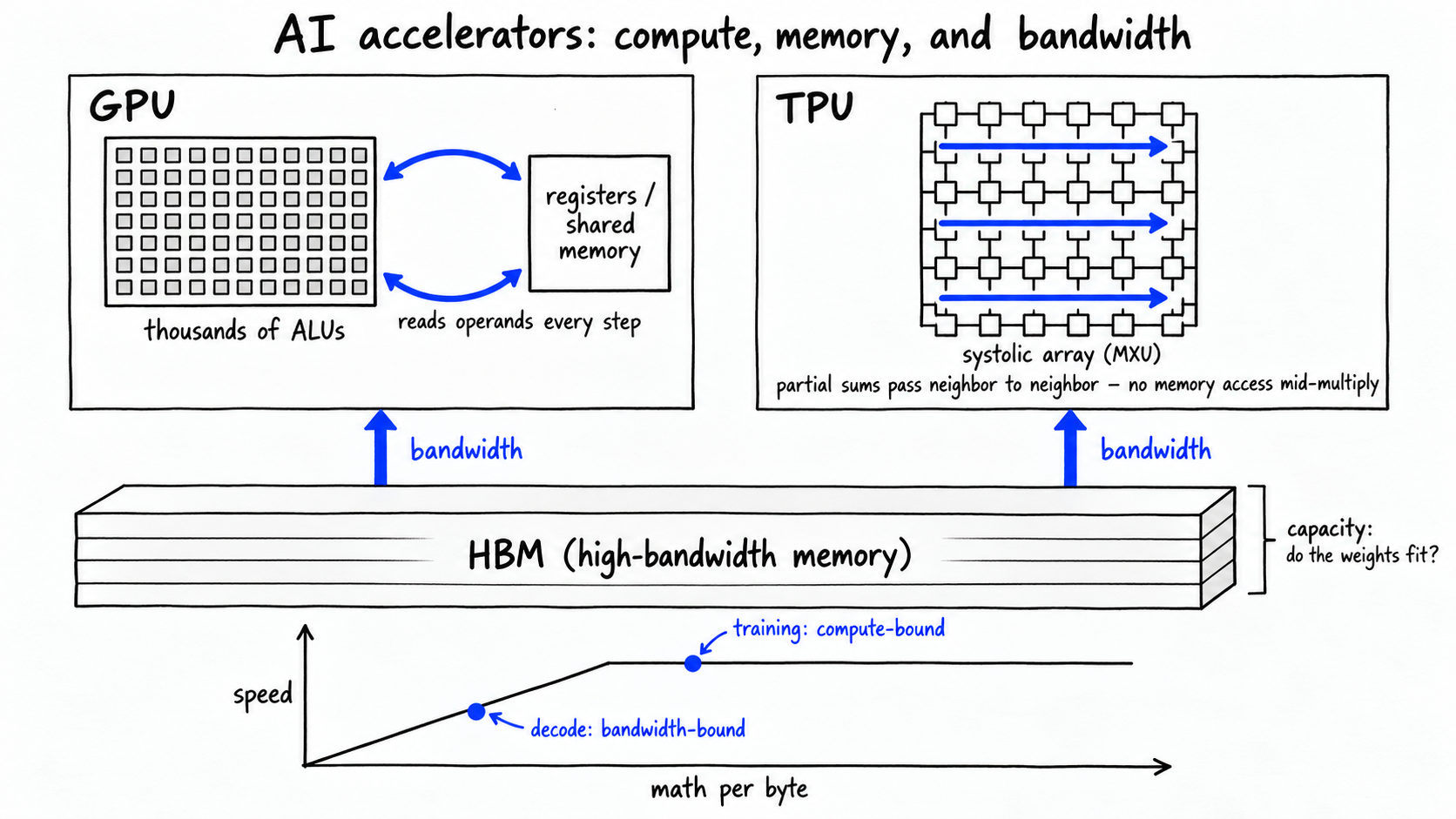
AI accelerators: compute, memory, and bandwidth

Hand-drawn diagram of AI accelerators. GPU panel: thousands of ALUs looping to registers/shared memory, reading operands every step. TPU panel: a systolic array (MXU) passes partial sums neighbor to neighbor, no mid-multiply memory access. An HBM box feeds both via bandwidth arrows, bracketed capacity: do the weights fit? A roofline marks decode bandwidth-bound, training compute-bound.View full-size diagram ↗

What it is

The three budgets every AI chip balances: compute (multiply-accumulate operations per second), memory capacity (how many weights fit in the HBM stacked next to the die), and bandwidth (how fast bytes move from memory into the compute units). GPUs are flexible parallel processors; TPUs are matrix ASICs whose systolic arrays skip memory traffic mid-multiply.

How it works

A GPU packs thousands of arithmetic units, but each step reads operands from registers or shared memory. A TPU wires a grid of multiply-accumulators into a systolic array: data streams through once, each unit passing partial sums onward. Real speed is arithmetic intensity, the math done per byte fetched. Training matmuls are compute-bound; one-token-at-a-time decode is bandwidth-bound.

A concrete example

A 70B model in 16-bit needs about 140GB of weights, overflowing one 80GB accelerator, so it shards. Serving one user streams all 140GB per token: at ~3TB/s of HBM bandwidth, memory, not FLOPs, caps tokens per second. Batch requests together and the same weight reads serve many tokens, tilting back toward compute-bound.

Why it matters

Headline FLOPs do not govern your serving bill. Decode throughput is bandwidth per dollar, context length is capacity, and scale-out jobs live or die on interconnect. It is why vendors race on HBM supply and why quantization speeds decode roughly in proportion to the bytes shaved off each weight.

What people get wrong: That more FLOPs means faster inference. Only if the workload feeds enough math per byte: for single-stream decode, a chip with double the FLOPs but the same bandwidth makes tokens at nearly the same rate. Spec sheets lead with FLOPs; serving engineers quote bandwidth.

Today's top 5

LabsOpenAI's Decisions API hits general availability: GPT-6 Luna answers bounded classify-and-route questions up to 10x faster than Responses

Classification and routing are the highest-volume calls inside agent loops; a 10x-faster bounded-answer path changes their latency and cost math.

AgentsAnthropic donates the Agent Skills standard to the Agentic AI Foundation, citing 70+ platform integrations, a year after donating MCP

Skills joins MCP as neutral infrastructure: the two building blocks of agent interoperability now live outside any single lab.

ResearchAnthropic and Theorem used Claude to prove security properties of RISC-V assembly in 100+ open-source libraries, finding long-missed bugs

Formal verification at assembly level used to take years of expert effort per project; LLM-written proofs could make proven-correct code a practical default for critical libraries.

BizDeepSeek raised about $15B in one of China's largest-ever rounds, with CATL and Tencent among the biggest contributors

Serious capital behind the leading open-weights lab, with SemiAnalysis detailing how deeply its workloads now co-design with Huawei compute.

AgentsWalmart unveils Agent Gateway, an MCP server that lets AI agents shop its site, plus Agent Profiles that authorize and track purchases

The counter-position to the banks' lockout: agent identity, authorization, and spend tracking offered as a product surface instead of a wall.

See the full wire feed →

Quick check

Was this issue useful?

Get Crabhaus in your inbox

A concise daily briefing on the AI developments worth understanding.