
Crabhaus

What matters in AI, and why.

Sun 25 Oct · Issue 103 · 3 min

Issue 103 · Sun 25 Oct

A robot model that works out of the box

01LabsDream-1 drives new robots zero-shot via API
02ResearchFive Qwen3.8-27B instances beat Fable 5 on code
03BizApollo: no AI payoff outside the tech sector

The one that matters

A robot model that works out of the box

Dream Labs came out of stealth with $90M in seed funding and Dream-1, a model served through a public API that controls robots it has never seen. Hand it a new bimanual robot with parallel grippers and it starts performing tasks zero-shot: no fine-tuning, no demonstrations from that robot. The pitch pairs generalizing models with capable arms that now cost as little as $2k.

Why it matters

Robotics has been stuck in a cold-start loop: a robot needs data from its exact hardware to be useful, and needs to be useful before anyone generates that data. A model that transfers zero-shot to unseen robots, sold as an API, turns robot capability into something you subscribe to, and makes the cheap-arm wave suddenly interesting to builders.
Learn one thing

AI gateways and provider routing

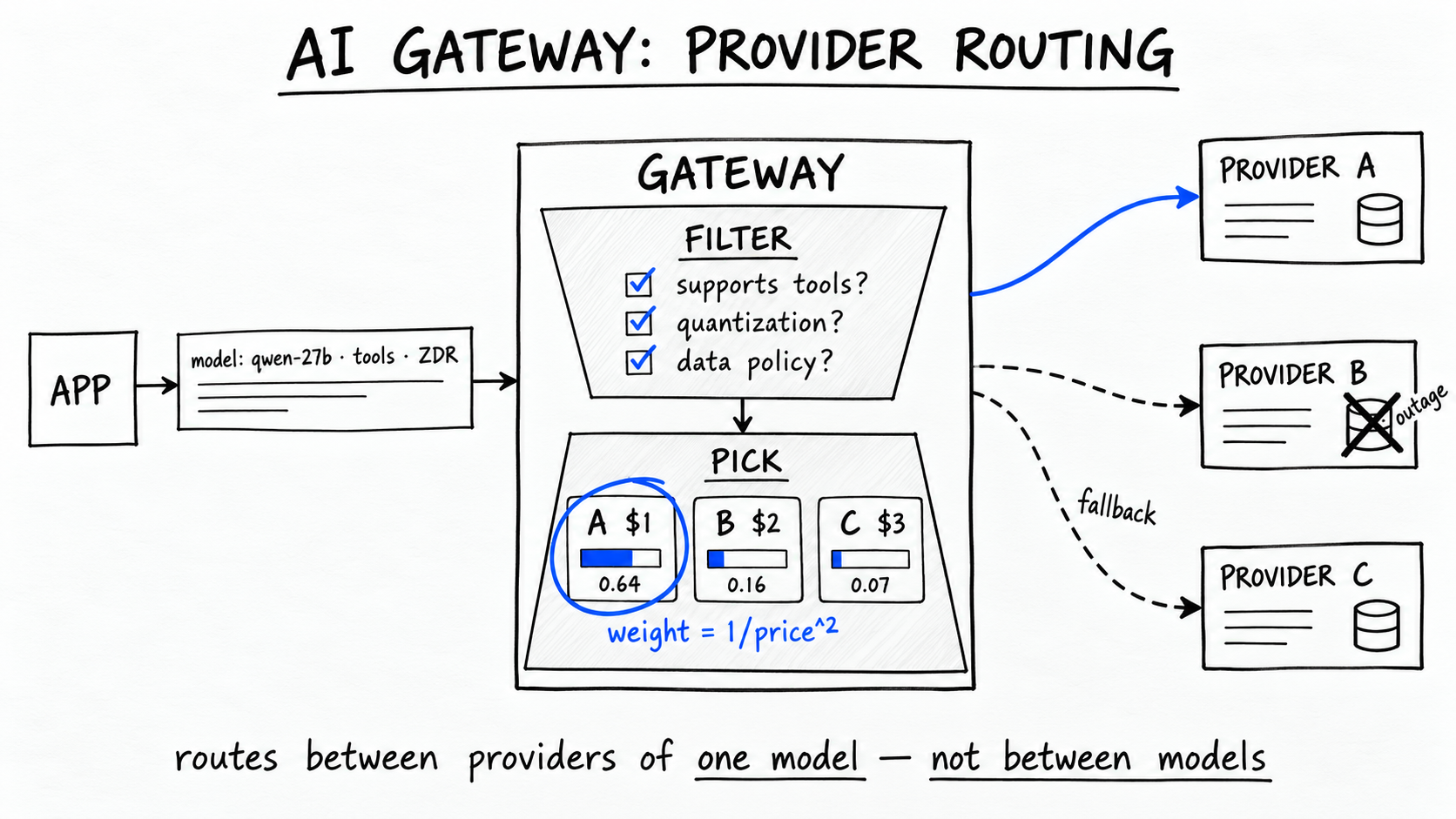
Hand-drawn diagram: an app request (model, tools, ZDR) enters a gateway with a FILTER checklist (tools? quantization? data policy?) and a PICK stage where provider cards A $1, B $2, C $3 carry weight bars 0.64/0.16/0.07, noted weight = 1/price^2. A cobalt arrow routes to Provider A, Provider B is marked outage, a dashed fallback curves to Provider C.View full-size diagram ↗

What it is

An AI gateway sits between your app and many model providers, exposing one API. Per request it picks which provider endpoint serves the model you named, then handles fallback when that endpoint fails. Routing here means choosing among providers serving one model, not choosing a model.

How it works

The gateway keeps a list of endpoints per model. It filters by your constraints: endpoints must support every request parameter, meet quantization needs, and satisfy data policies like zero retention. A strategy then orders the survivors; OpenRouter's default load-balances by price, weighting stable providers by the inverse square of cost. Failures fall through to the next candidate.

A concrete example

Three providers serve the same open-weights model at $1, $2, and $3 per million tokens. Price-weighted routing picks the $1 endpoint nine times more often than the $3 one, and a provider with an outage in the last 30 seconds drops to fallback. If the cheap endpoint errors, the request retries against the next provider without your app changing anything.

Why it matters

Provider outages and price moves become a config concern instead of an application rewrite, and policies like data retention or region are enforced per request. The trade-off is a middleman on your latency and privacy path, plus silent variation: two calls to one model name can land on different hardware, quantizations, or logging regimes.

What people get wrong: That the gateway picks the best model for your task. Provider routing never changes the model: it chooses which company's endpoint serves the model you requested. Task-based model selection is a separate layer, built in your app or with a dedicated model-router, on top of provider routing.

Today's top 5

AgentsHarnessRouter open-sources a unified API that runs agent tasks across 26 harnesses, including Codex, Claude Code, and Gemini CLI

Teams multiplexing coding agents hand-roll one integration per harness today; an Apache-2.0 layer handling sessions, streaming, files, and cancellation makes the harness a swappable backend, the same commoditization gateways brought to model APIs.

ResearchFive self-orchestrated Qwen3.8-27B instances hit 92.4% on hard LiveCodeBench, past Fable 5's 90.4%, with training-free coordination

A training-free scaffold lifting a self-hostable 27B model from 66.8% to 92.4% suggests orchestration, not scale, is the cheapest route to frontier coding accuracy, though the authors note gains are not universal across models.

ResearchStudy of nine frontier models finds AI text uses denser, lower-frequency language than human writing, making it harder to understand

All nine models drift the same direction, and the authors' fine-tuning experiment points at a cause: optimizing for math, code, and reasoning rewards information density over successful communication. A measurable cost, not a style complaint.

BizApollo economist Torsten Slok reports no signs of an AI payoff outside the tech sector in the firm's Daily Spark analysis

Three years into the boom, mainstream finance still cannot find measurable AI productivity gains outside tech itself, and the capital expenditure wave is priced on those gains arriving. Expect this note in every bear thesis.

BizUS creative industries shed 200k+ jobs in four years, ~50k in the past year; recession-scale losses coincide with generative AI

Loss intensity previously seen only in the 2001 and 2008 recessions is happening with no recession, concentrated where generative tools substitute output. The first careful employment-data look at a question mostly argued by anecdote.

See the full wire feed →

Quick check

Was this issue useful?

Get Crabhaus in your inbox

A concise daily briefing on the AI developments worth understanding.