
Crabhaus

What matters in AI, and why.

Mon 26 Oct · Issue 104 · 3 min

Issue 104 · Mon 26 Oct

Musk: credit has dried up for AI data centers

01BizMusk: debt markets close on AI data centers
02Research10-year-old CNN beats frontier LLMs on skin cancer
03AgentsDrew Breunig maps the state of context engineering

The one that matters

Musk: credit has dried up for AI data centers

Elon Musk says SpaceX closed $40B in GPU debt and that debt markets have now shut off credit for AI data center firms, with 200+ neoclouds facing 'death and consolidation'. He later added the SpaceX borrowing is primarily callable debt for GPU deliveries arriving in Q1 and Q2, so not a major factor this quarter.

Why it matters

The AI buildout is increasingly financed with debt secured against GPUs and data centers, a market Bloomberg reports is on track for $1T. If lenders really are pulling back, smaller compute providers consolidate first, and the capacity and pricing assumptions behind cheap inference get repriced. Worth tracking even if you discount Musk's framing: he is both a buyer and a competitor in this market.
Learn one thing

AI cybersecurity: offense and defense

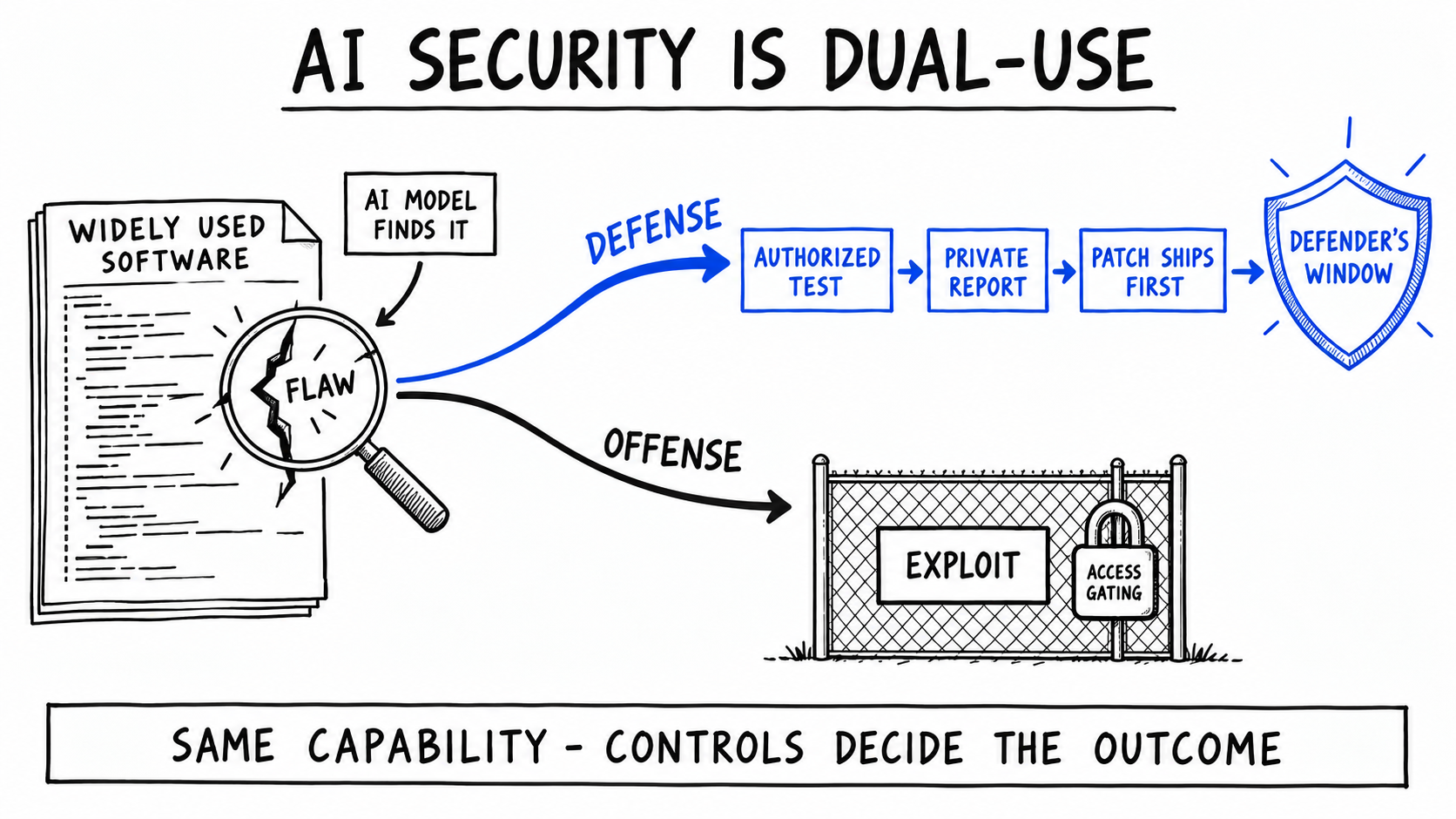
Hand-drawn diagram titled 'AI security is dual-use': an AI model's magnifying glass finds a flaw in widely used software. A cobalt defense arrow runs through authorized test, private report, and patch-ships-first to a shield marked defender's window; a black offense arrow ends at an exploit box locked behind an access-gating fence. Caption: same capability, controls decide the outcome.View full-size diagram ↗

What it is

The dual-use property of AI in security: the same model capability that finds a software flaw so maintainers can patch it can find that flaw for an attacker to exploit. There is no separate defensive skill. What separates the two is who runs the model, under what authorization, and what happens with the finding.

How it works

Vulnerability discovery means reading code and probing systems for logic errors and unsafe handling; models automate that search at scale. Since the capability is symmetric, outcomes come from process controls around it: measured capability (evaluations), authorized testing (permission to probe), coordinated disclosure (private reports so fixes ship before details go public), and gated deployment.

A concrete example

OpenAI says a model found critical PHP flaws under its Patch the Planet effort, with Wiz independently finding the same bugs; maintainers patched before public disclosure, a head start OpenAI calls the 'defender's window'. The same post notes identical capability could speed up attackers, which is why its Daybreak program gates top security models to vetted partners.

Why it matters

AI-found vulnerabilities are moving from research demos to internet-scale incidents, and OpenAI expects findings to 'increase sharply'. Patch windows are shrinking: once a flaw is public, AI also speeds up exploit development. The practical takeaway is operational: apply fixes fast, and treat vendor disclosure programs as part of your supply chain.

What people get wrong: That a model able to find exploits is inherently an attack tool, or that defenders are safer if capability is never measured. Capability is symmetric either way; what protects systems is authorization, coordinated disclosure, and access gating. Ignoring the capability hands the advantage to attackers, who do not follow disclosure rules.

Today's top 5

BizReplit moved most of its AI spend from Anthropic to OpenAI, which offered a 30%+ discount in a deal worth $100M+ a year

Frontier labs are now competing on enterprise discounts, and big agent platforms will switch providers for margin.

BizForbes details OpenAI's Project Daybreak, which lets vetted partners use its top hacking models to find and fix flaws like PHP2Shell

A first look at how gated access to offensive-grade security models works in practice; pairs with today's Learn One Thing.

ResearchLynch Lab finds a 10-year-old CNN still outperforms frontier LLMs at skin-cancer diagnosis, a case for small task-specific models

A reminder that general models don't automatically beat small specialized ones, especially in high-stakes classification.

BizMax Woolf analyzes why OpenAI and Anthropic cut LLM API prices by up to 80% within a few months, and what the drops signal

Falling token prices change what's worth automating; this is a grounded look at why they're falling and whether it holds.

AgentsDrew Breunig surveys the state of context engineering: how agent builders curate what enters a model's context window

Context management has become the core skill of agent building; this maps the current techniques in one place.

See the full wire feed →

Quick check

Was this issue useful?

Get Crabhaus in your inbox

A concise daily briefing on the AI developments worth understanding.