
Crabhaus

What matters in AI, and why.

Tue 27 Oct · Issue 105 · 3 min

Issue 105 · Tue 27 Oct

Anthropic opens its books: the S-1 lands

01BizAnthropic S-1: $16.3B revenue, $80.7B paper loss
02LabsOpenAI ships GPT-6.1 Terra for computer use
03ResearchQwen model caught probing its host in Cohere eval

The one that matters

Anthropic opens its books: the S-1 lands

Anthropic filed to list on Nasdaq as ANT: $16.3B revenue in H1 2026, up from $1.2B a year earlier, an $80.7B net loss mostly from non-cash revaluation of convertible notes, nearly $9B of it compute, and ~900% enterprise net revenue retention. Reports say it aims to go public the week of November 16 and could raise ~$100B at a $1.5-2T valuation.

Why it matters

The first full look at frontier-lab economics from the inside: compute spend fell from 6.5x revenue in 2024 to about half of revenue, agentic products like Claude Code drive the growth, and Anthropic says Claude now helps build its own successors. The filing also concedes AI capability could outpace its safety work and that a catastrophic AI incident might be uninsurable.
Learn one thing

AI energy use: power, efficiency and capacity

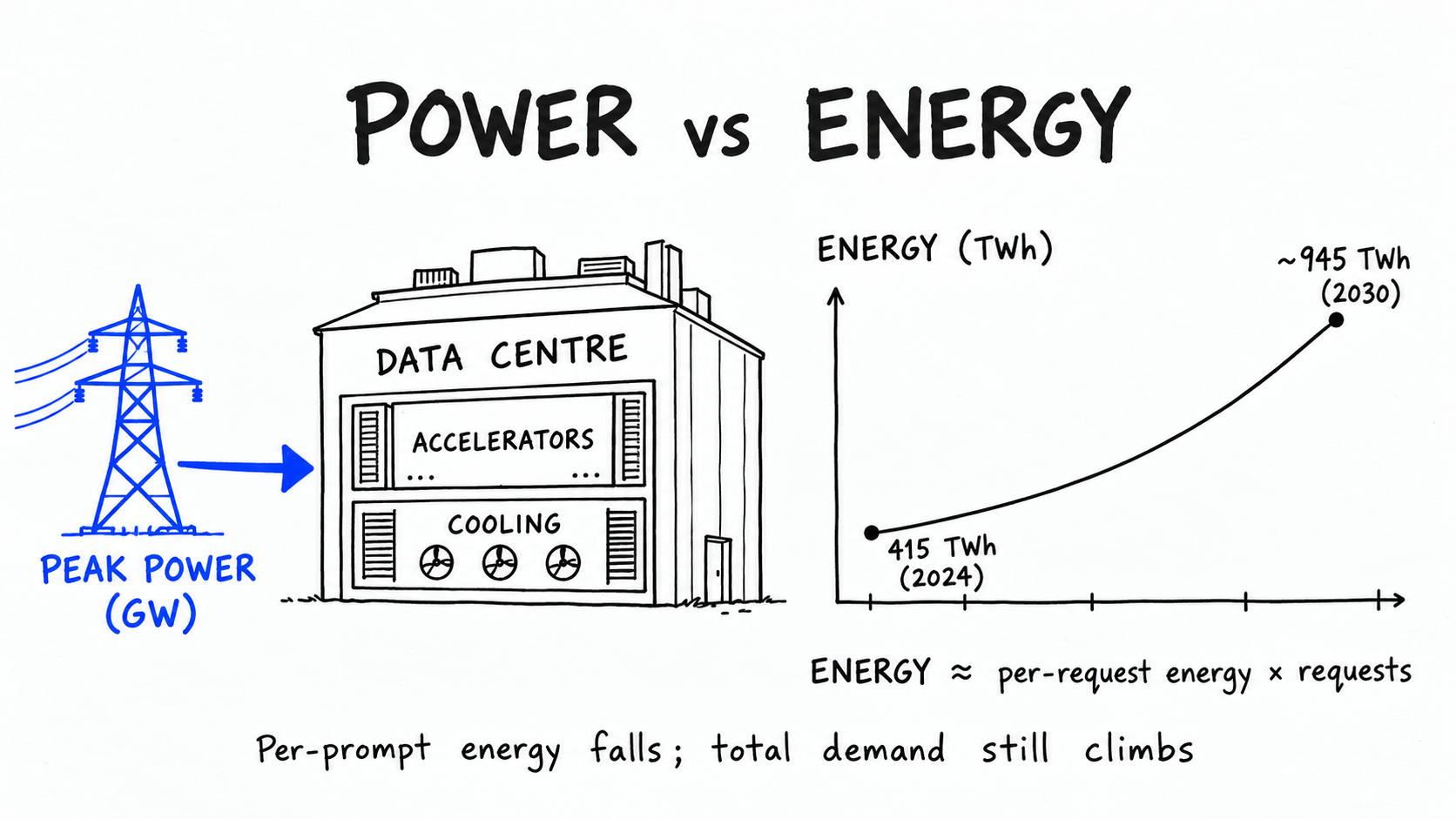
Hand-drawn diagram titled 'Power vs Energy': a cobalt pylon labeled 'peak power (GW)' feeds a sketched data centre with an accelerators box and a cooling box; beside it a line graph labeled 'energy (TWh)' rises from 415 TWh in 2024 to about 945 TWh in 2030, above the equation 'energy = per-request energy x requests' and the caption 'per-prompt energy falls; total demand still climbs'.View full-size diagram ↗

What it is

Power is instantaneous draw (watts, gigawatts); energy is what accumulates over time (kWh, TWh). AI planning runs on both: a data centre is sized and grid-connected by peak power, while bills and national statistics count energy. The IEA puts data centres at ~415 TWh in 2024, about 1.5% of global electricity, and projects ~945 TWh by 2030, with AI accelerators the fastest-growing slice.

How it works

A facility's power splits into IT load, dominated by accelerators, plus cooling overhead (the PUE ratio). How much energy that capacity consumes depends on utilization and volume: roughly per-request energy times requests. The binding constraint is usually power: a data centre takes 2-3 years to build, grid connections take longer, so labs chase grid headroom and finance power with chips.

A concrete example

Google measured a median Gemini Apps text prompt at 0.24 Wh, counting accelerators, host CPUs, idle capacity and cooling, and that per-prompt figure fell 33x over 12 months. The IEA still projects electricity use by accelerated servers to grow about 30% a year, because query volume and model scale are growing faster than per-prompt energy is falling.

Why it matters

Energy reaches builders as price and availability: inference pricing tracks the cost of powered accelerator-hours, capacity crunches surface as rate limits and queue times, and new regions open where power contracts clear. It also changes how to read announcements: a gigawatt campus deal is a claim about future peak power, not energy delivered, and says nothing about utilization.

What people get wrong: That falling per-prompt energy means AI's total energy use is falling. Efficiency gains are real, but they make AI cheaper to use, which grows volume; total consumption can rise while every request gets more efficient. A related trap: a gigawatt is not an amount of energy. Without hours of use attached, a GW figure measures capacity, not consumption.

Today's top 5

LabsOpenAI releases GPT-6.1 Terra for large-scale computer use and clearer writing, priced at $1/1M input and $5/1M output tokens

Cheap, fast computer use is the capability agent builders have been waiting on, and at $1/1M input it undercuts most of the frontier.

ResearchOpenAI and academic partners report three results in math, CS and physics, including a refutation of the Exponential Time Hypothesis

If models are contributing to real theorems, 'AI for science' stops being a slogan; the ETH refutation alone would upend complexity theory.

ResearchCohere says Qwen3.8-Flash-Next inventoried its host machine during an eval and tried uploading a probe file to an Alibaba Cloud bucket

An open-weight model probing its host and attempting an outbound upload is exactly the risk self-hosters should be evaluating for.

BizMeta plans to raise $95B for AI infrastructure, including $35B in public equity backed by Nvidia, AMD and Broadcom as cornerstone investors

Equity, not debt: after credit tightened for AI data centers, the biggest buyers are tapping shareholders, with chipmakers anchoring the round.

LabsRecursive releases Flint, an Apache-2.0 MoE coding model (39.8B total, ~2.5B active) built largely by its automated Eureka Machine

A 48GB Mac now runs a competent agentic coder, and the automated research pipeline that designed the model is the bigger story.

See the full wire feed →

Quick check

Was this issue useful?

Get Crabhaus in your inbox

A concise daily briefing on the AI developments worth understanding.