
Crabhaus

What matters in AI, and why.

Wed 28 Oct · Issue 106 · 3 min

Issue 106 · Wed 28 Oct

Genie 4: worlds you can steer in real time

01BizAnthropic S-1: 85% margins, profitable June quarter
02LabsOne Mirendil researcher pretrained a 100B+ LLM
03Agentsuzu runs a 9B LLM 4x faster than llama.cpp on a Mac

The one that matters

Genie 4: worlds you can steer in real time

Google DeepMind launched Genie 4, a world model that generates interactive 3D environments in real time: you steer events, camera and actions in a running simulation, it renders photorealistic scenes with real-world physics, and it generates matched native audio including characters that converse live. Gemini reasoning keeps multi-step events coherent. It opens as a preview to trusted testers.

Why it matters

World models are becoming the next competitive front after chat: a system that can simulate steerable, physics-aware environments on demand is both a new creative medium and a training ground for robots and agents. Genie 4 moving to real-time interaction with audio is the clearest signal yet that generated worlds are leaving the research-demo stage.
Learn one thing

Scaling laws and compute-optimal training

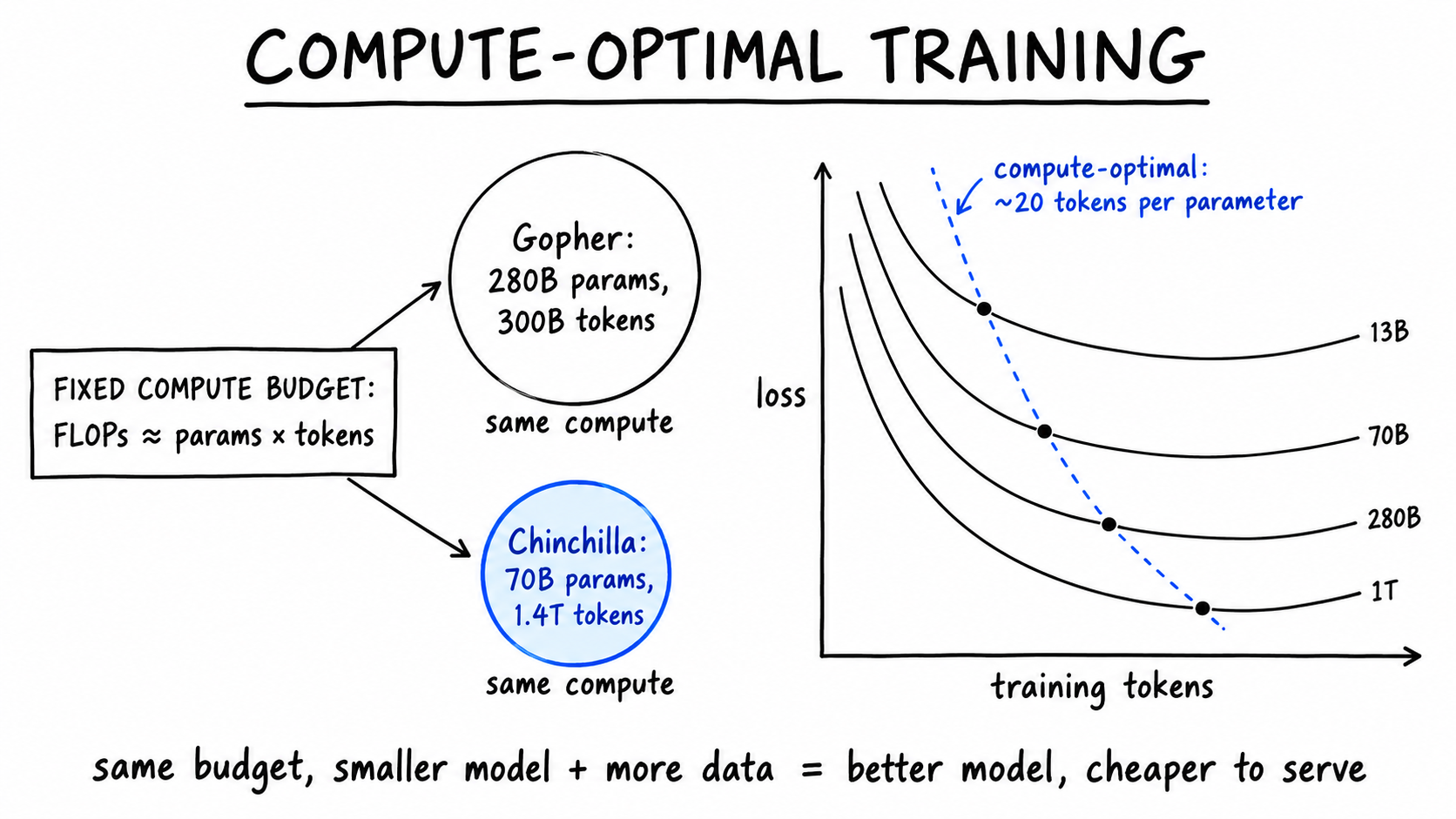
Hand-drawn diagram titled 'Compute-optimal training': a fixed compute budget box points to two circles trained on the same compute, Gopher (280B params, 300B tokens) and a cobalt-highlighted Chinchilla (70B params, 1.4T tokens); a loss-versus-tokens chart shows curves for 13B to 1T models with a dotted compute-optimal line at about 20 tokens per parameter.View full-size diagram ↗

What it is

Scaling laws are empirical curves showing how language-model loss falls predictably as parameters, training tokens and compute grow together. Compute-optimal training is the question they answer: for a fixed compute budget, what mix of model size and training data produces the best model?

How it works

Training cost is roughly parameters times training tokens, so one budget can buy a big model fed little data or a small one fed lots of it. Labs train model families across sizes, fit power-law curves to the losses, and read off the best trade-off. OpenAI's 2020 fits said grow parameters fastest; DeepMind's 2022 rerun found parameters and tokens should scale together, near 20 tokens per parameter.

A concrete example

DeepMind tested the revised fit with Chinchilla: 70B parameters trained on about 1.4T tokens, the same compute as its 280B-parameter predecessor Gopher trained on 300B tokens. The 4x smaller model beat Gopher on nearly every benchmark, and being smaller made it far cheaper to serve.

Why it matters

These fits decide how hundreds of millions of dollars of training compute get split, and they explain today's model menu: labs now routinely train compact models well past the compute-optimal token count because serving cost, not training loss, dominates a deployed model's economics. A small model that punches above its size is usually deliberate over-training on data, guided by these curves.

What people get wrong: That compute-optimal means optimal, full stop. The Chinchilla recipe minimizes training loss per training dollar and ignores inference entirely; a model served billions of times is often better trained far beyond its 'optimal' token count. The fits are also empirical extrapolations tied to one data distribution and setup, not guarantees that more scale keeps paying off.

Today's top 5

BizAnthropic's S-1 shows $16.3B H1-2026 revenue, a $974M June-quarter operating profit and ~85% gross margin on model serving

The margin detail answers the loudest bubble argument: pay-as-you-go model serving, run well, is a high-gross-margin business.

LabsMirendil says one researcher pretrained Mirendil-Base, a 100-500B-param LLM, in 3.5 months for under $10M in compute

A cold-start org near the open-weight frontier with one human is the most concrete recursive-self-improvement data point yet.

AgentsMirai Labs' open-source uzu engine runs Qwen3.5 9B at 92 tok/s on a base M5 Mac, ~4x llama.cpp, decoding several tokens per pass

Local inference has been stuck at the memory-bandwidth ceiling; multi-token verification blows past it on stock consumer hardware.

ResearchClaude Opus 5.5 hits 18.5% resolved (70.5% near-pass) on ProgramBench's rebuild-programs-from-binaries tasks, up from 0% in May

A benchmark going from unplayable to 18.5% in five months is the cleanest current measure of how fast agentic coding is moving.

BizMeta's upsized $25B share sale drew ~5x demand at $625/share toward a $98B AI raise; Nvidia is taking $3B of the offering

After months of debt-market nerves about AI capex, equity investors oversubscribing a $25B sale 5x is a loud confidence vote.

See the full wire feed →

Quick check

Was this issue useful?

Get Crabhaus in your inbox

A concise daily briefing on the AI developments worth understanding.