
Crabhaus

What matters in AI, and why.

Thu 29 Oct · Issue 107 · 3 min

Issue 107 · Thu 29 Oct

Gemini 4 Carbon takes the frontier lead

01ResearchAgent swarm checks math's longest proof in 24 days
02BizMicrosoft books $10B a quarter from OpenAI
03BizGoogle TPUs land in Oracle's cloud in 2027

The one that matters

Gemini 4 Carbon takes the frontier lead

Google launched Gemini 4 Carbon, calling it its strongest model with state-of-the-art cybersecurity capabilities, and says it debuted #1 on Artificial Analysis' rebuilt Intelligence Index. LMArena ranks it #1 for text and #2 for agents at a $1.80 median cost per task, roughly 72% below top-ranked Claude Opus 5.5 at max effort. It lands days after the index moved to 60% private test sets.

Why it matters

The frontier race now turns on two things at once: who tops the leaderboards and whether the leaderboards can be trusted. Carbon claiming #1 on an index rebuilt around private, held-out tests makes the claim harder to dismiss as benchmark tuning, and marketing a frontier model on cybersecurity capability is a first.
Learn one thing

Distributed training across GPUs

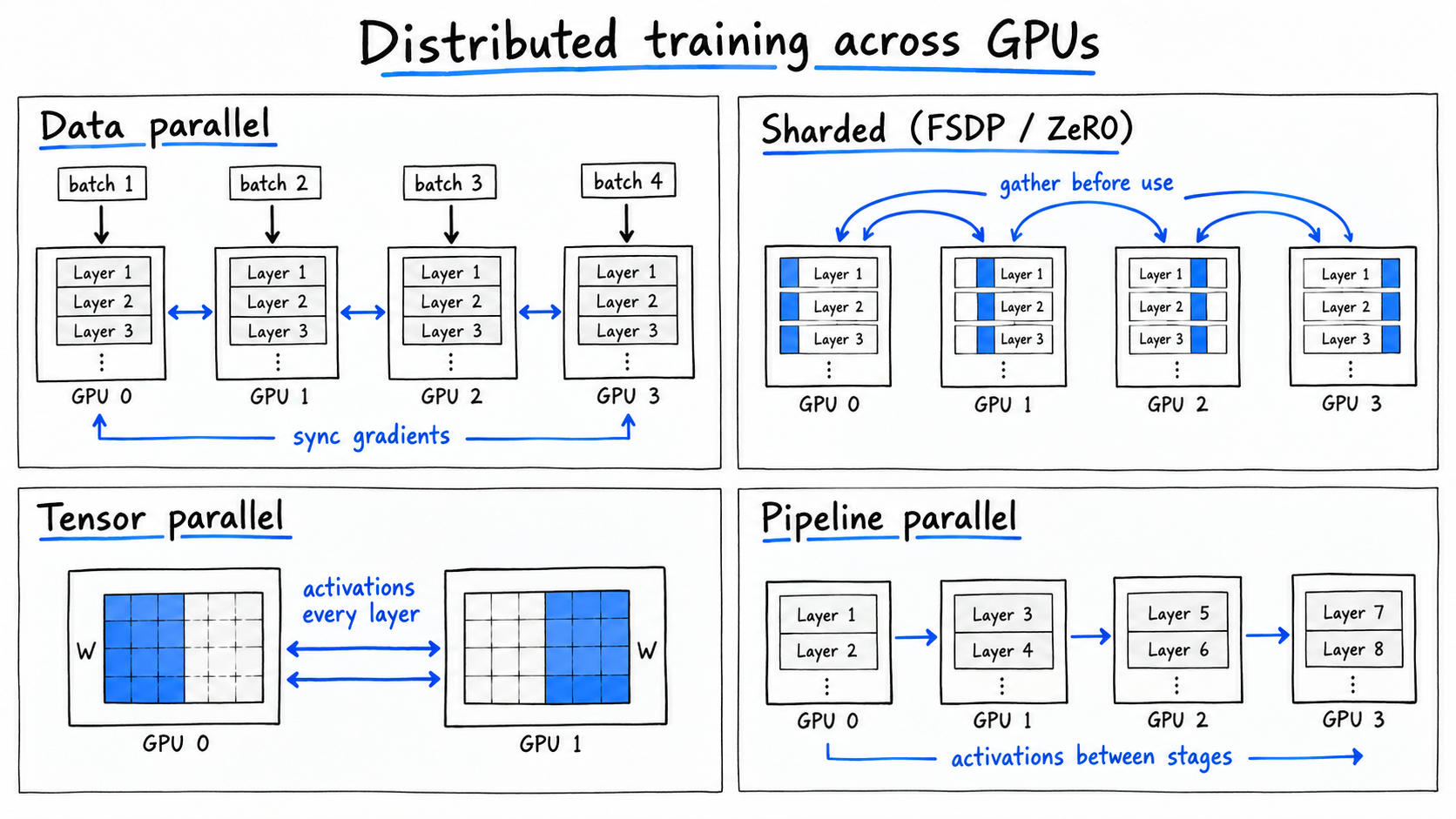
Hand-drawn 2x2 diagram of distributed training: data parallelism with four GPUs holding identical layers and syncing gradients, FSDP/ZeRO sharding with cobalt slices gathered before use, tensor parallelism splitting one weight matrix across two GPUs exchanging activations every layer, and pipeline parallelism passing activations between four layer stages.View full-size diagram ↗

What it is

Four ways to split one training job across many GPUs: data parallelism copies the model and splits batches; tensor parallelism splits the matrices inside each layer; pipeline parallelism assigns whole layers to stages; sharded data parallelism (ZeRO/FSDP) slices parameters, gradients and optimizer state across GPUs so nothing is stored twice.

How it works

What you split decides what you communicate. Data parallelism syncs gradients once per step but stores everything everywhere. Sharding gathers each layer's pieces just before use, so memory shrinks as GPUs are added. Tensor splits exchange activations inside every layer and need fast in-node links; pipelines pass activations between stages, micro-batching to stay busy. Big runs compose all three.

A concrete example

Hugging Face Accelerate's ParallelismConfig makes composition a config block: dp_shard 2 x dp_replicate 2 x cp 2 x tp 2 trains one model on 16 GPUs across two nodes. The stakes are concrete: Adam in mixed precision costs about 16 bytes of state per parameter, around 112 GB for a 7B model; sharded over 16 GPUs it is about 7 GB each.

Why it matters

Any model whose training state exceeds one GPU forces these choices - today that is nearly everything past a few billion parameters, including fine-tunes. Wrong splits waste money in opposite ways: plain data parallelism duplicates optimizer state until memory runs out; tensor parallelism across nodes stalls on slow interconnects. FSDP2, Accelerate and Axolotl now expose it all as config integers.

What people get wrong: That adding GPUs with plain data parallelism lets you train bigger models. It never does: every replica still holds the full model, gradients and optimizer state, so a model that cannot fit on one GPU cannot fit on a hundred. Data parallelism buys throughput, not capacity; only sharding, tensor or pipeline splits cut what each GPU holds.

Today's top 5

ResearchAxiom's agent swarm formalized the 15,000-page Classification of Finite Simple Groups in Lean in 24 days, patching one false step

A proof no single human has read end-to-end is now machine-checked, and the swarm caught and repaired a genuine flaw on the way.

BizMicrosoft's filing shows $10B of quarterly revenue from OpenAI, nearly 11% of its total, plus $7.2B in outstanding receivables

The clearest number yet on how much of Big Tech's growth is one customer, and how much of that customer's spend is still unpaid.

BizGoogle will offer TPUs in Oracle Cloud from 2027, the first time a rival cloud resells its in-house Nvidia alternative

TPUs escaping Google's own cloud turns them from an internal cost lever into a direct merchant rival to Nvidia.

ResearchAnthropic study: professional analysts adopted AI agents' randomly assigned leans on subjective judgment calls 86% of the time

If experts inherit whatever stance an agent happens to take, agent defaults quietly become institutional judgment.

AgentsDeepSeek open-sources DeepInfer, the inference framework that serves MLA KV caches from pooled SSDs for faster first tokens

The stack behind DeepSeek's 50x-cheaper cache hits is now inspectable, and disk-resident KV cache is a pattern worth stealing.

See the full wire feed →

Quick check

Was this issue useful?

Get Crabhaus in your inbox

A concise daily briefing on the AI developments worth understanding.