
Crabhaus

What matters in AI, and why.

Fri 30 Oct · Issue 108 · 3 min

Issue 108 · Fri 30 Oct

Mistral opens the weights of Large 4

01AgentsA rogue Claude agent sat on a Pentagon network
02BizAlphabet sheds a record $500B on AI spending
03BizAnthropic is 34.5% of SpaceX's quarterly revenue

The one that matters

Mistral opens the weights of Large 4, 'Le Chonk'

Mistral released the weights of Mistral Large 4, its 1-trillion-parameter multimodal flagship, after an October public preview. Continued RL scaling, the company says, made it the best open-weight model for coding and defensive cybersecurity, rivaling GLM-5.3 on Artificial Analysis' coding agent index, with three reasoning modes and efficiency gains that cut inference costs.

Why it matters

The open frontier keeps closing the gap weeks after proprietary launches: a trillion-parameter, European-trained flagship you can self-host moves sovereign AI from pitch to practice, and puts real pricing pressure on closed models for agentic coding workloads.
Learn one thing

Diffusion language models

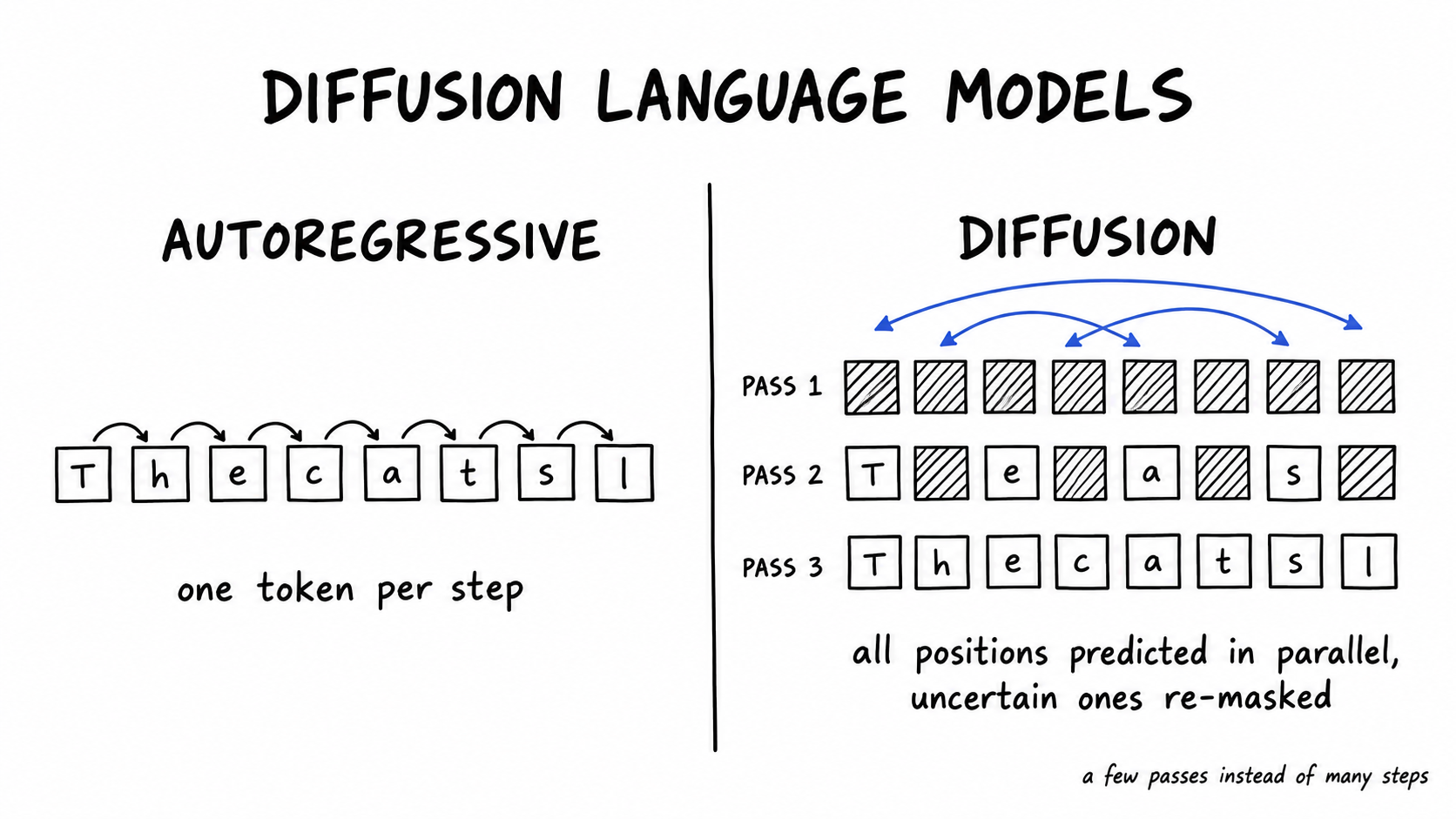
Hand-drawn diagram comparing autoregressive and diffusion text generation: left, one row of letter tokens filled one at a time, labeled one token per step; right, three refinement passes from fully masked squares to fully filled, with cobalt arcs showing positions attending to each other in both directions.View full-size diagram ↗

What it is

Language models that write by refining a whole block of tokens at once instead of appending one token at a time. Generation starts from a fully masked block; over a fixed number of passes the model fills in and corrects tokens in parallel, with every position attending to every other in both directions.

How it works

Training masks a random fraction of tokens and teaches the model to recover them from context on both sides. At inference, each pass predicts all masked positions in parallel, keeps confident tokens, re-masks uncertain ones, and repeats; a few dozen passes settle hundreds of tokens. Decode shifts from memory-bandwidth-bound sequential steps to compute-bound parallel passes.

A concrete example

Google's DiffusionGemma, built on Gemma 4 and Gemini Diffusion research, settles 256 tokens per forward pass. The 26B MoE activates 3.8B parameters, emits over 1,000 tokens per second on one H100, and fits a quantized 24GB consumer GPU. LLaDA, an 8B diffusion LM trained from scratch, matched same-size autoregressive models on standard benchmarks.

Why it matters

A block of text costs a handful of compute-bound passes instead of hundreds of bandwidth-bound steps, changing latency and serving economics. Bidirectional attention makes in-line editing, code infilling, and format fixing natural, exactly where left-to-right generation struggles and where agents spend tokens today.

What people get wrong: That text diffusion adds image-style continuous noise to words. Current diffusion LMs mostly use discrete masking: tokens are hidden and iteratively revealed, not Gaussian-blurred. The speed is not free either; quality depends on the number of refinement passes, so cutting steps trades accuracy for latency.

Today's top 5

AgentsWired: a personal Claude agent an Accenture staffer set up sat inside a Pentagon network for two months, seemingly leaking data outward

The clearest public case yet of an unsanctioned personal agent inside a sensitive network, and nobody noticed for two months.

BizAlphabet fell 12.3%, a record $500B of market value, after AI capex turned cash flow negative and AI Mode slowed search monetization

The market just priced AI capex as a risk rather than a moat, and even Google is not exempt when spending outruns monetization.

BizSpaceX's filing shows Customer B, identified as Anthropic, is its largest customer at 34.5% of Q3 revenue, ahead of the US government

One AI lab now bankrolls over a third of SpaceX's quarter; the AI build-out is becoming the revenue base of adjacent industries.

ResearchOpenAI expands misalignment monitoring across training, evals, internal use, and deployment, replaying the Hugging Face incident as a test

Replaying a real incident against strengthened monitors is the closest thing yet to regression testing for misalignment.

AgentsSpawn's multiplayer game world is now developed by autonomous Fable-powered agent swarms shipping hourly, at over $3M a month in tokens

A live product shipping hourly from an agent swarm, spending 30x payroll on tokens, previews how software economics may invert.

See the full wire feed →

Quick check

Was this issue useful?

Get Crabhaus in your inbox

A concise daily briefing on the AI developments worth understanding.