
Crabhaus

What matters in AI, and why.

Sat 31 Oct · Issue 109 · 3 min

Issue 109 · Sat 31 Oct

A backdoored Claude Code extension hits Cursor

01ResearchClaude now reviews its own chats for misuse
02BizBig Tech's AI commitments pass $3 trillion
03BizReddit and Intel each drop 29% on AI fears

The one that matters

A backdoored Claude Code extension hit about 5,000 Cursor developer machines

A tampered version of Anthropic's Claude Code VS Code extension (2.1.313) was published to Cursor's extension marketplace and auto-updated onto developer machines, where it collected host details and tried to plant a persistent SSH reverse backdoor. Cursor says roughly 5,000 systems were affected; Anthropic says the attacker used access to Cursor's marketplace and the version was pulled.

Why it matters

Supply chain attacks just reached the AI coding stack. Extension marketplaces auto-update straight onto the laptops that hold your source, credentials, and agent keys, and the fix shipped silently: check your extension versions, rotate keys, and audit authorized_keys if you run Claude Code through Cursor.
Learn one thing

How video generation works

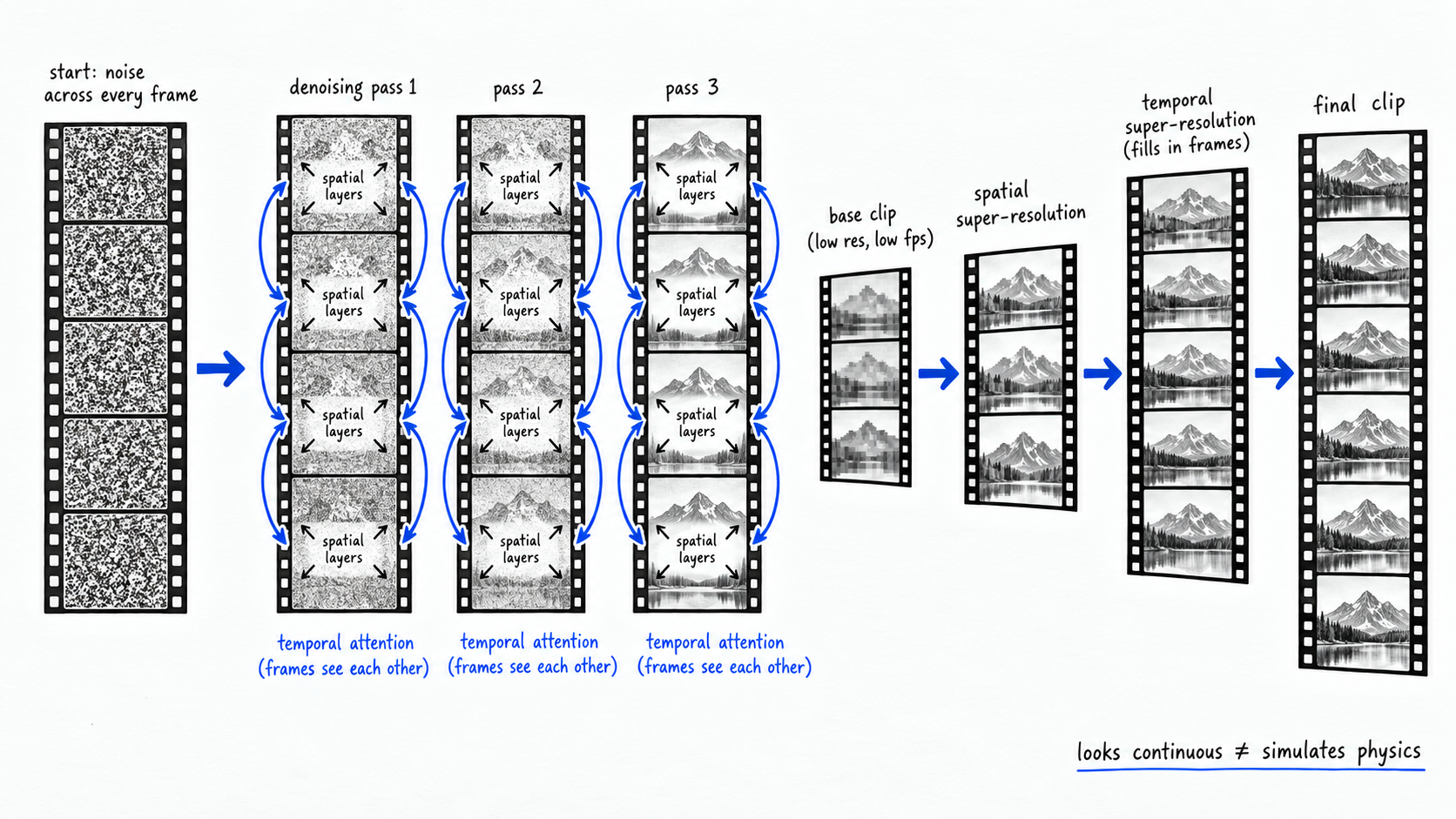
Hand-drawn diagram of diffusion video generation: a filmstrip of pure noise passes through three denoising passes, with cobalt arrows between frames labeled temporal attention and arrows inside frames labeled spatial layers, then a cascade from a low-res base clip through spatial and temporal super-resolution to the final clip; a note reads looks continuous, not simulates physics.View full-size diagram ↗

What it is

Video models generate a clip as one spatio-temporal block, not frame by frame. Diffusion starts from noise spanning every frame at once and iteratively denoises toward a clip, with temporal connections so each frame is generated in view of all the others rather than on its own.

How it works

An autoencoder compresses frames into a latent grid; a denoiser refines the whole grid over many passes. Spatial layers shape each frame while temporal attention lets frames exchange information, keeping subjects coherent. A base model makes a short low-res draft; cascaded upsamplers raise resolution and fill in frames. Attention spans height x width x time, so cost climbs steeply with length.

A concrete example

Imagen Video chains seven diffusion models: a base text-to-video stage plus alternating spatial and temporal super-resolution stages, turning a tiny low-fps draft into 128 frames at 1280x768, 24 fps. Stable Video Diffusion applies the recipe in latent space, fine-tuning an image model with temporal layers to animate one input image.

Why it matters

Video models are entering ad tooling, previsualization, and world-model research, and their failure modes fall out of the mechanism: temporal attention optimizes visual continuity, not physics. That is why hands morph, objects teleport, and clips stay seconds long: each extra second of attention is paid for quadratically.

What people get wrong: That a physically plausible-looking video model is simulating physics. It denoises toward clips that resemble training video, reproducing the look of gravity and collisions without enforcing conservation laws. Visual continuity is learned correlation; reliable physical simulation needs constraints these models lack.

Today's top 5

ResearchAnthropic's self-assessment has Claude review its own chats for misuse since June, catching 94% of high-priority harms at 1% false positives

Using the model as its own abuse monitor surfaced real large-scale misuse, but Anthropic admits it only halves red-team attack success.

BizAlphabet, Meta, Microsoft, Amazon, and Oracle hold $3T+ in AI spending commitments; their shareholder cash returns hit a 15-year low

The AI build-out is now visibly crowding out buybacks and dividends; the bill is landing on shareholders before the returns arrive.

BizReddit fell 29% and Intel 29% in a day on weak guidance, with Google's AI Mode traffic shift and AI cost fears driving the tech selloff

A day after Alphabet's record drop, the market kept repricing AI: traffic-dependent platforms and lagging chipmakers took the hit.

BizOpenAI, Google, Microsoft, and Anthropic will adopt a shared policy-token standard letting publishers opt out of AI scraping across crawlers

One opt-out signal honored by the four biggest labs beats per-crawler robots.txt whack-a-mole, and lands mid-copyright-litigation.

LabsGoogle's Suncatcher prototype data-center satellite is online: its orbital TPUs booted and Gemma 4 transmitted its first response to Earth

A month after launch the orbital TPUs actually serve inference; space data centers moved from render to running hardware.

See the full wire feed →

Quick check

Was this issue useful?

Get Crabhaus in your inbox

A concise daily briefing on the AI developments worth understanding.