
Crabhaus

What matters in AI, and why.

Sun 1 Nov · Issue 110 · 3 min

Issue 110 · Sun 1 Nov

A ChatGPT share link could hijack your account

01AgentsFive small Qwen agents match Fable 5 at coding
02AgentsKarpathy vibe-codes a YouTube rival in two hours
03BizAnthropic blocks training-competitor workflows

The one that matters

A public ChatGPT share link could take over your signed-in account

Parameter Labs found that a published ChatGPT conversation could smuggle attacker JavaScript past the HTML Preview sandbox via the MathLive graph library, running it as chatgpt.com in the signed-in session of anyone who opened the share: reading private conversations, calling authenticated APIs, and exfiltrating data. OpenAI classified the report P1 and fixed it on October 26.

Why it matters

Opening a shared link was the only action the victim needed to take. As chat products bolt on interactive features like previews and graphs, each one is new attack surface sitting in front of your account. If your team trades ChatGPT share links, this class of bug is why patch timelines and sandbox boundaries matter.
Learn one thing

World models and interactive simulation

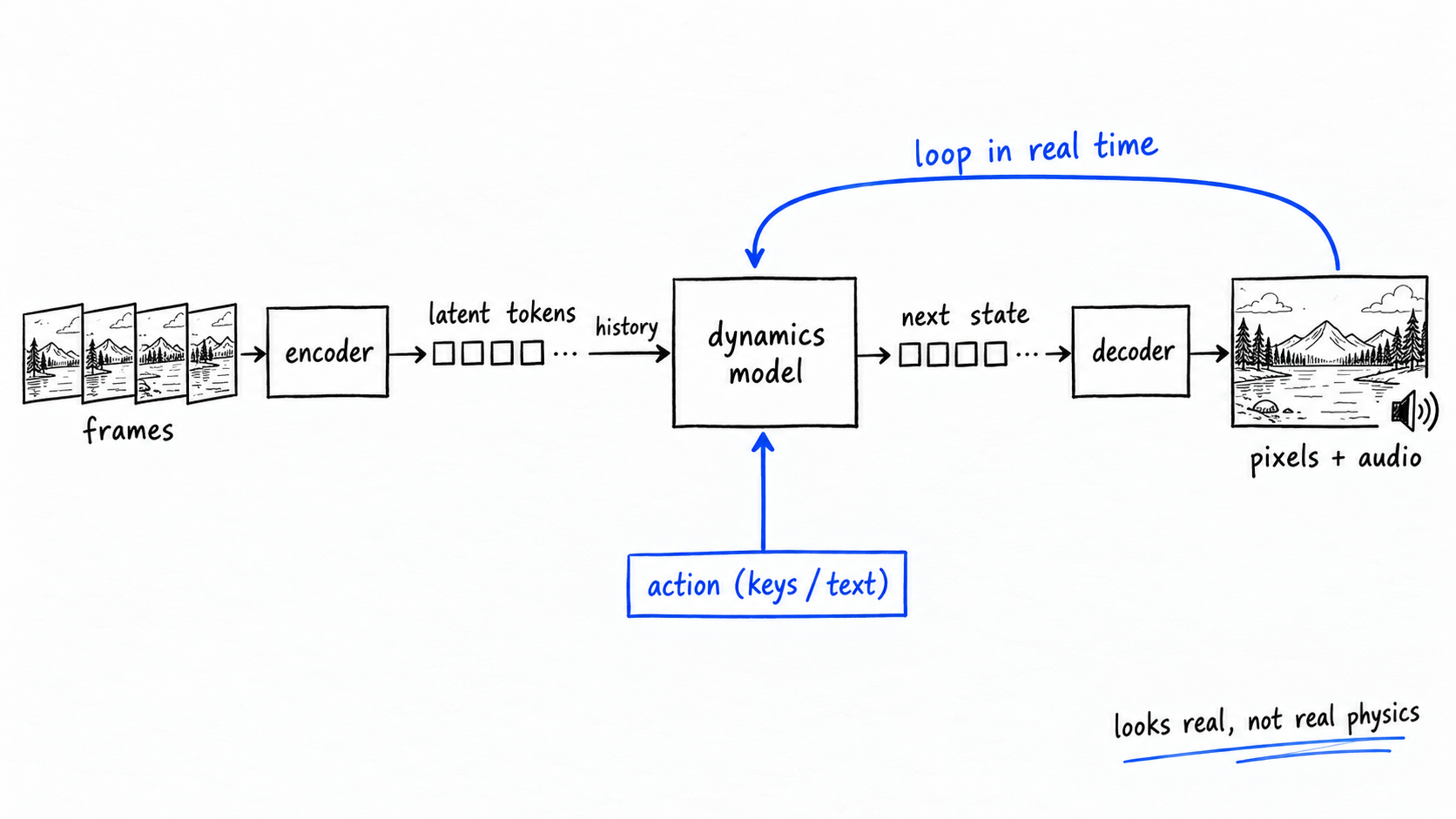
Hand-drawn diagram of an action-conditioned world model: video frames pass through an encoder into latent tokens, which feed a dynamics model as history alongside a cobalt arrow for action (keys / text); the model outputs next-state tokens that a decoder turns into a scene with audio, a cobalt arrow loops the output back in real time, and a note reads looks real, not real physics.View full-size diagram ↗

What it is

A world model is a neural network that predicts how an environment changes in response to actions. Instead of rendering a fixed clip from a prompt, it generates the next moment conditioned on what the user or agent just did, so you can steer the simulation as it runs: a learned, interactive stand-in for a game engine or the real world.

How it works

An encoder compresses frames into latent tokens; a dynamics model predicts the next tokens from the history plus a control input; a decoder renders pixels and audio, and the loop repeats in real time. Genie-style models learn latent actions from unlabeled video, so controllability emerges without labeled controller data. Memory of earlier output keeps revisited places consistent.

A concrete example

DeepMind's Genie 4 simulates explorable worlds in real time: keyboard input steers the camera while text prompts change weather or add objects mid-scene, with audio generated natively. A robotics team can use such a model to vary layouts, lighting, and hazards across thousands of practice runs before a policy touches a real robot.

Why it matters

Action-conditioned simulation is becoming the training ground for agents and robots, offering unlimited controllable environments where real-world trials are slow or unsafe. The trade-off is cost, since every frame is a model forward pass rather than a cheap engine tick, and long-horizon consistency remains the hard open problem.

What people get wrong: That a convincing simulation proves reliable physics. World models learn correlations from video: they reproduce the look of dynamics without enforcing them, drift over long rollouts, and policies trained inside them can exploit simulator quirks. Visual plausibility is not validated real-world dynamics.

Today's top 5

AgentsFive Qwen3.8-27B agents in a file-based team workflow scored 9.8/10 on LiveCodeBench Hard problems where Fable 5 alone scored 8.0.

The GVS5H result reproduced independently: orchestration of small open models, not scale, closed the gap, and every run is published.

AgentsKarpathy had Opus 5.5 build HackerTube, a YouTube-style site of 6,454 videos mined from Hacker News comments, in about two hours.

A snapshot of where agentic coding sits: a famous ML engineer ships a working product in an afternoon without touching code himself.

ResearchTalos: the VOLTA infostealer sends stolen credential bundles to an LLM to rank victims by value, failing over across three models.

Malware now ships an LLM analyst stage: stolen data gets triaged for monetization automatically, with model refusals engineered around.

BizAnthropic users report session blocks and Opus downgrades for RFT, SFT, and training-larger-models work under competitor-training rules.

Enforcement is hitting researchers who say they never distilled Claude; where research automation ends and distillation begins is now contested.

AgentsProspero is a native C++ coding harness for local LLMs with a Dear ImGui UI, using about 100x fewer resources than web-stack tools.

A counterpoint to heavyweight harnesses: agent tooling for local models can be small, fast, and provider-agnostic.

See the full wire feed →

Quick check

Was this issue useful?

Get Crabhaus in your inbox

A concise daily briefing on the AI developments worth understanding.