
Crabhaus

What matters in AI, and why.

Mon 2 Nov · Issue 111 · 3 min

Issue 111 · Mon 2 Nov

OpenAI raised half of what it wanted

01AgentsDeepSeek open-sources a proactive coding agent
02ResearchAI's 700-paper dump has mathematicians adapting
03BizData-center politics hit Tuesday's governor races

The one that matters

OpenAI's funding round comes up short of its $30B target

The WSJ reports OpenAI has secured about $11B in commitments for its latest round, under half the initial $30B target, and expects to raise more in coming weeks. Per the FT, the ask is now roughly $20B at a $1.25T valuation, down from $1.4T, as some investors cut commitments amid an AI selloff, and OpenAI is now courting high-net-worth individuals and family offices.

Why it matters

The most-funded AI lab just met price resistance: when OpenAI has to discount its own valuation, every private AI round reprices beneath it. Watch the knock-on effects - neoclouds are already shut out of the bond market in today's feed - because the compute buildout assumes this capital keeps flowing.
Learn one thing

Vision-language-action models for robots

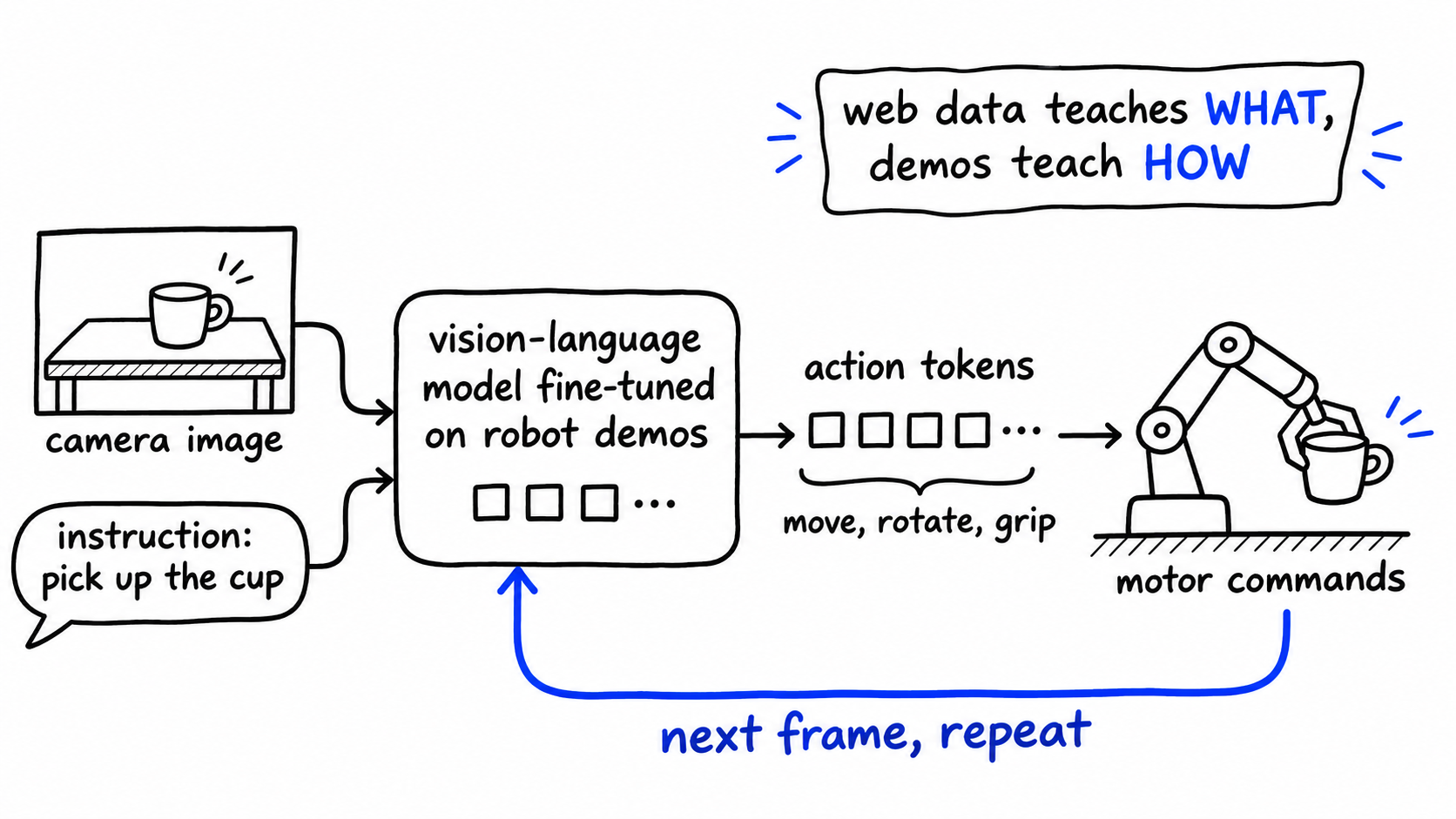
Hand-drawn diagram of a vision-language-action model: a camera image of a cup and an instruction bubble 'pick up the cup' feed a vision-language model fine-tuned on robot demos; it emits action tokens (move, rotate, grip) that become motor commands for a robot arm grasping the cup; a cobalt arrow 'next frame, repeat' loops back; a note reads 'web data teaches WHAT, demos teach HOW'.View full-size diagram ↗

What it is

A vision-language-action (VLA) model is one network that takes camera images plus a language instruction and directly outputs robot motor commands. Instead of separate perception, planning, and control stages, it is a pretrained vision-language model fine-tuned on robot demonstrations, so the robot inherits web-scale knowledge of objects it never saw in its own training.

How it works

Robot actions - end-effector translation, rotation, gripper state - are discretized and written as action tokens, so the VLM's input and output spaces never change. The model is co-fine-tuned on web data and robot trajectories together, then reads the camera frame plus instruction and emits action tokens step by step. Newer VLAs like pi0 use continuous action outputs for smoother control.

A concrete example

DeepMind's RT-2 co-trained PaLI-X and PaLM-E backbones on web and robot data. Across 6,000 real trials it handled commands like 'pick up the bag about to fall off the table' on objects absent from its robot data, and success on unseen scenarios roughly doubled over RT-1, from 32% to 62%.

Why it matters

VLAs are the bet behind the humanoid push, including Meta's Fourier prototype in today's feed: one instruction-following policy beats programming every task by hand. They also turn robotics into a data problem - demonstrations are the scarce ingredient - driving cross-embodiment datasets and open models like OpenVLA.

What people get wrong: That semantic generalization equals physical competence. A VLA can recognize a novel object and attempt a plausible grasp yet still misjudge force or clearance; benchmark scores come from curated lab tasks, not safety guarantees. Recognizing 'what' transfers from the web; reliable 'how' still needs embodied data.

Today's top 5

AgentsDeepSeek open-sourced dsh-superagent, an MIT-licensed prototype coding agent that watches a repo and team chat and opens its own work items.

A frontier lab is giving away the proactive-agent pattern - repo plus chat awareness with scoped permissions - as an open harness bundle.

BizWSJ: lenders demanding tougher terms have effectively shut neoclouds CoreWeave, Nebius, and Nscale out of the bond market in recent weeks.

GPU buildouts run on borrowed money; if debt stays expensive, capacity growth and GPU pricing both change.

ResearchFrank Calegari, on Tao's blog: OpenAI's 700-paper release shows AI now contributes real mathematics; journals and hiring must adapt.

A working number theorist concedes the watershed and redirects the fight to norms mathematicians actually control: publishing, attribution, training.

BizThe Information analysis: candidates backing data-center moratoriums could win up to 15 of 36 US governors' races on Tuesday.

Data-center siting is becoming retail politics; state-level pauses would hit buildout timelines faster than any federal rule.

BizWashington Post tests: chatbots lean on three obscure AI-built voter sites; Copilot cited the error-prone Ballot Brief in 75% of tests.

Two days before the midterms, chatbots have quietly become election infrastructure with an unvetted citation layer underneath.

See the full wire feed →

Quick check

Was this issue useful?

Get Crabhaus in your inbox

A concise daily briefing on the AI developments worth understanding.