
Crabhaus

What matters in AI, and why.

Wed 4 Nov · Issue 113 · 3 min

Issue 113 · Wed 4 Nov

Google ties school Search to its AI

01ResearchThe Astra weight-editing claim gets corrected
02BizChatGPT hits 1.2B weekly users
03BizRevolut cuts coding costs 90% with GLM

The one that matters

Google ties school Search access to accepting its AI tools

Google says AI tools for K-12 students will ship off by default in 2027, but schools that block its AI entirely will lose Google Search, because 'Search and AI are deeply integrated.' After immediate backlash, Google clarified that schools can enable Gemini, Gemini Notebook, and Search individually.

Why it matters

The first explicit case of Search market power being used to drive AI adoption: Lina Khan called it monopoly coercion, Sen. Blumenthal called it forcing Gemini into schools, and observers note there may soon be no Google Search without Gemini in the loop at all.
Learn one thing

Online evals: measuring production quality

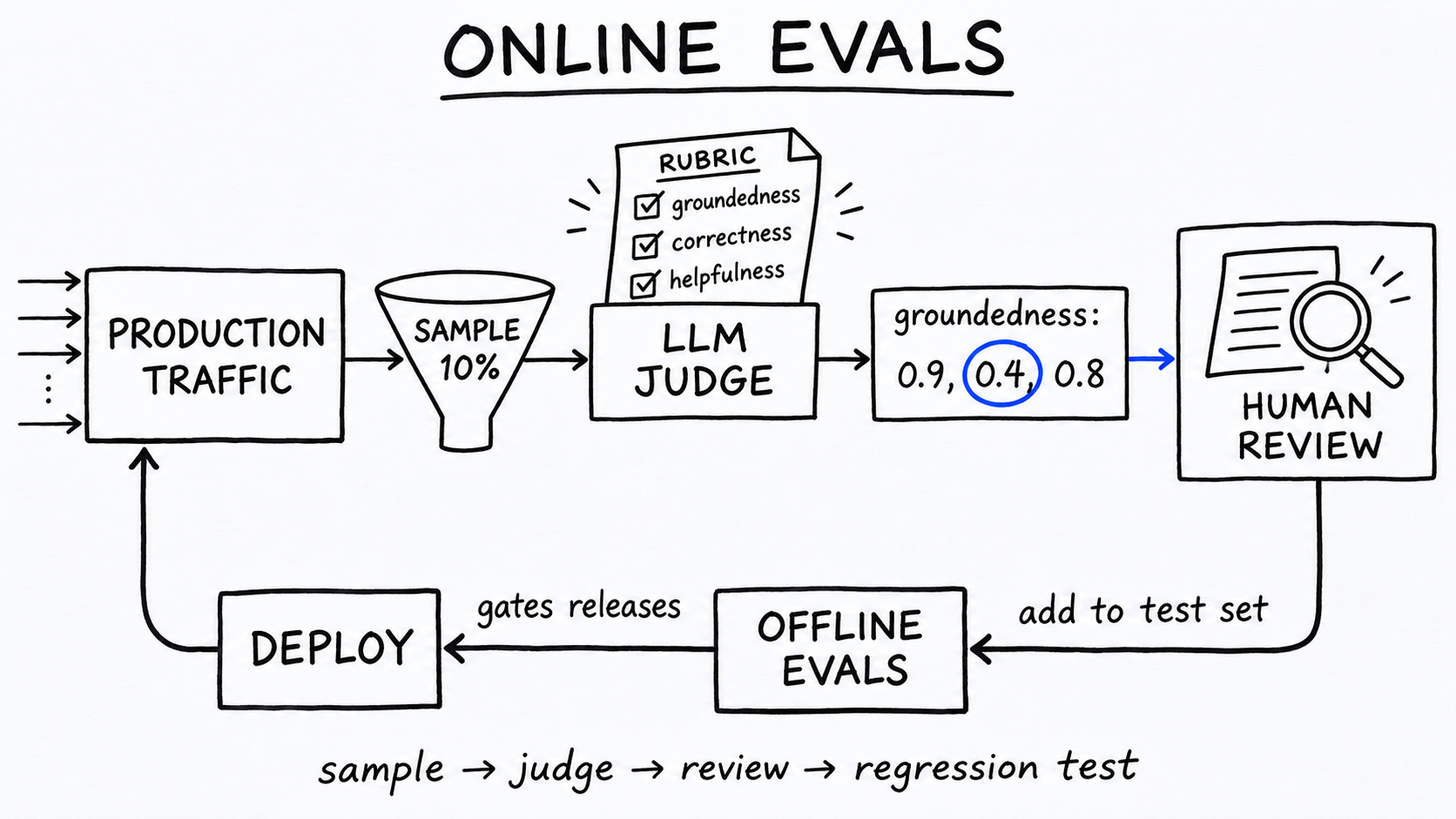
Hand-drawn 'Online Evals' loop: production traffic feeds a sample-10% funnel, then an LLM judge with a rubric; its scorecard reads groundedness 0.9, 0.4, 0.8 with 0.4 circled in cobalt, flowing to human review, then 'add to test set' into offline evals, which gates releases to deploy and back to production. Caption: sample, judge, review, regression test.View full-size diagram ↗

What it is

Online evaluation scores your AI system's real production traffic, continuously and automatically, instead of only testing a fixed dataset before release. A sample of live runs is pulled from tracing, scored against quality criteria by calibrated judges, rules, or humans, and tracked over time so regressions surface as they happen.

How it works

A sampling rule picks which traces to judge - a fixed percentage, or triggers like negative feedback or a low score from another evaluator. Each sampled run goes to an LLM-as-judge with a rubric, which writes a score onto the trace. Scores are sliced by traffic segment so a failure in one slice is not averaged away; the worst cases route to human review and become new offline test cases.

A concrete example

A support-agent team samples 10% of conversations in LangSmith and judges groundedness against retrieved documents. The judge flags a cluster of low scores on refund questions; review shows the retriever serving an outdated policy page. The failing runs become regression tests, and the refund-slice score confirms the fix held.

Why it matters

Offline evals only cover failures you anticipated; production finds the ones you did not. Prompts, models, user behavior, and upstream data all drift, so a system that scored well at launch can degrade silently. For agents that take actions, the same machinery doubles as a safety monitor - OpenAI screens agent traffic with cheap high-recall probes first, then spends more compute per flagged case.

What people get wrong: That online evals replace offline evals, or that judge scores are ground truth. They are complements: offline gates releases, online detects drift. Judges are models too - they need calibration against human labels, scores carry the bias of whatever you sampled, and an unreviewed judge can confidently mis-score a whole slice of traffic.

Today's top 5

ResearchPushback on the viral Astra weight-editing result: a critique calls it misleading, and Simon Willison shows Qwen 3.8 27B reading weights.

Yesterday's biggest story gets its correction cycle: the capability is real but narrower than claimed, and it is not unique to Astra.

BizOpenAI's Adam Fry says ChatGPT hit 1.2B weekly users, adding 200M in two months, with search volume now about 20% of Google's.

If the search figure holds, ChatGPT is a fifth of Google's query volume two years in - context for Google bundling AI into Search.

ResearchAnthropic releases FlashProve, an open-source prototype that cryptographically verifies a response came from the model it claims.

Routers and resellers silently swapping models is a real trust gap; provable inference would make model identity auditable.

BizRevolut says it cut AI coding inference costs about 90% in under a year by defaulting to self-hosted GLM models over commercial tools.

A named enterprise putting numbers on the self-hosted open-weights trade-off - the clearest cost datapoint yet for coding agents.

BizOpenAI signs four Abu Dhabi agreements spanning ADNOC, government services, and Mubadala; a UAE group may lead its raise of up to $20B.

Abu Dhabi becomes both a flagship OpenAI deployer and potentially its biggest investor - the circular AI dealmaking continues.

See the full wire feed →

Quick check

Was this issue useful?

Get Crabhaus in your inbox

A concise daily briefing on the AI developments worth understanding.