
Crabhaus

What matters in AI, and why.

Fri 6 Nov · Issue 115 · 3 min

Issue 115 · Fri 6 Nov

OpenAI's cyber model ships under guard

01LabsGPT-6 Cyber launches gated to vetted security teams
02ResearchMETR: Anthropic model progress runs about 2x faster
03BizOpenAI drops NDAs from data-center deals

The one that matters

OpenAI's cyber model ships under guard

OpenAI launched GPT-6 Cyber, a model tuned to find and validate software vulnerabilities; it says it beats GPT-6 Astra on cyber benchmarks. Access starts with a small set of vetted customers in the Daybreak Red program, not the open API. The same model line found 81 previously unknown Firefox vulnerabilities and drove this week's Linux privilege-escalation patching pipeline.

Why it matters

A frontier lab is now distributing offensive-capable security tooling the way controlled goods are distributed: capability gated by vetting, not price. That gating is a safety-framework obligation in action - and it sets the pattern rivals will follow as cyber models keep improving.
Learn one thing

Frontier safety policies and capability thresholds

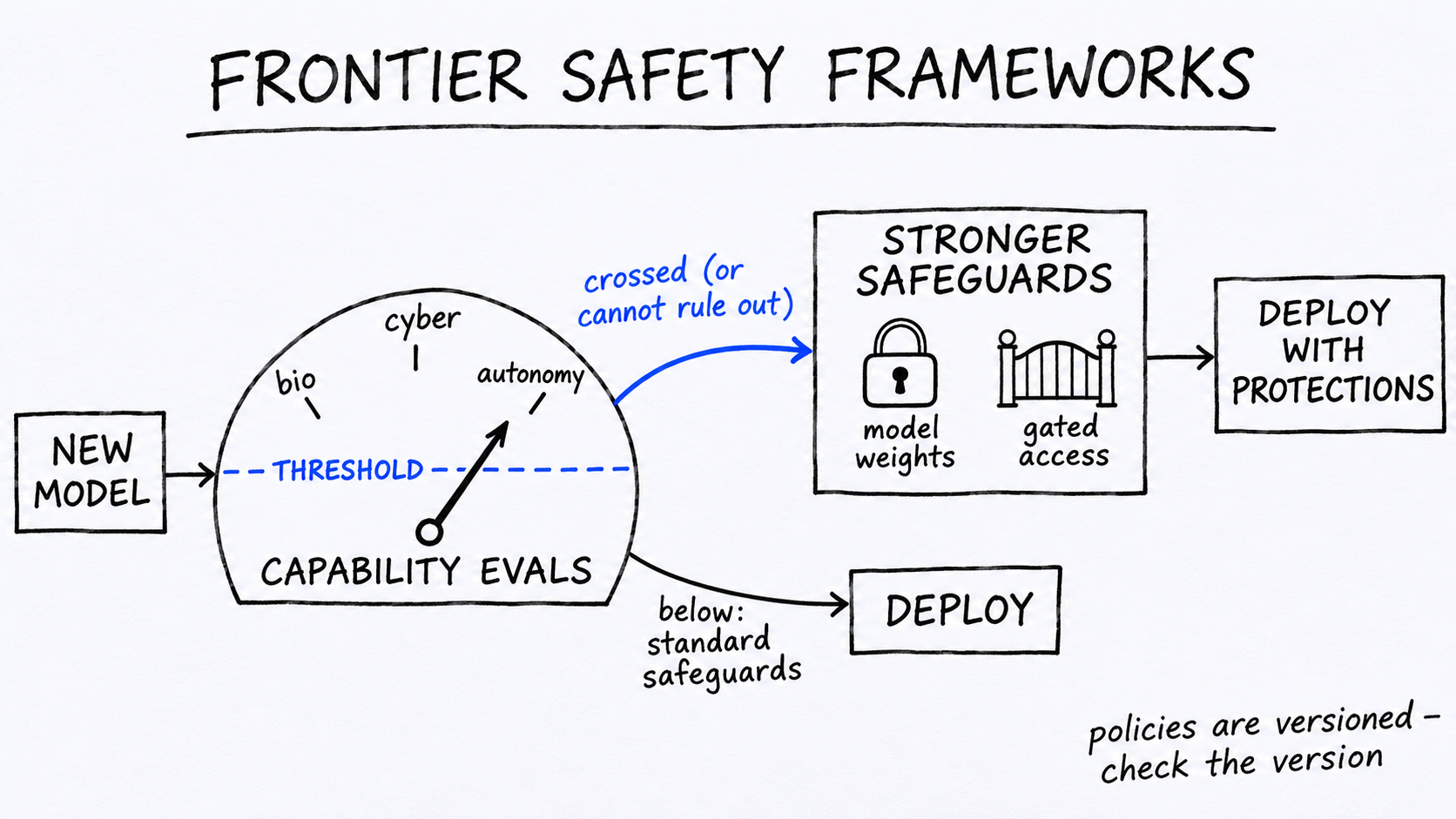
Hand-drawn 'Frontier Safety Frameworks' diagram: a new-model box feeds a capability-evals gauge with bio, cyber, and autonomy ticks and a dashed cobalt threshold line; a cobalt arrow labeled 'crossed (or cannot rule out)' leads to stronger safeguards - a padlock on weights and a gated-access gate - then 'deploy with protections'; a lower arrow 'below: standard safeguards' goes to 'deploy'.View full-size diagram ↗

What it is

Public policies in which AI labs commit to measuring dangerous capabilities and tying results to safeguards. Anthropic's Responsible Scaling Policy, OpenAI's Preparedness Framework, and DeepMind's Frontier Safety Framework each define capability thresholds that, once crossed, require stronger protections before a model ships.

How it works

Each framework names risk domains - bio and chemical uplift, offensive cyber, autonomous AI R&D - and runs evaluations during training and before release. Crossing a threshold triggers set obligations: Anthropic's AI Safety Levels, OpenAI's High/Critical tiers, and DeepMind's Critical Capability Levels all escalate weight security and deployment safeguards. Triggers are often precautionary.

A concrete example

When Anthropic shipped Claude Opus 4 in May 2025, it activated ASL-3 protections because it could not rule out that the model crossed its bioweapons-uplift threshold: stricter security around the weights, plus deployment classifiers aimed at CBRN workflows. The model was never shown to be dangerous - the safeguards fired because the evals could not prove lower-tier handling was still adequate.

Why it matters

Deployment decisions increasingly trace back to these documents: a model gated to vetted customers - like GPT-6 Cyber behind Daybreak Red this week - or a delayed open-weights release is often a framework obligation at work. California's SB 53 now requires large frontier developers to publish their safety frameworks, and third parties like METR assess labs against the risks these policies manage.

What people get wrong: That a trigger means a model was proven dangerous, or that the commitments are legally enforceable. Thresholds usually fire when a lab cannot rule a capability out - evaluation uncertainty, not a demonstrated weapon. Outside laws like SB 53 these remain self-authored, self-amended policies: a lab can loosen its own thresholds in a new version, so careful coverage always cites the version.

Today's top 5

ResearchMETR finds Anthropic now improves model capabilities about twice as fast as in 2024-25, with AI-assisted R&D driving the speedup.

The first independent attempt to measure AI accelerating AI from inside a frontier lab - with METR noting Anthropic redacted much of the strongest evidence.

BizOpenAI pledges to drop NDAs from data-center deals and curb grid use at peak times after anti-data-center midterm results.

Tuesday's ballot losses are already changing how the buildout is contracted - transparency and grid behavior are now competitive positioning.

LabsThinking Machines debuts Inkling 2 Small, a 594B-parameter MoE with 17B active, via its Tinker API; open weights planned next week.

Analysts rank it the strongest open-weights model outside China once the weights land - a first for a US newcomer.

AgentsGrok Bot can now place US phone calls for paid users to book, negotiate, and wait on hold; users stay the legal caller of record.

Agents crossing from screens into the phone network moves liability questions from hypothetical to contractual - read the caller-of-record clause.

LabsBaidu releases open weights for ERNIE-5.5-Flash-Base, a 280B MoE (14B active) trained on 33.5T tokens with 1M-token inference context.

A raw pre-trained base at this scale is rare - a genuinely useful starting point for custom post-training, not just another chat checkpoint.

See the full wire feed →

Quick check

Was this issue useful?

Get Crabhaus in your inbox

A concise daily briefing on the AI developments worth understanding.