
Crabhaus

What matters in AI, and why.

Sat 7 Nov · Issue 116 · 3 min

Issue 116 · Sat 7 Nov

Anthropic lines up a pre-Thanksgiving IPO

01BizAnthropic eyes an $80-100B IPO before Thanksgiving
02ResearchPSI: Anthropic model proves 2008 quantum conjecture
03AgentsPerplexity Teammates puts always-on agents to work

The one that matters

Anthropic lines up a pre-Thanksgiving IPO

Anthropic is continuing with plans to list this month, expecting to raise $80-100B at a $1.25-1.75T valuation, the FT reports - weeks after OpenAI closed roughly $11B of private funding at $1.25T.

Why it matters

It would be among the largest listings ever, and it moves frontier-lab economics into public-market scrutiny: quarterly disclosure, priced risk factors, and a live referendum on whether AI capex can be financed at these valuations. Some early buyers are already arguing the number should start closer to $1.1T.
Learn one thing

AI training and copyright

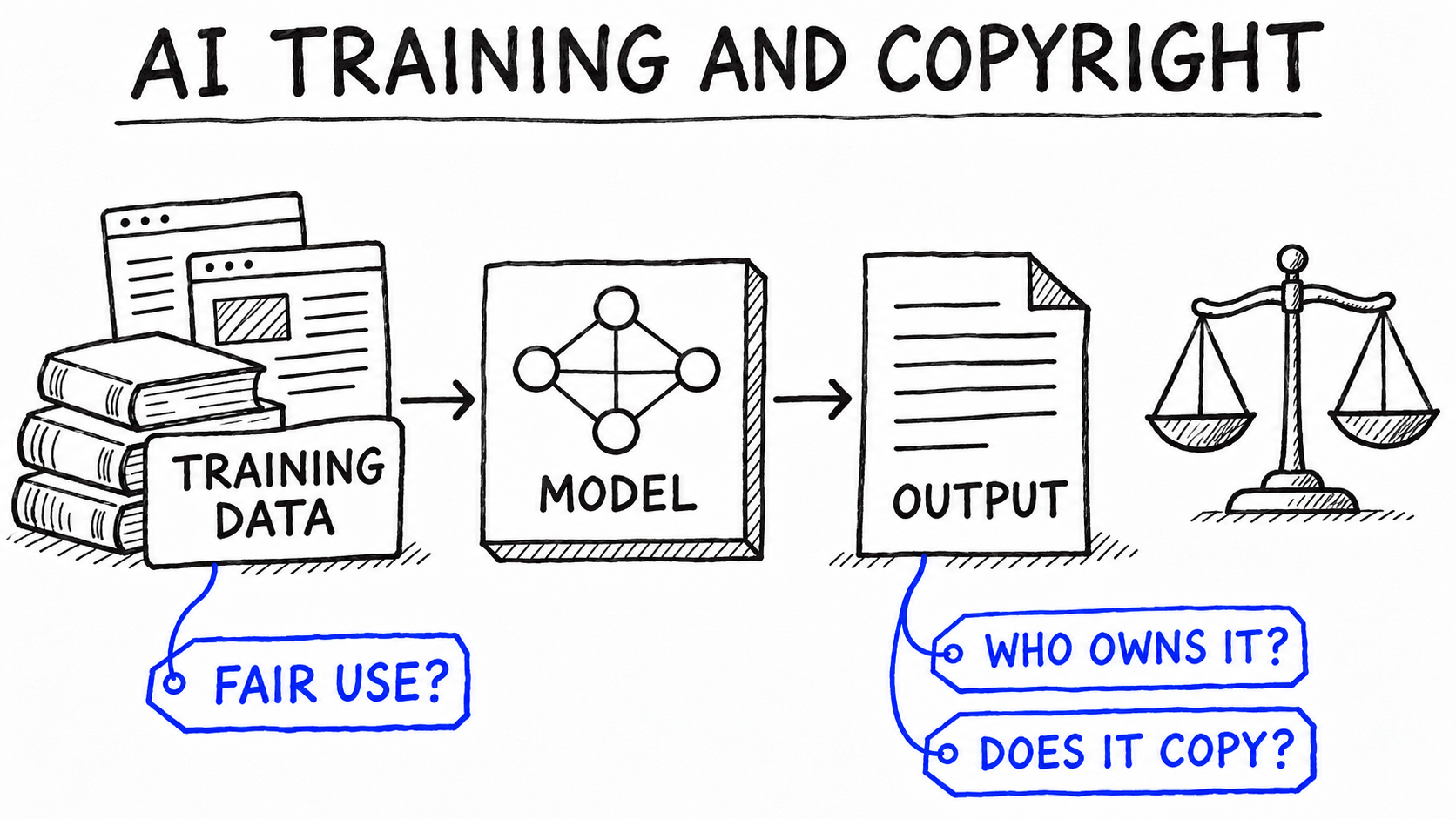
Hand-drawn 'AI Training and Copyright' diagram: books and web pages labeled Training Data flow into a Model block and out to an Output page, with a cobalt 'Fair use?' tag on the data and 'Who owns it?' and 'Does it copy?' tags on the output, beside a sketched balance scale.View full-size diagram ↗

What it is

How copyright applies to AI is really three separate questions: whether copying works to train a model is lawful, who (if anyone) owns a model's outputs, and whether a given output infringes an existing work. Each has its own legal test, and an answer to one settles nothing about the others.

How it works

US courts judge training-stage copying under fair use, case by case. 2025's Bartz v. Anthropic and Kadrey v. Meta called LLM training transformative - but one court ruled a pirated-book library was not fair use, and the other noted plaintiffs never proved market harm. The Copyright Office adds that pure machine output can't be copyrighted; the EU uses opt-out text-and-data-mining rules.

A concrete example

Bartz v. Anthropic shows how fact-dependent the analysis is. The same company and the same models produced opposite outcomes in one case: training on lawfully bought, scanned books was ruled fair use, while retaining millions of pirated copies in a permanent library was not - and Anthropic settled that exposure for $1.5B, roughly $3,000 per work.

Why it matters

For AI builders, data provenance is now a priced risk: where training data came from can matter more in court than what the model does with it. It shapes build-versus-license decisions, dataset audits, and indemnification clauses in model contracts, and it determines whether users can claim copyright in what AI tools help them make.

What people get wrong: That US courts ruled AI training is fair use, so the issue is settled. Both headline rulings are district-level, fact-bound, and partly hinged on acquisition method and unproven market harm; the Copyright Office expects some training uses to fail fair use, appeals and dozens of suits are pending, and other jurisdictions apply different rules entirely.

Today's top 5

ResearchPSI says its internal research system, running a non-public Anthropic model, proved the Aaronson-Ambainis conjecture, open since 2008.

If the proof holds up to community verification, an AI system settled a central open problem in quantum complexity theory - a concrete research result, not a benchmark score.

AgentsPerplexity launches Teammates: always-on agents on its Computer platform, each owning an ongoing project across roles and tools.

The pitch shifts from assistant-in-a-tab to standing digital staff - agents that persist, hold context, and own outcomes rather than answer queries.

BizUS intelligence concluded China's MSS recruited Megaspeed exec Alice Huang to collect intelligence on Nvidia CEO Jensen Huang, NYT says.

AI chip supremacy now has live espionage tradecraft around it - and the target was the supply chain's single most influential decision-maker.

BizTSMC is weighing a move into 3D DRAM manufacturing at Nvidia's request as the AI boom strains memory supply, The Information reports.

Memory, not logic, is becoming the binding constraint on AI hardware; TSMC entering DRAM would redraw the supplier map.

AgentsHightouch pairs a small, well-calibrated judge model with Claude Opus escalation, matching frontier accuracy at 4x lower cost.

A directly reusable pattern: route on the cheap model's confidence, escalate only uncertain cases, and keep frontier quality.

See the full wire feed →

Quick check

Was this issue useful?

Get Crabhaus in your inbox

A concise daily briefing on the AI developments worth understanding.