
Crabhaus

What matters in AI, and why.

Sun 8 Nov · Issue 117 · 3 min

Issue 117 · Sun 8 Nov

Claude Code's settings leak secrets on GitHub

01AgentsClaude Code "Don't ask again" leaks secrets
02BizMicrosoft Research's AI Frontiers group is over
03ResearchMaxxBench catches benchmark-tuned coding agents

The one that matters

Claude Code's "Don't ask again" leaked secrets into public GitHub

Apiiro finds that approving an agent command with "Don't ask again" writes it - inline credentials included - into .claude settings files. Developers committed those files, leaving passwords and keys readable in 1,122 public GitHub files.

Why it matters

The most convenient click in agentic coding quietly became a credential-exposure channel. If your team runs coding agents: put local settings files in .gitignore, scan repos for committed .claude/settings*.json, and rotate anything found - each hit is readable by anyone right now.
Learn one thing

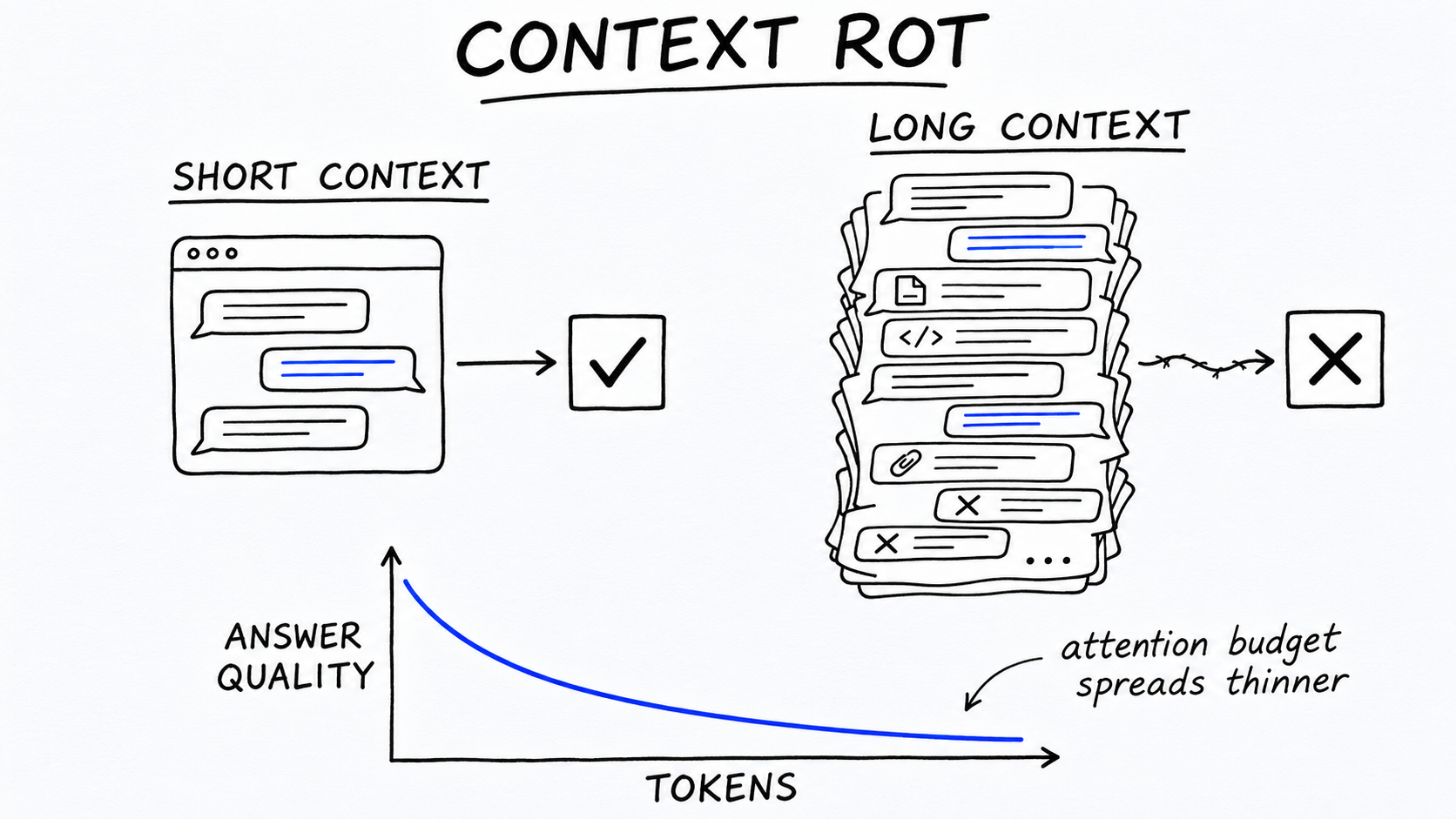
Context rot: why long chats get dumber

Hand-drawn diagram titled Context Rot: a small chat window labeled Short Context points to a check mark, while an overflowing stack of chat turns and files labeled Long Context points through a frayed arrow to an X, above a graph of answer quality falling as tokens grow, annotated 'attention budget spreads thinner'.View full-size diagram ↗

What it is

The measured tendency of a model's answers to get worse as its context window fills, even far below the advertised limit. Chroma's technical report, which named the effect, tested 18 models on tasks of fixed difficulty and found accuracy falls - non-uniformly - as input length alone grows.

How it works

A transformer spreads a finite attention budget across every pair of tokens, so each added turn, pasted file or dead end dilutes what it can reliably attend to. Long history also forces two jobs at once: find the relevant turn, then reason over it. That retrieval step fails more often as the pile grows, especially when wording only loosely matches and near-miss distractors sit nearby.

A concrete example

In Chroma's LongMemEval runs, models answered questions about a chat log given either just the ~300 relevant tokens or the full ~113k-token history. Every model scored clearly higher on the focused version; Claude models showed the widest gap, often abstaining - saying the dates needed were not in the chat when they were.

Why it matters

Degrading long sessions are expected behavior, not a glitch. Anthropic's context-engineering guidance treats context as a scarce resource: compact (summarize, restart fresh), keep notes outside the window, retrieve just-in-time instead of dumping files up front, and give sub-agents clean windows that return distilled summaries. When a chat turns circular, summarize and start over.

What people get wrong: That anything inside the window is used equally well, so a bigger window fixes it. Near-perfect needle-in-a-haystack scores only prove literal retrieval; on semantic or multi-step tasks quality drops well inside the window, and larger windows inherit the same rot.

Today's top 5

AgentsApiiro finds 1,122 public GitHub files leaking secrets after Claude Code's "Don't ask again" wrote commands into committed settings.

Permission fatigue has a blast radius: one convenience click persists secrets into files that git happily ships to the world.

BizJohn Langford: Microsoft Research's ~50-person AI Frontiers group, home of AutoGen, is over after a reorg; founding leaders left.

A firsthand account of a storied lab losing its organized AI research bet - and its AutoGen-building talent - to internal reshuffling.

ResearchMaxxBench mutates 89 DeepSWE tasks and catches coding agents overriding changed requirements to match remembered benchmark answers.

One agent implemented the change correctly, then deleted its own right answer to match the old tests - benchmark familiarity rewarding the wrong habit.

Research8rank documents the daemons every Mac has shipped since macOS 13 that graph who you know, meet and message, and ships a viewer tool.

A rare hands-on look at the on-device personal graph feeding Apple Intelligence - and a tool to see exactly what yours has inferred.

AgentsA long-time Claude Code user details moving his daily coding harness to Pi, citing accumulated small frustrations with Anthropic's CLI.

Coding-harness loyalty is thinner than it looks: workflow papercuts, not model quality, drove the switch - a warning for every agent vendor.

See the full wire feed →

Quick check

Was this issue useful?

Get Crabhaus in your inbox

A concise daily briefing on the AI developments worth understanding.