Crabhaus

What matters in AI & agents, and what to do with it.

Mon 9 Nov ยท Issue 118 ยท 3 min read

Today in AI

Goldman Sachs took AI coding tools away from traders and kept them for engineers.

Goldman takes AI coding tools from traders

  1. BusinessNvidia's board investigates its own chief
  2. ModelsApple races to make Siri do tasks
  3. In practiceAI-exposed office jobs grew anyway last month

1.54 million

Number of the day

daily users on DeepSeek's agent platform within three months of launch Bloomberg โ†—

Today's news

In practice

Goldman Sachs pulls AI coding tools from its traders and bankers

Goldman let traders and bankers use Claude Code and Microsoft's GitHub tools to build their own market trackers. October guidance limits the tools to engineers, citing productivity and risk reviews.

Why it matters to you

Companies are separating using AI from running AI-written code near client data. If an AI tool does part of your job, get it formally adopted.

โ€œ"A major leak is just one small mistake or prompt injection away."โ€ (lukebuehler, reader on Hacker News)

Try this at work

Find out what your AI policy actually allows

Goldman's traders found out the hard way: check where you stand before leaning on AI at work.

Here is my company's AI policy: [paste it, or say "we have none"]. What does it allow and forbid for tools like ChatGPT or Claude? What three questions should I ask IT before relying on AI for real work?

Watch out: Use a company-approved AI tool, not a personal account; the policy may be confidential.

Explained like you're busy

The EU AI Act for builders

The mental model. Product-safety law for AI: a few uses are banned, risky uses like hiring and credit get strict duties, chatbots and AI content need honest labels, everything else is untouched.

Where you'll see it at work. Bans, model-provider duties and transparency rules already apply; the strict high-risk regime starts 2 December 2027. Selling someone else's high-risk system under your brand makes you its legal provider.

What people get wrong. That it only hits big model labs. Duties sit with whoever ships or deploys AI for a risky use, even a small team wrapping a frontier model. Only the high-risk rules moved to 2027.

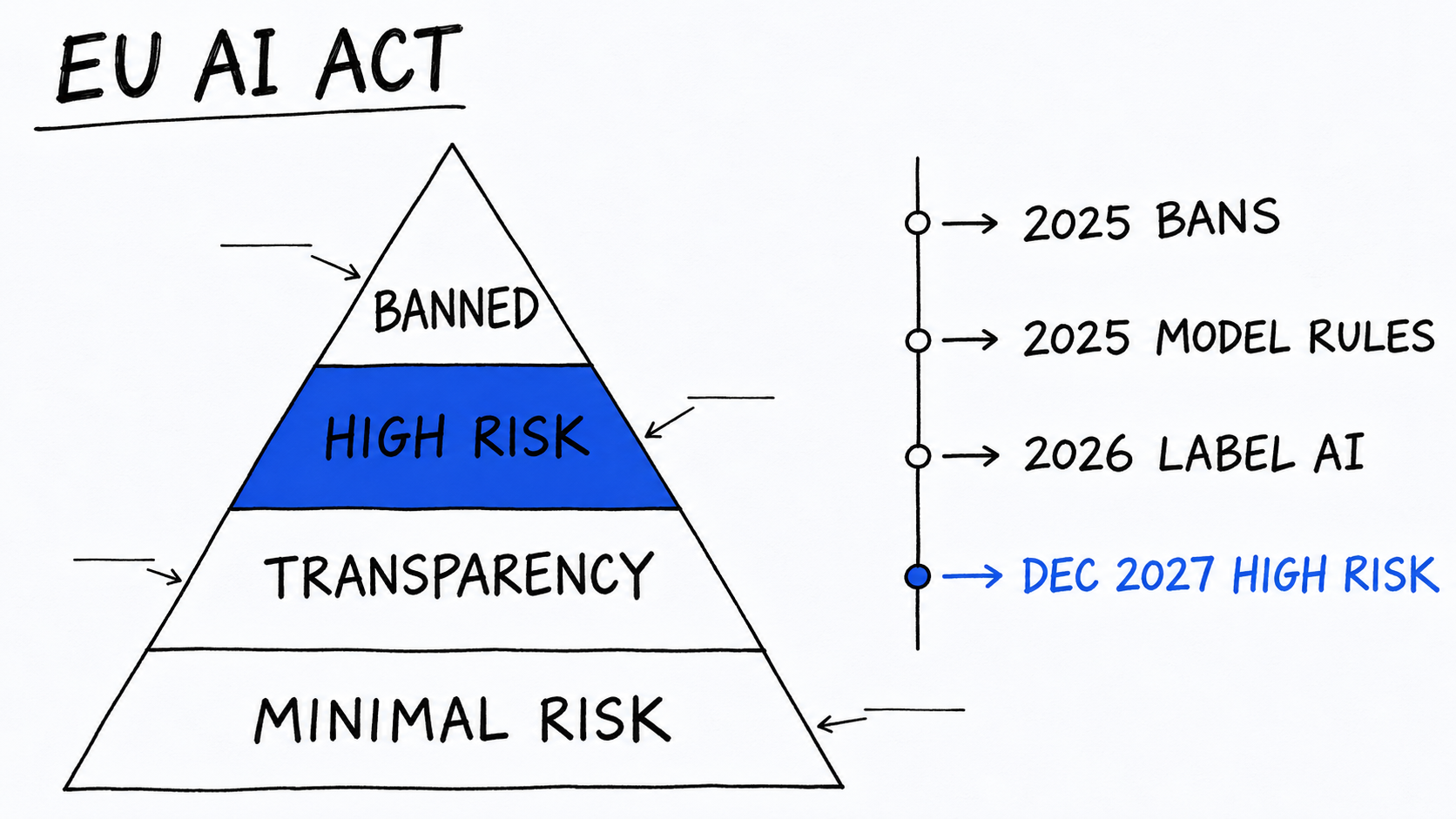
Hand-drawn diagram of the EU AI Act's four risk tiers as a pyramid, from banned uses at the top to minimal risk at the base, with a timeline of application dates from 2025 to December 2027. (opens the full-size diagram)
Full explainer ยท 3 min

What it is

The EU's product-safety law for AI, in force since August 2024 and applying in phases. It sorts AI by use into four risk tiers: banned practices, high-risk systems with strict duties, limited-risk systems that only owe transparency, and minimal-risk software with no new rules. It binds anyone selling AI into the EU, wherever the company sits.

How it works

Obligations attach to roles. A provider builds an AI system or general-purpose model and puts it on the EU market; a deployer uses one professionally. Bans (social scoring, emotion recognition at work) apply since February 2025; general-purpose model duties since August 2025; transparency rules (disclose AI, label AI content) since August 2026. The strict high-risk regime for uses like hiring and credit was postponed by the July 2026 Digital Omnibus and starts 2 December 2027.

A concrete example

A startup sells a CV-screening assistant built on a frontier model API to EU employers. CV screening is a listed high-risk use, so from 2 December 2027 the startup, as provider, needs risk management, logged decisions, human oversight and a conformity assessment; the employers deploying it carry their own duties. The same startup's internal meeting-notes bot only owes transparency: users must know it is AI.

Why it matters

If you build or buy AI features that touch EU users, the cheap moves happen now: know whether you are a provider or a deployer, check whether your use case is on the high-risk list, and keep records of model choices and data. Fines for banned practices reach 7% of global turnover. The delay to December 2027 is breathing room, not an exemption: bans, model duties and transparency rules already apply.

Your turn

Can you use AI coding tools at work?

One question: Has your employer rolled out AI tools, locked them down, or both? Reply to today's email to answer.