
Crabhaus

What matters in AI & agents, and what to do with it.

Tue 10 Nov · Issue 119 · 3 min read

Today in AI

Anthropic's new Claude models write faster, cost less, and claim two open physics problems.

Anthropic's new Claude models: faster and cheaper

  1. BusinessNvidia's spy scandal deepens as shares fall
  2. Policy & riskHumans review some Gemini chats and files
  3. BreakthroughsAn AI settled an 18-year maths question

$129 million

Number of the day

lost to scam calls faking executives' voices with AI, US prosecutors say New York Times ↗

Today's news

Models

Anthropic launches Claude Fable 5.2 and Mythos 5.2

Anthropic says its newest top models write up to 30% faster and cost 20% less than the last version. It credits them with solving two open black-hole physics problems and formally verifying Fermat's Last Theorem in 30 hours.

Why it matters to you

If your tools run on Claude, the strongest tier just got quicker and cheaper. Treat launch-day numbers as the maker's own until outside testers weigh in.
Also today

BusinessNvidia fell 4.3% as the board investigation of CEO Jensen Huang began

The company behind most AI computing has an espionage cloud over its chief.

Policy & riskConsumer Gemini chats using Drive files and Gmail can reach human reviewers

Assume a free AI app may show people what it touches; keep work files in business accounts.

This covers the consumer Gemini app with connected apps on; Google says Workspace business accounts are excluded. (bri3d, reader on Hacker News)

BreakthroughsAn AI proved a quantum computing conjecture open since 2008

AI is starting to settle real research questions, every step machine-checked.

Try this at work

Give the new model an old failure

The cheapest test of this week's new models: a task the old one got wrong.

An AI assistant got this wrong before. Task and what was wrong: [paste both]. Try the task now, then tell me what you did differently and what I should double-check before trusting the result.

Watch out: Upgrades shift behavior quietly; recheck the parts that failed last time.

Explained like you're busy

Writing a definition of done for an AI agent

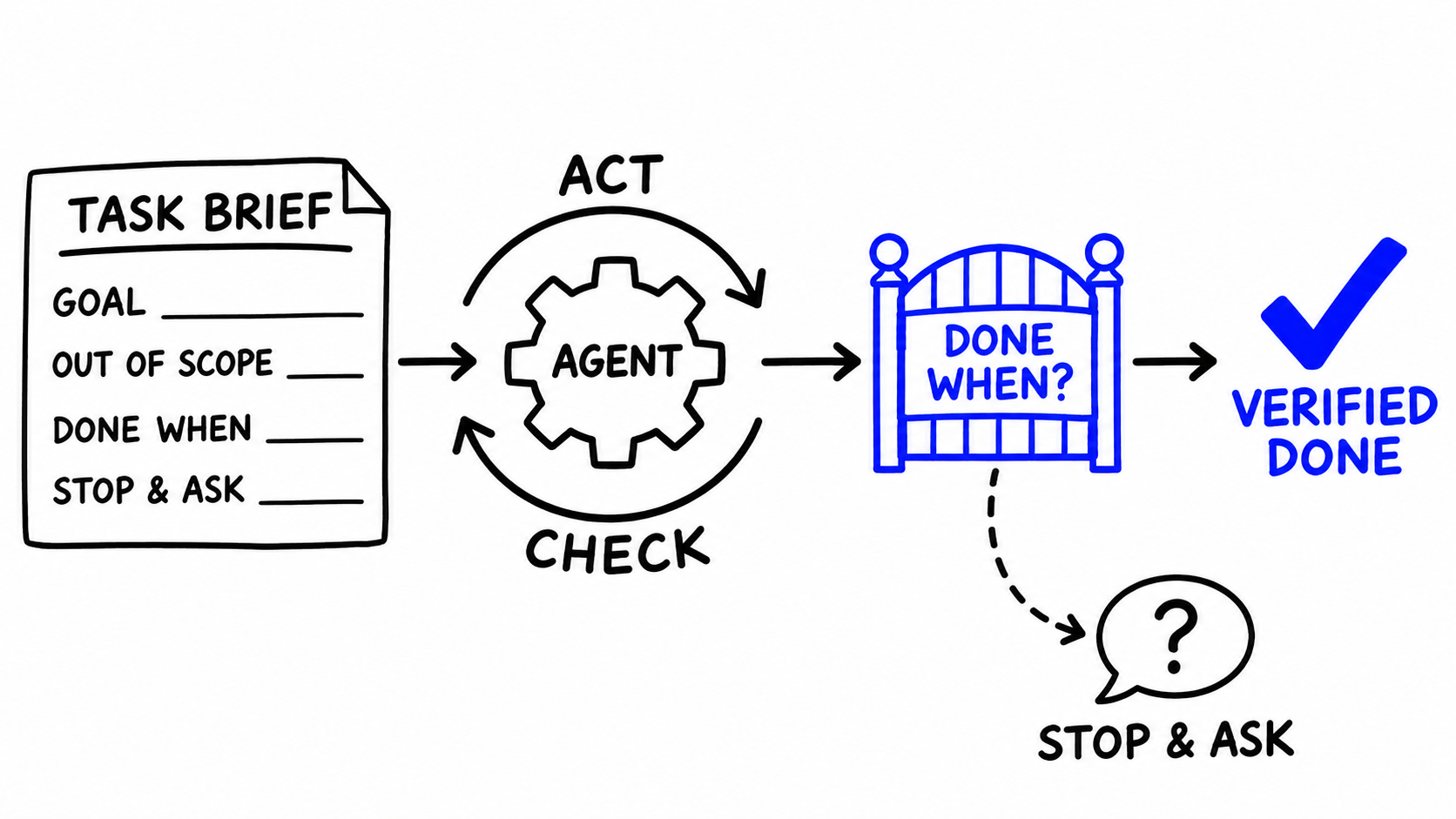
The recipe. Four lines before an agent starts: the goal, what it must not touch, the check proving it finished, and when to stop and ask you. Work ends in something you can verify, not an open-ended loop.

When to use it. When you hand an AI a task, add one “Done when:” line with a check you could run yourself, plus one “stop and ask” line for anything destructive or missing. This works for spreadsheets and documents, not just code.

What goes wrong. That a longer prompt does the job. Instructions say how to work, not when to stop. Without a check it can run, the agent decides what finished means and declares success early.

Hand-drawn diagram of a four-line task brief for an AI agent, with goal, out of scope, done when and stop-and-ask lines feeding an act-and-check loop that exits through a done check to a verified result, with a side path for asking a human. (opens the full-size diagram)
Full explainer · 4 min

What it is

A short written contract you give an AI agent before it starts: the goal in one line, what is out of scope, the check that proves the work is finished, and when to stop and ask a human. Anthropic's guidance on building agents treats explicit stopping conditions and verifiable checks as core design decisions, not polish. Without them, the agent decides for itself what finished means, and its idea of done is usually smaller or stranger than yours.

How it works

Agents work in a loop: act, look at the result, act again. The loop ends well only if the agent can tell that the goal is met, so the brief has four working parts. The goal line sets direction. The out-of-scope line blocks helpful detours, like reorganizing files you never mentioned. The finish check is something the agent can run or verify: a passing test, a document matching a template, totals that reconcile. The stop-and-ask rule names the moments it must pause for you: missing access, anything destructive, or a cap like a maximum number of attempts.

A concrete example

You hand an agent a messy sales spreadsheet. A weak brief says: tidy this up. A strong brief says: Goal: one row per customer with name, region and 2026 total. Out of scope: leave every other tab untouched. Done when: the row count matches the customer list and the totals equal the Summary tab. Stop and ask if more than five rows have no matching customer. The agent now has a target it can verify, a fence, and a tripwire, and you can confirm the result in seconds.

Why it matters

Delegating to agents fails most often at the finish line: the agent announces success and the work is nearly right, which costs more than obviously wrong, because you stop checking. A definition of done moves that judgment from the agent's optimism to a check you chose. It also caps the open-ended loop that burns time and tokens when an agent keeps improving something nobody asked for. Two minutes writing the brief is repaid on every delegated task, whatever tool you use.

Your turn

When a new AI model launches, when do you try it?

Yesterday: 2 of 2 readers picked “Yes, pretty freely” (Q: Can you use AI coding tools at work?)

One question: Do you switch to new AI models right away, or wait? Reply to today's email to answer.