
Crabhaus

What matters in AI & agents, and what to do with it.

Wed 11 Nov ยท Issue 120 ยท 3 min read

Today in AI

Anthropic has started selling shares in what could be one of the biggest stock listings ever.

Claude's maker Anthropic kicks off a record IPO

  1. ModelsGoogle's newest AI model opens to everyone
  2. In practiceThousands of AI-built apps leaked private data
  3. BreakthroughsGoogle AI verified a messaging app's security math

35,000

Number of the day

Grok Build apps a researcher found publicly exposed to anyone online Ars Technica โ†—

Today's news

Business

Anthropic launches its IPO roadshow

Claude's maker is selling 825 million shares at $70 to $78 each, listing on the Nasdaq next week at up to a $1.405 trillion valuation, and bankers are reportedly weighing a higher price after heavy early demand.

Why it matters to you

The maker of one of the most-used AI assistants will soon answer to public shareholders, shaping pricing and priorities for tools many teams use. If you are tempted to invest, nearly all voting control stays with the founders.
Also today

ModelsGoogle's newest model, Gemini 4 Carbon, is now open to paid users everywhere

The strongest Gemini is now available to try on your own work tasks.

In practiceA researcher found 35,000 apps built with xAI's Grok Build coding tool exposing confidential data

Assume a vibe-coded tool is public until someone checks where its data lives.

BreakthroughsGoogle DeepMind's AlphaProof Code formally verified the security maths of the Signal messaging protocol

Agents produced machine-checked proofs of real security code in four weeks.

โ€œI'm expecting that very soon, perhaps in the next two or three years, it will seem mad that we ever ran _any_ unverified software on our systems, like how it now seems mad we used Telnet or plaintext HTTP.โ€ (Mizza, reader on Hacker News)

Try this at work

Check what your AI-built app exposes

35,000 vibe-coded apps just leaked data because nobody looked. Five minutes of checking prevents it.

  1. Open the app in a private browser window, signed out, and note everything it still shows.
  2. Ask the AI that built it where the data is stored and what can be fetched without logging in.
  3. Add one piece of fake data and try to reach it signed out; fix access rules if you can.

Watch out: Builders often default storage to public so demos work; a login screen does not mean the data is locked.

Explained like you're busy

Agent payments and spending authority

The mental model. An AI assistant never gets free rein with your card. You sign a small digital permission slip, a mandate, saying what it may buy and how much it may spend. The shop and the payment company verify that slip in plain code before money moves.

Where you'll see it at work. Piloting agents that order supplies or book travel? Ask the vendor: what exactly does the user sign, and what does the payment side verify? If the answer is a stored card, your spending limit exists only in a prompt.

What people get wrong. People picture a rogue AI on a spending spree. The nearer risk is unprovable purchases: with no signed mandate or receipt, a dispute is your word against a bot's log.

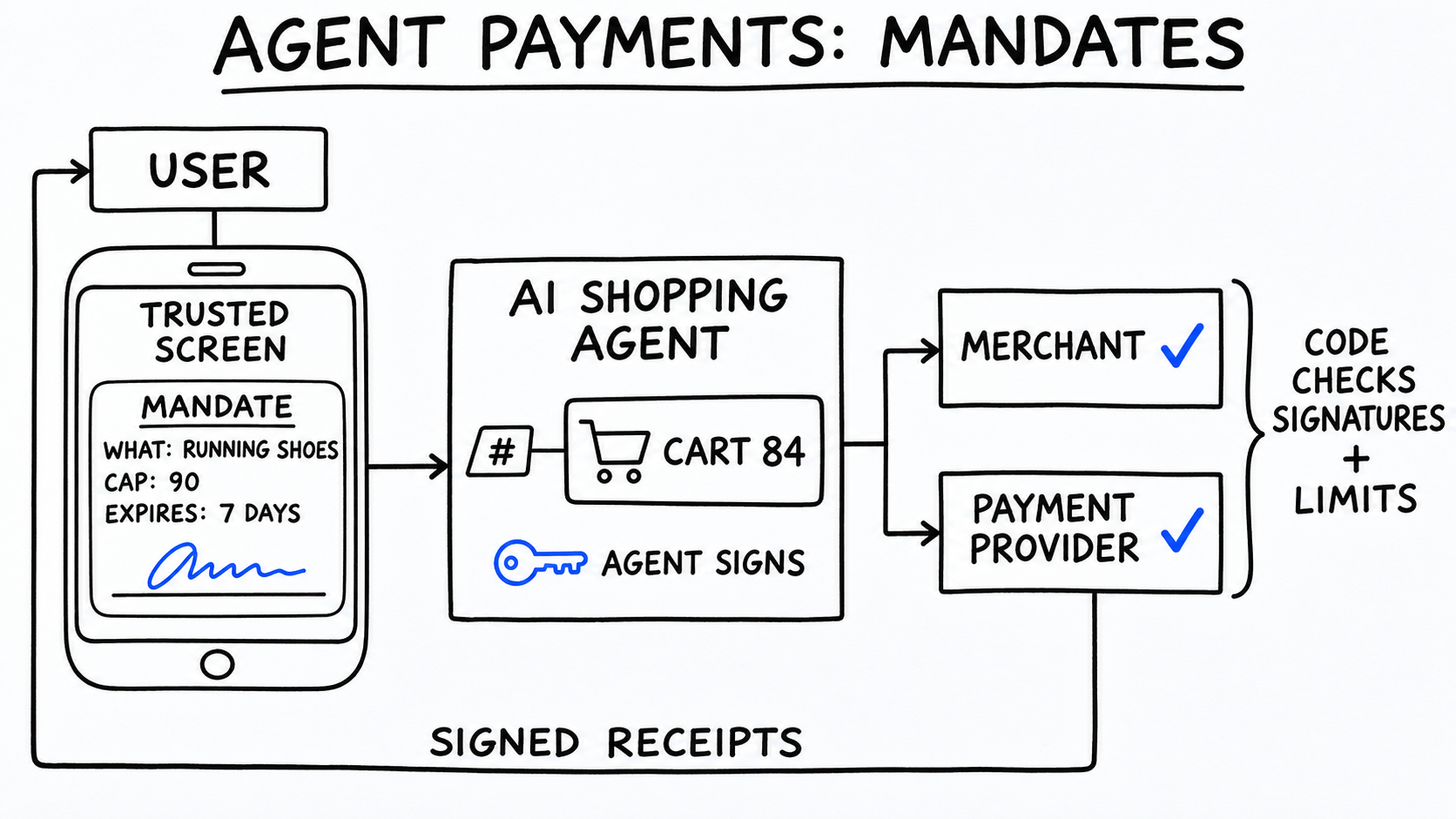
Hand-drawn diagram of agent payments: a user signs a mandate on a trusted screen, the shopping agent presents it with the cart, and the merchant and payment provider verify the signatures before money moves (opens the full-size diagram)
Full explainer ยท 4 min

What it is

A way to let an AI assistant buy things without handing it your card. Instead of trusting the agent to behave, you sign small digital permission slips called mandates: a checkout mandate saying what may be bought, and a payment mandate saying how it may be paid. Ordinary deterministic code at the shop and the payment company checks those signatures before any money moves.

How it works

A new standard, the Agent Payments Protocol (AP2), has you approve purchases on a trusted screen the AI cannot touch. If you are present, you sign the exact cart. If the agent shops alone, you pre-sign an open mandate with limits (what, how much, until when) and the agent signs the specific checkout with its own key. The shop and the payment provider check both signatures and the limits in plain deterministic code, each purchase is tied to its exact cart by a cryptographic hash, and signed receipts flow back at every step.

A concrete example

You tell an assistant to buy a specific pair of running shoes if the price drops under 90 euros this week. You approve that once on your phone, signing an open mandate capped at 90 euros that expires in seven days. On Thursday the agent finds them for 84 euros, assembles the checkout, signs it, and presents both signatures to the shoe shop and the payment provider. The shop's code verifies the cart matches the signed constraints before charging. If the agent instead tried a 300-euro smartwatch, the mandate would not cover it and the charge would be refused automatically.

Why it matters

Agents are starting to buy things for real: OpenAI is rolling out business agents inside ChatGPT, and eBay just blocked third-party shopping agents partly because nobody can yet prove what a bot was authorised to do. Spending authority that lives only in a prompt is a hope, not a control. Mandates turn it into something a merchant, a bank and a dispute process can verify, which is what will decide whether companies let agents spend money at work.

Your turn

Would you let an AI assistant spend your money?

No votes yet on yesterday's question: When a new AI model launches, when do you try it?

One question: Would you buy shares in an AI company? Reply to today's email to answer.