
Crabhaus

What matters in AI & agents, and what to do with it.

Sat 14 Nov Β· Issue 123 Β· 3 min read

Today in AI

ChatGPT agents can now buy things for you, and you approve every purchase with a fingerprint.

ChatGPT can now spend your money

  1. BusinessNvidia courts a rival chip boss
  2. ModelsGoogle's AI glasses open for pre-orders
  3. BreakthroughsAI decodes a great mathematician's notebooks

$1B

Number of the day

raised by Mirendil, a startup founded by ex-Anthropic researchers to speed up AI research itself The Wall Street Journal β†—

Today's news

Agents

OpenAI gives ChatGPT a wallet

ChatGPT Wallet lets OpenAI's shopping agents complete purchases for you. Add a card once; the agent pays with a one-time substitute number, and you approve each purchase with a face or fingerprint check. US Pro subscribers get it first, and card rewards and dispute protections still apply.

Why it matters to you

The biggest chatbot just moved from recommending products to paying for them. If you try it, read the items, total and card on every approval screen.
Also today

BusinessNvidia's board approaches Arm chief Rene Haas about the top job

Whoever runs Nvidia shapes prices and supply for nearly every AI product you use.

ModelsGoogle's Gemini smart glasses open for $395 pre-orders

A serious rival to Meta's glasses, on sale December 10, with bystanders' faces hidden by design.

BreakthroughsAI transcription opens Kurt Godel's shorthand notebooks to scholars

The same tools that draft your email can unlock century-old archives; experts still must verify.

β€œit is unlikely that he would have produced illuminating, conclusive new theorems by chance and without realizing it” (iltennico, reader on Hacker News)

Try this at work

Write your rules before an AI shops for you

Agents that can pay are arriving. Set your rules before the first purchase.

Help me write rules for letting an AI assistant shop for me: a per-purchase cap, a monthly cap, categories it must never buy, and what it must show me before I approve. Ask questions until the rules are complete, then list them.

Watch out: Chat rules are not enforced by any wallet; check which limits the product itself supports.

Explained like you're busy

Knowledge graphs: how AI connects related facts

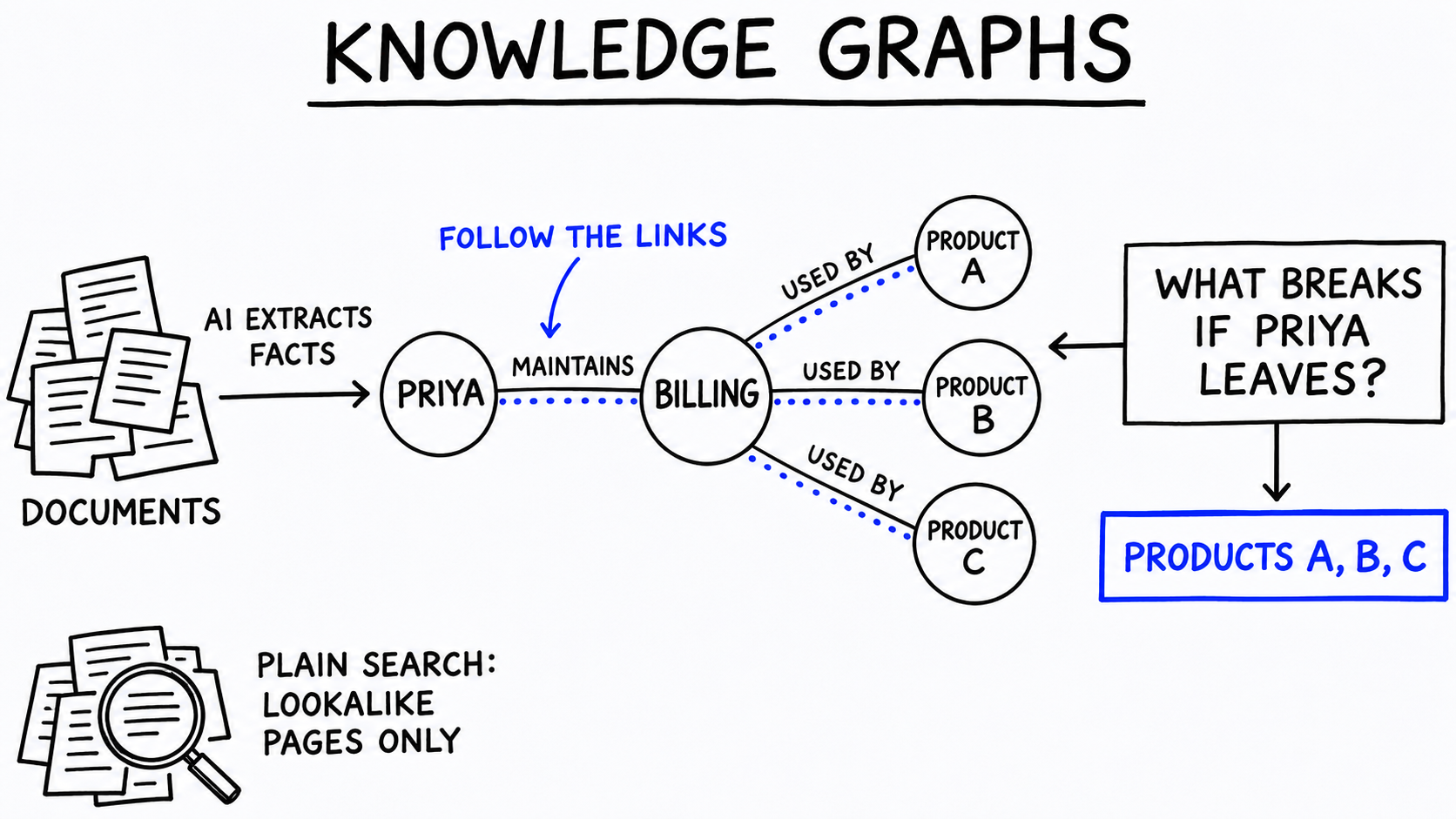
The mental model. A pile of documents versus a map. Ordinary AI search rummages the pile for lookalike pages. A knowledge graph is the map: people, projects and documents as dots, lines for who wrote what and what depends on what. Relationship questions are answered by following the lines.

Where you'll see it at work. Check whether your real questions are about connections: who owns this system, what breaks if we retire that tool, which clients touch this contract. If so, a graph-backed assistant can follow those links; if you mostly need the right paragraph found, plain search is cheaper and usually as good.

What people get wrong. That the graph is free accuracy. Building one means an AI pass over every document, and the map goes stale as facts change. Gains showed up on broad sense-making questions, not simple lookups, so pay the indexing cost only if relationship questions are what you ask.

Hand-drawn diagram titled Knowledge Graphs: a pile of documents with an arrow labelled AI extracts facts pointing to a network where Priya connects to Billing by a line labelled maintains, and Billing connects to Products A, B and C by lines labelled used by; a dotted cobalt path labelled follow the links traces the chain, answering the question of what breaks if Priya leaves with Products A, B, C. A small magnifying glass over a document pile is labelled plain search: lookalike pages only. (opens the full-size diagram)
Full explainer Β· 4 min

What it is

A knowledge graph stores information as things and the links between them: people, projects and documents become dots on a map, and relationships such as wrote, owns or depends on become the lines connecting them. For an AI assistant, that map is an alternative to the usual approach of searching for passages of text that merely look similar to your question. With a graph, the system can follow the lines from one fact to the next, which is what questions about relationships actually require.

How it works

Building the graph is itself an AI job: a model reads each document, pulls out the entities and how they relate, and the results merge into one map. Microsoft's open-source GraphRAG also groups tightly connected entities into clusters and summarises each cluster in advance. For a question about a specific thing, the system starts at that dot and gathers its neighbours plus the underlying text. For a question about the whole collection, it hands the model the cluster summaries and merges the partial answers. Plain retrieval cannot hop from a person to their project to its dependencies.

A concrete example

Picture a company wiki, an HR directory and a project tracker indexed into one assistant. Someone asks which projects would be hit if Priya left. Ordinary search returns pages that mention Priya, which is not an answer. A knowledge graph walks the lines: Priya maintains the billing service, the billing service is a dependency of three client products, so those three projects are exposed. The chain is the answer, and each hop exists as a stored link the assistant can cite.

Why it matters

Questions about connections are everyday work questions: who owns this system, what breaks if we retire that tool, which contracts touch this client. Assistants backed only by passage search routinely fumble them because the answer lives in no single passage. But the graph is not free: building it means an AI pass over the whole document set, and the map goes stale as facts change. Microsoft's research showed gains on broad sense-making questions, not simple lookups, so the cost is worth paying only when connection questions are what you actually ask.

Your turn

Would you wear AI glasses with a camera?

No votes yet on yesterday's question: Would you let an AI pick where you shop online?

One question: Would you let an AI agent buy things for you? Reply to today's email to answer.