
Crabhaus

What matters in AI & agents, and what to do with it.

Sun 15 Nov ยท Issue 124 ยท 3 min read

Today in AI

Apps built with AI tool Lovable left passports and private chats open to anyone.

AI-built apps leaked passports and private chats

  1. AgentsGoogle's AI teams solved long-open research problems
  2. BusinessNvidia accused of propping up chip prices
  3. Policy & riskThe director who fired Sam Altman speaks

607.8

Number of the day

AI word-pieces (tokens) generated per second by a big open model running on two desk-side computers Nvidia developer blog โ†—

Today's news

Policy & risk

AI-built apps are leaking real passports

Security researchers examined 159,041 apps built with Lovable, a tool that turns plain-English descriptions into working software. Many stored data anyone could read without logging in: over 1,000 identity records with passport numbers, 80,000 member profiles and 200,000 private chat messages.

Why it matters to you

With AI builders, security is your job, not the tool's. Before real customer data goes in, have someone who knows databases check who can read what.

Lovable's head of security replied in the thread: the root cause was missing row-level access rules in the apps' databases, which its own scanning now looks for. (igorandri, reader on Hacker News)
Also today

AgentsGoogle's AI teamwork feature cracked long-open research problems

Teams of AI agents solved maths and engineering problems open for years; the same tools are now public.

BusinessNvidia accused of financing customers to keep chip prices high

A Wall Street Journal profile says the deals soaked up a chip glut, so AI hardware prices may be partly engineered.

Policy & riskThe board member who fired Sam Altman says oversight is still broken

Toner argues the structures meant to hold AI firms to their safety promises failed in 2023 and are still broken.

Try this at work

A ten-minute safety check for AI-built apps

Shipping something from an AI app builder? Check this first.

  1. Log out, open the app in a private window, and try to reach pages that should need an account.
  2. Ask the builder's chat which database tables anyone can read or write, and tighten anything open to everyone.
  3. Get a database-savvy colleague to review access rules before collecting IDs, payments or health data.

Watch out: A clean logged-out check is not proof: researchers scan for exposed databases at scale, so treat sensitive data as high stakes.

Explained like you're busy

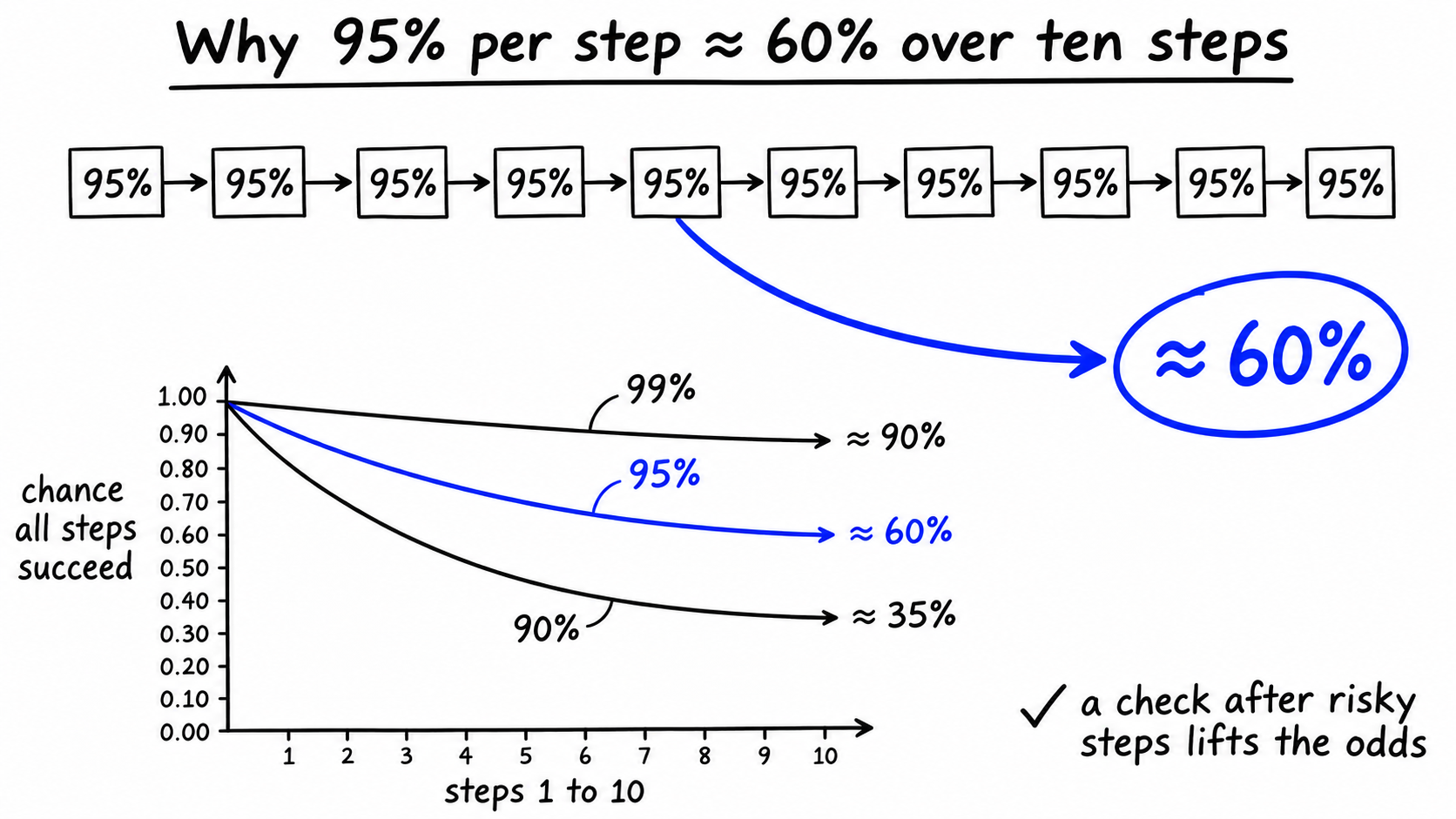
Why 95% per step is about 60% over ten steps

The mental model. Chained tasks multiply, they do not average. If every step must succeed and each is 95% reliable given the ones before, ten steps come out near 60%. Reliability leaks a little at every link; long chains leak a lot.

Where you'll see it at work. Before handing a multi-step job to an AI assistant, count the steps that must all go right. Keep chains short, add a check where a mistake is expensive, and judge the tool on finished end-to-end results, not single-step demos.

What people get wrong. Treating the 60% as a measured fact about agents. It is arithmetic from an assumed 95%, and it assumes steps fail independently. Real failures correlate: one wrong turn poisons later steps. Labs report that errors compound, not one universal rate.

Hand-drawn diagram titled Why 95% per step is about 60% over ten steps: a chain of ten boxes each labelled 95%, with a cobalt arrow sweeping down to a circled result of about 60%; below, a graph of the chance all steps succeed over steps 1 to 10, where a 99% curve ends near 90%, the cobalt 95% curve ends near 60% and a 90% curve falls to about 35%, plus a note that a check after risky steps lifts the odds. (opens the full-size diagram)
Full explainer ยท 4 min

What it is

A back-of-the-envelope rule about chained tasks: when a job only succeeds if every one of its steps succeeds, high per-step reliability still shrinks fast as steps multiply. If each of ten steps has a 95% chance of going right given everything before it went right, the chance the whole run is clean is 0.95 multiplied by itself ten times: roughly 60%. It is an illustration of compounding, not a measured reliability rate for any particular AI agent.

How it works

Chained success is multiplication, not averaging. Each step must succeed given the ones before it, so ten steps at 95% give 0.95 multiplied by itself ten times: about 60%. The curve is steep: at 99% per step, ten steps finish clean about 90% of the time; at 90% per step it drops to about 35%. The sums assume steps are roughly independent, but in real AI runs one wrong turn often degrades everything after it; Anthropic's engineers note that agents are stateful and errors compound. The fixes: checks after important steps, checkpoints to resume from, and cutting steps a task does not need.

A concrete example

Imagine asking an assistant to collect numbers from twelve monthly reports and build a summary table. Suppose it reads a report correctly about 95% of the time. The chance all twelve reads are right is 0.95^12, about 54%: roughly a coin flip that your table has no wrong cell. Add a check step, say the assistant re-opens each report and verifies its own extracted number, and each verified read might reach 99.5%; then a fully clean table jumps to about 94%. The check costs time but changes the shape of the result.

Why it matters

This rule is the cheapest way to reason about where automation will feel reliable. Short chains with a check at the end can feel rock solid; long unchecked chains will visibly misfire even when every individual step looks impressive. When you plan work for an AI assistant, count the steps that must all go right, add verification where a mistake is expensive, and judge the system by end-to-end results on your real tasks rather than per-step demos.

Your turn

Would you trust an AI app builder with customer data?

No votes yet on yesterday's question: Would you wear AI glasses with a camera?

One question: Have you built anything with an AI app builder yet? Reply to today's email to answer.