
Crabhaus

What matters in AI & agents, and what to do with it.

Mon 16 Nov Β· Issue 125 Β· 3 min read

Today in AI

A 100,000-signature petition wants Nvidia's ousted chief back in the top job.

Investors push to bring back Nvidia's ousted chief

  1. BusinessAnthropic's stock market debut is seven times oversubscribed
  2. ModelsAlibaba's new flagship AI model undercuts rivals' prices
  3. ModelsApple plans smart glasses powered by Siri AI

$90.4B

Number of the day

What Anthropic and some of its backers aim to raise around its stock market listing Bloomberg β†—

Today's news

Business

The campaign to bring Jensen Huang back to Nvidia

Jensen Huang resigned under board pressure; now allies have formed a 'war room' to lobby for his return, a petition has passed 100,000 signatures (Elon Musk among them), and investors holding $2.13B in Nvidia stock wrote to the board. The US Treasury Secretary wants an outside hire instead.

Why it matters to you

Nvidia makes the chips behind nearly every AI product, so who runs it shapes prices and supply across the industry. If your company buys AI tools, expect months of pricing uncertainty.
Also today

BusinessAnthropic's listing is reported to be about seven times oversubscribed, with up to $90.4B raised around it

The maker of Claude is the AI boom's flagship listing, and a bellwether for the AI in your pension.

ModelsAlibaba released flagship model Qwen4-Max, priced well below Western rivals for similar claimed coding skill

Capable models keep getting cheaper; if your team pays per use for AI, revisit costs every few months.

β€œIt scores a 43 on Artificial Analysis with an average cost of $3.27 ... For reference, GPT-6.1 Sol (medium) gets a 46 with an average of $0.36.” (maplet, reader on Hacker News)

ModelsApple plans smart glasses for 2027, unveiled at its June developer event, with Siri AI controlling iPhone apps

The next platform fight is glasses. Expect every big tech company to pitch AI eyewear within a year.

Try this at work

Get a straight answer from a messy email thread

Long thread, no visible decision? Make your AI assistant commit.

Here is an email thread. Summarise what was decided, what is still open, and who owes what by when. Quote the exact sentence behind each decision.

Watch out: If nothing was actually settled, the model may invent closure; the quoted sentences are your check.

Explained like you're busy

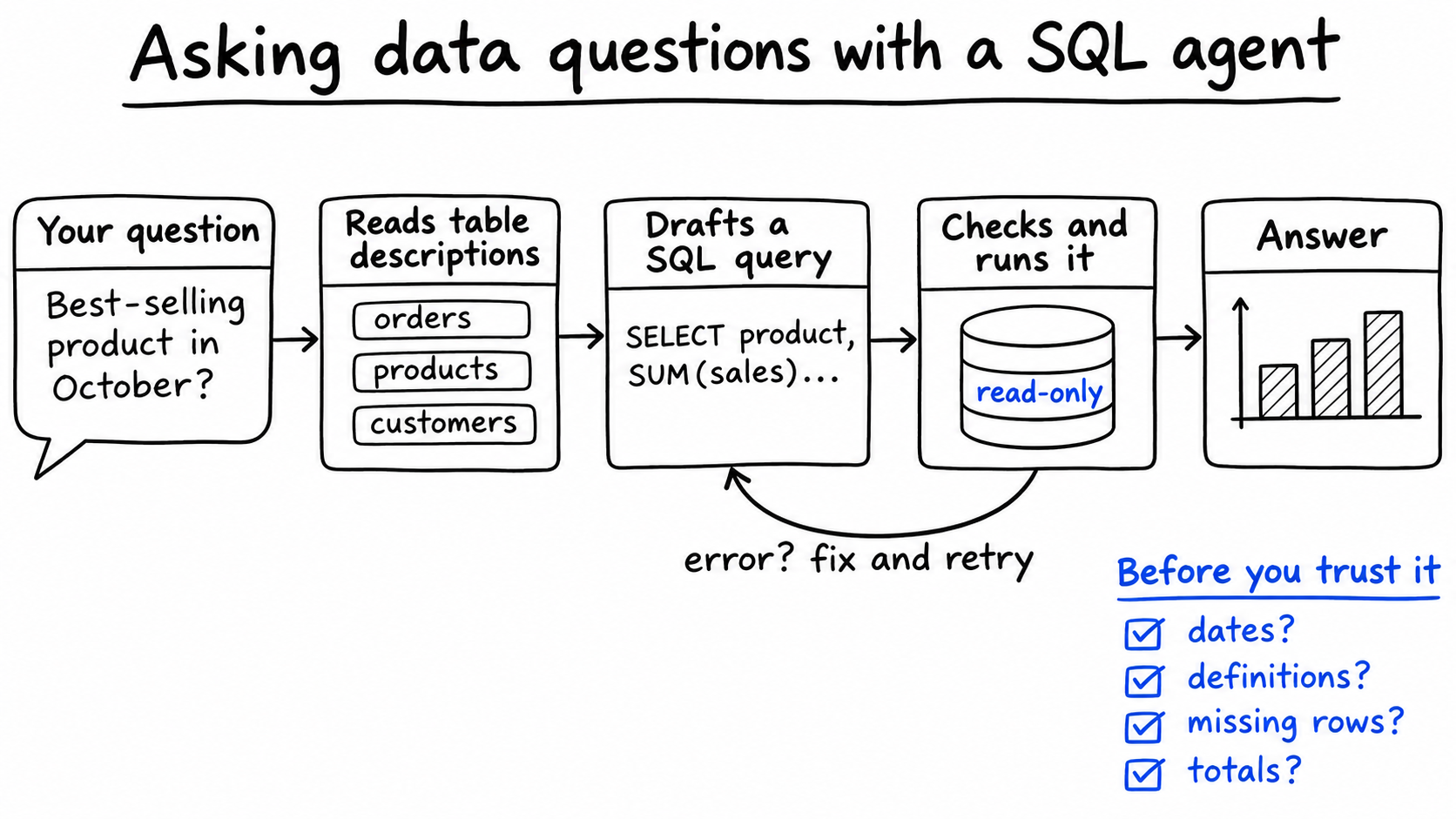
Asking business data questions with a SQL agent

The mental model. A very fast junior analyst with database access: it hears your question, writes the query, runs it and reports back. It takes your words literally, so everything turns on whether its reading of 'sales' or 'last quarter' matches yours.

Where you'll see it at work. Before a number goes into a decision, check the date range, the definition of each term, whether empty rows were dropped, and one total you already know. Insist the agent's database account is read-only, enforced by the database.

What people get wrong. A query that runs is not a right answer: top systems still trail human data engineers on BIRD (a public test of hard business questions), about 83% versus 93%, usually by answering a slightly different question than asked.

Hand-drawn diagram titled Asking data questions with a SQL agent: a question, 'Best-selling product in October?', flows through boxes for reading table descriptions, drafting a SQL query, checking and running it on a read-only database, and an answer bar chart, with a return arrow labelled 'error? fix and retry' and a cobalt checklist: dates? definitions? missing rows? totals? (opens the full-size diagram)
Full explainer Β· 3 min

What it is

A SQL agent is an AI assistant connected to a company database. You ask a question in plain English, such as 'Which region had the most refunds last quarter?'; it reads the database's table descriptions, writes a query in SQL (the standard language for pulling data out of tables), runs it, and answers with the result.

How it works

The agent first lists the available tables and their descriptions, picks the ones that look relevant, and drafts a query. Good setups add two safety loops: the model double-checks its own query for common mistakes before running it, and if the database returns an error, it revises and retries until a query succeeds. The answer you see is its summary of whatever that final query returned. Access should be read-only, enforced by the database account itself, never just by instructions in the prompt.

A concrete example

Ask 'What was our best-selling product in October?' and the agent finds the orders and products tables, joins them, sums the sales, and replies with a product name. But 'best-selling' could mean most units or most revenue: two different queries, two different winners. The agent silently picked one definition; a human analyst would have asked you which you meant.

Why it matters

Teams get data answers in seconds instead of waiting days on an analyst queue, which is why these assistants are spreading through business tools. The catch: a query that runs is not the same as an answer that is right. On BIRD, a hard benchmark of real business questions, top automated systems reach about 83% while human data engineers reach about 93%, so hard questions still go wrong regularly.

Your turn

Should Nvidia bring Jensen Huang back?

No votes yet on yesterday's question: Would you trust an AI app builder with customer data?

One question: Would you take your old boss back after a messy exit? Reply to today's email to answer.