
Crabhaus

What matters in AI & agents, and what to do with it.

Thu 19 Nov ยท Issue 128 ยท 3 min read

Today in AI

Google's new Neon model does frontier-level work at a fraction of the usual price.

Google's new AI model is cheaper and faster

  1. BusinessAnthropic shares start trading today
  2. In practiceAI agents out-questioned human auditors
  3. ModelsOpenAI's new models get rough reviews

$83

Number of the day

the price of one Anthropic share as it starts trading on Nasdaq today Anthropic โ†—

Today's news

Models

Google's new model does more work for less money

Gemini 4 Neon tops an independent coding-agent ranking, costs about a third less per task than its bigger sibling, and is live today in the Gemini app and developer tools.

Why it matters to you

Frontier-quality help keeps getting cheaper. If cost made you shelve an AI task, rerun one real piece of work on Neon this week and compare.
Also today

BusinessAnthropic, the company behind Claude, starts trading on Nasdaq today at $83 a share

Claude's maker now answers to public investors; expect faster pricing and product moves.

In practiceAccounting firm KPMG put over 100 AI agents on a real audit; they sometimes asked better questions than the humans

Try it at your desk: let an AI interrogate your report before a reviewer does.

A Hacker News commenter who rarely uses AI outside coding says it remembers tedious details like a steel trap, calling auditing a perfect use case. (Zigurd, reader on Hacker News)

ModelsOpenAI's new GPT-6.2 models landed to harsh reviews, with independent tests showing no real gain on coding

No need to rush an upgrade; the gains are in science and analysis, not coding.

Try this at work

Let the AI play auditor on your own work

KPMG's agents impressed by asking sharp questions. Aim that at your own document.

Here is my draft: [paste document]. As a sceptical auditor, list the five questions it leaves unanswered, ranked by how much each answer could change the decision.

Watch out: It may ask confident questions the document already answers; skim the list before acting.

Explained like you're busy

Delegating to agents: research versus action

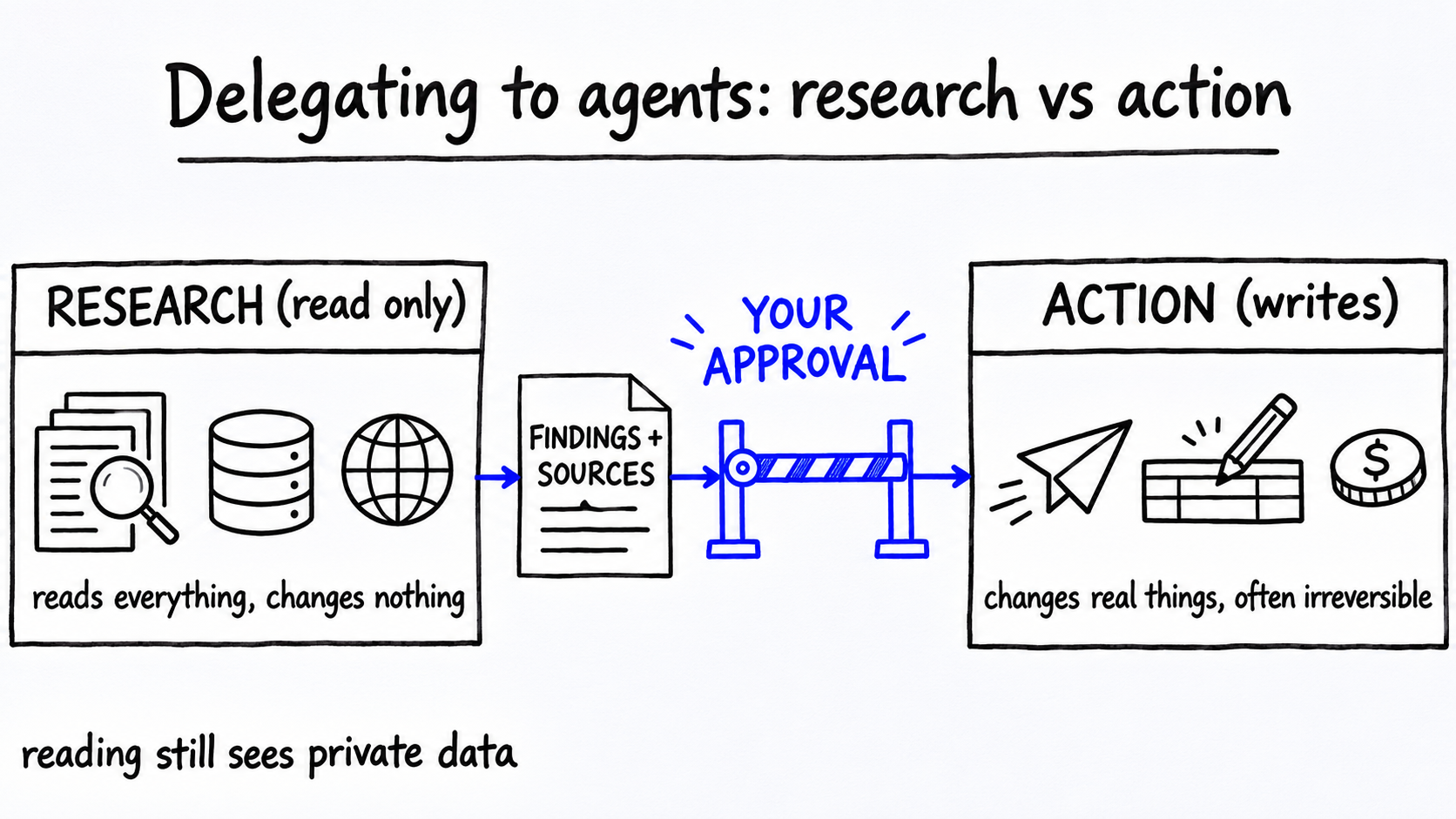
The mental model. Give an agent a library card before a company credit card. Reading can be checked and redone; sending, editing and spending often cannot. Split every delegation into a look stage and a touch stage, and keep your approval between them.

Where you'll see it at work. Pick a first task the agent can only read: gather, compare, summarise, draft. Ask for sources you can spot-check, and note what private material it could see on the way. Let it change records, message people or spend money only as a separate step you approve.

What people get wrong. That a read-only agent is harmless. It still sees whatever its access allows, so private files and bad sources are real risks. And a good research result is not permission to act: that is a separate decision, made by you, every time.

Hand-drawn diagram: a research stage marked read only, with a magnifying glass over documents, a database and a globe, produces a findings and sources sheet; a cobalt arrow passes through a barrier gate labeled your approval before reaching the action stage with icons for sending, editing and paying, captioned changes real things, often irreversible. (opens the full-size diagram)
Full explainer ยท 3 min

What it is

The split between asking an AI agent to find things out and letting it change things. Research tasks only read: search, compare, summarise, draft. Action tasks touch the world outside the chat: sending messages, editing records, spending money. Research can be checked and redone cheaply; actions can be irreversible, so they need your approval and a verifiable result before they run.

How it works

An agent works in a loop: it takes a goal, uses tools, checks results and decides its next step. Read tools (search, open files, query a database) leave everything unchanged, so a wrong step costs only time and bad work can be discarded. Write tools (send an email, update a record, make a payment) change things other people depend on, and one early mistake compounds through later steps. Anthropic's builder guidance reflects the split: check real results at each step, pause for human approval at checkpoints, and sandbox-test an agent before trusting it with consequential actions.

A concrete example

You want help clearing overdue invoices. The research half: let the agent read the ledger and the payments inbox, list which invoices are genuinely unpaid and which were paid but misfiled, and draft the reminder emails, with every claim pointing at the source row so you can spot-check a few. Only after you approve does the action half run, as its own smaller step: sending exactly the reminders you signed off. Skip the split and one misread row means a customer who already paid gets a payment-demand letter.

Why it matters

Most of the immediate value of agents at work is on the research side, where mistakes are recoverable, so you can start delegating today without signing up for irreversible errors. The split also tells you what to set up before the first action task: an approval step between finding and doing, and a result you can verify against a source you trust.

Your turn

Would you let an AI agent send emails for you?

No votes yet on yesterday's question: When a new AI model launches, what do you do?

One question: Which everyday task would you hand to an AI agent first? Reply to today's email to answer.