
Crabhaus

What matters in AI & agents, and what to do with it.

Fri 20 Nov ยท Issue 129 ยท 3 min read

Today in AI

The company behind Claude finished its first day of trading worth about $1.3 trillion.

Anthropic is now a $1.3 trillion public company

  1. BreakthroughsAI helped solve two black hole physics problems
  2. AgentsGoogle's AI can now operate your Mac
  3. In practiceAI school gun alert flagged a snack bag

46%

Number of the day

of OpenAI researchers' multi-hour tasks are now finished by AI agents alone, up from 23% in March OpenAI โ†—

Today's news

Business

Anthropic is now a $1.3 trillion public company

Claude's maker closed its first Nasdaq day up 17% at $97.17, the largest stock market debut on record. Its CEO says safety will set the pace, whatever the market wants.

Why it matters to you

Claude's maker now answers to shareholders who want growth. Judge each new price or product change on whether it helps your work, not on the launch-day noise.
Also today

BreakthroughsAnthropic says Claude solved two open problems in black hole physics and posted the proofs for checking

Real research help, but results count only after human experts check them.

A physicist on Hacker News cautions that physics has near-endless open problems, and few specialists may care about any single result. (turzmo, reader on Hacker News)

AgentsGoogle's Gemini on Mac can now operate your computer across files, apps and the web

Try it on one tedious desktop chore; watch what it may touch.

In practiceMaryland teens are suing school and police after an AI gun detector flagged a Doritos bag

Ask any AI detection vendor for its false alarm rate before you buy.

Try this at work

Delegate one chore, demand a receipt

OpenAI's agents now finish nearly half of researchers' long tasks alone. Use the same split on yours.

Here is a task I keep putting off: [describe it]. Split it into steps you can do and steps that need me. Do yours, and give me a one-minute way to verify each result.

Watch out: Keep any step that sends, pays or deletes on your side of the list.

Explained like you're busy

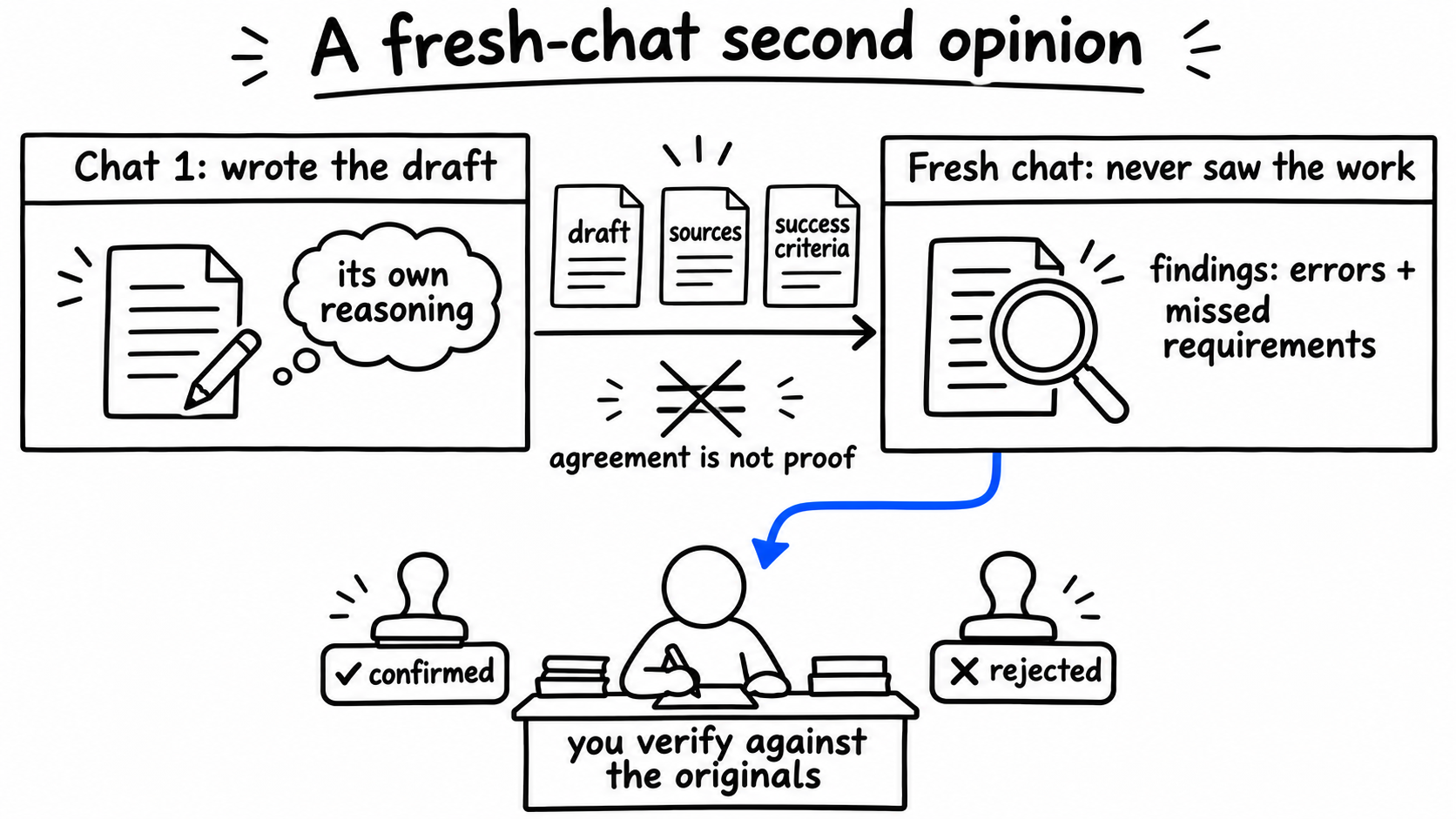
Steal this workflow: a fresh-chat second opinion

The recipe. A second opinion only counts if the doctor has not been following the case. A fresh chat reads your draft cold, with no memory of the reasoning that produced it.

When to use it. Paste the finished draft, its sources and the brief into a new chat. Ask only for errors that would change a decision and missed requirements. Verify each finding against the originals yourself.

What goes wrong. Two chats agreeing is not independent proof: they usually run the same model with the same blind spots. A reviewer asked to find problems always finds something, so act only on findings you have checked.

Hand-drawn diagram: a box labeled Chat 1 wrote the draft, with a thought bubble reading its own reasoning, passes three sheets labeled draft, sources and success criteria to a fresh chat that never saw the work, where a magnifying glass produces findings: errors plus missed requirements; a cobalt arrow leads to a person at a desk who verifies against the originals beside confirmed and rejected stamps, and a crossed-out equals sign notes agreement is not proof. (opens the full-size diagram)
Full explainer ยท 4 min

What it is

A quick quality check for anything an AI helped you produce. Before you ship a document, open a brand-new chat with no history, paste in the finished draft, the source material it was built from and what success looks like, then ask for consequential problems only. The new chat never saw the conversation that produced the draft, so it reads the work cold, the way a colleague would.

How it works

Three steps. First, collect the draft, the sources it relied on and your success criteria: the brief, the checklist or the requirements. Second, open a fresh chat and paste all three with one ask: find errors that would change a decision and requirements the draft does not meet, and ignore style. Third, verify each finding against the originals before changing anything, and reject the ones that do not hold up. Anthropic gives Claude Code the same treatment: changes are reviewed in a fresh session that never saw the working conversation, so the reviewer cannot be led by the author's reasoning.

A concrete example

You used AI to build a quarterly budget summary from a spreadsheet and a list of finance rules. In a new chat, paste the summary, the spreadsheet figures and the rules, and ask: which figures do not match the source, and which rules does this summary break? The reviewer flags that one total excludes a late invoice and that a required disclaimer is missing. You check both against the originals, confirm the first, find the disclaimer was actually present in a footnote, and fix only the real problem.

Why it matters

The chat that helped write a draft is the worst-placed reviewer of it: everything it got wrong sits in its own context as if it were true. A cold reader given the evidence and the success criteria catches the misread number and the skipped requirement in minutes, not meetings. OpenAI's evaluation guidance points the same direction: models judge work more reliably when checking against specific criteria than when generating freely, and automated checks still need a human to calibrate them. This workflow is that advice at desk scale, and the final judgment stays yours.

Your turn

Would you buy shares in an AI company right now?

No votes yet on yesterday's question: Would you let an AI agent send emails for you?

One question: Does an AI company being publicly traded change how much you trust its products? Reply to today's email to answer.