
Crabhaus

What matters in AI & agents, and what to do with it.

Sat 21 Nov · Issue 130 · 3 min read

Today in AI

An Anthropic mathematician says Claude helped him prove math's most famous unsolved problem.

AI may have cracked math's most famous problem

  1. BusinessStocks slumped as the AI sell-off deepened
  2. Policy & riskSignal blocks AI assistants from reading chats
  3. ModelsGoogle's homepage is turning into a chatbot

10 million

Number of the day

Chinese job ads analysed: AI-exposed roles saw double-digit declines versus less-exposed work Bloomberg ↗

Today's news

Breakthroughs

AI may have cracked math's most famous problem

Anthropic mathematician Levent Alpöge claims he used Claude to prove the Riemann hypothesis, unsolved for 167 years. The proof is posted in Lean, a language computers can check line by line, and experts are verifying it now.

Why it matters to you

Nothing is settled until mathematicians finish checking, and grand claims have collapsed before. If this holds, AI moves from helping with drafts to settling century-old questions.

“These proofs really are quite huge. The proof is 1.3GB, ~15M lines of code” (djoldman, reader on Hacker News)
Also today

BusinessThe Nasdaq erased its 2026 gains as the AI sell-off deepened; Anthropic fell 8.5% on its second trading day

If your savings sit in tech-heavy funds, this week moved them. Check how much AI exposure you hold.

Policy & riskSignal will restrict screenshots by default so phone AI assistants cannot read your private chats

An assistant that can see your screen can see your messages. Review what screen access you have granted.

ModelsGoogle's new desktop homepage adds an AI sidebar with your chat history and drops the search button

Your default search is quietly becoming a chatbot. Keep checking where answers come from.

Try this at work

Make a long thread cough up its decisions

For any thread you have been dreading to reread.

Here is a long thread. List what was decided, what is still open, and who owes what by when. For every decision, quote the exact sentence it comes from.

Watch out: Check each quote against the thread before acting; names and dates are where it slips.

Explained like you're busy

How AI reads PDFs, tables and scanned pages

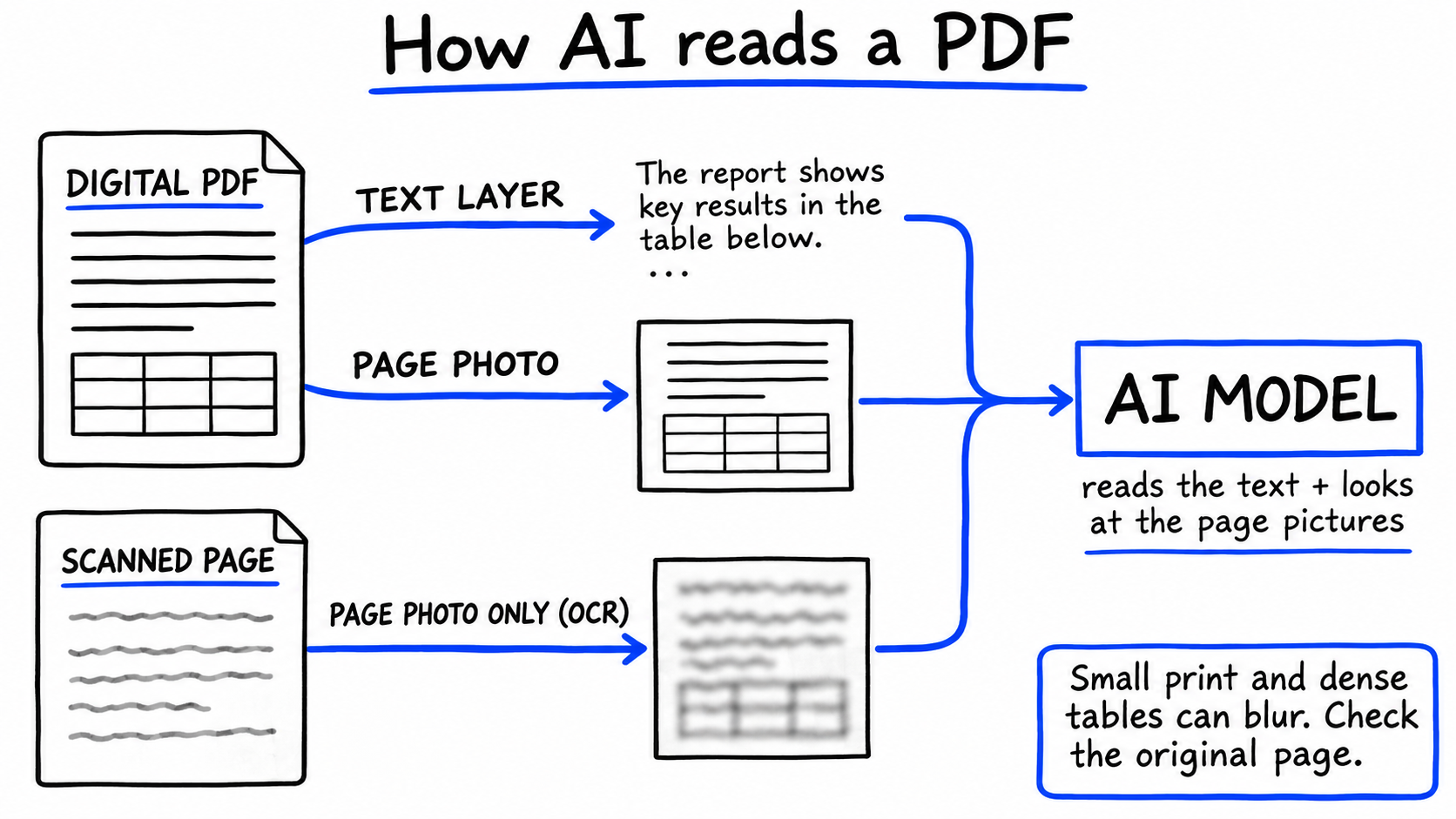
The mental model. A PDF reaches the model twice: as extracted text and as a photo of each page. A clean digital file gives reliable text; a scan gives only the photo. The assistant reads what survived that conversion.

Where you'll see it at work. Before trusting a number from a PDF, ask the assistant to quote the exact line and page it came from, then look at that page yourself. Scans, small print and wide tables are where quiet misreads happen.

What people get wrong. A confident summary is not proof the whole file was readable. Dense or scanned pages can be partly illegible to the model, and it rarely announces which parts it skipped or squinted at.

Hand-drawn diagram titled How AI reads a PDF: a digital PDF splits into two cobalt arrows, a text layer of clean extracted sentences and a page photo thumbnail, while a scanned page sends only a blurry page photo labelled OCR; every path converges on a box labelled AI model that reads the text and looks at the page pictures, beside a callout warning that small print and dense tables can blur, so check the original page. (opens the full-size diagram)
Full explainer · 3 min

What it is

What actually happens when you hand an AI assistant a PDF. The assistant does not open the file the way you do: the platform first converts the document into things a model can read, extracted text plus a picture of each page, and the model works from those. How well that conversion goes decides how well your document gets read.

How it works

When you attach a PDF, the platform pulls out any machine-readable text and also takes a snapshot of each page as an image; the model reads both, which is how it can see charts and layout. Anthropic and Google both document this text-plus-image pipeline. A file exported from Word carries clean text. A scan carries none, so the model reads the picture alone using optical character recognition, which falls off with small print, faint ink and crooked pages. Page snapshots are capped in resolution, so dense pages get squeezed: text can arrive out of order, and the photo may blur small table cells.

A concrete example

You ask an assistant for the penalty clause in a 40-page supplier agreement. Pages 1 to 35 were exported digitally and read perfectly. The penalty schedule, though, is a scanned appendix with a small-print table, so there the assistant is reading a squeezed photo. It answers confidently either way. Asking it to quote the exact penalty line and page, then opening that page yourself, takes twenty seconds and checks the one number that matters.

Why it matters

Work decisions ride on numbers that live in exactly the hard cases: scanned invoices, dense financial tables, small-print schedules. An assistant that misread one cell will still produce a fluent, confident summary, and it will rarely tell you which pages it could barely see. Knowing the mechanism turns vague distrust into one cheap habit: for any number or clause that changes a decision, look at the original page before you accept it.

Your turn

Would you trust a math proof only a computer has fully read?

No votes yet on yesterday's question: Would you buy shares in an AI company right now?

One question: Would you trust a proof that no human has read end to end? Reply to today's email to answer.