
Crabhaus

What matters in AI & agents, and what to do with it.

Sun 22 Nov · Issue 131 · 3 min read

Today in AI

A 17-million-line proof of the Riemann Hypothesis passed independent machine checks in a day.

A famous maths proof passed its computer check

  1. Policy & riskAI middlemen caught mishandling customer data
  2. ModelsA huge AI model now fits on phones
  3. ModelsNew AI models fail simple trick questions

125

Number of the day

endpoints OpenRouter removed from its zero-data-retention list after a data-handling investigation OpenRouter ↗

Today's news

Breakthroughs

The Riemann Hypothesis proof passed its machine check

Anthropic mathematician Levent Alpöge released his Claude-assisted Riemann Hypothesis proof on Thursday: 17 million lines of machine-checkable code. Within a day, the Lean community compiled it, checked it against the official statement and certified it correct.

Why it matters to you

A result that would once have waited years for referees was machine-checked in a day. The same lesson applies to AI answers: trust comes from independent verification, not a confident tone.
Also today

Policy & riskOpenRouter cut three AI providers and pulled 125 endpoints off its 'no data kept' list after researchers caught leaks

A provider's privacy promise is only as good as its subcontractors; ask where your prompts actually land.

🛠 ModelsA free compiler shrinks a 19 GB open model to 5.4 GB, small enough for recent iPhones

Private, offline AI on hardware you already own is getting practical.

ModelsOpenAI's new models score below Claude and ordinary humans on SimpleBench, a trick-question test

Leaderboards disagree; judge a model on your own tasks before switching.

“they are marked improvements over the previous releases... The only benchmark that matters is how well any model works for your current use-case.” (0xbadc0de5, reader on Hacker News)

Try this at work

Make it admit what it doesn't know

For questions where a wrong answer costs you something.

Answer only what you can support. Mark each part [known] or [unsure]. For any [unsure] name, number or date, say 'I don't know' and tell me what you would need to check.

Watch out: These labels are self-reported, not measured; still verify anything you will act on.

Explained like you're busy

Confidence calibration and abstention: when an AI should say ‘I don’t know’

The mental model. Confidence only means something after it is scored against reality. A weather service saying 70% rain earns trust because its 70% days were counted and checked. Most assistants never get that checkup, so a sure tone is style, not a track record.

Where you'll see it at work. Let the assistant answer low-stakes questions freely. For dates, figures, names and legal wording, tell it to say ‘I don’t know’ when unsure, then verify the answers that matter.

What people get wrong. A chatbot’s ‘95% confident’ is not a measured probability, just text that imitates one. A calm, precise answer and a wild guess can arrive in the same voice.

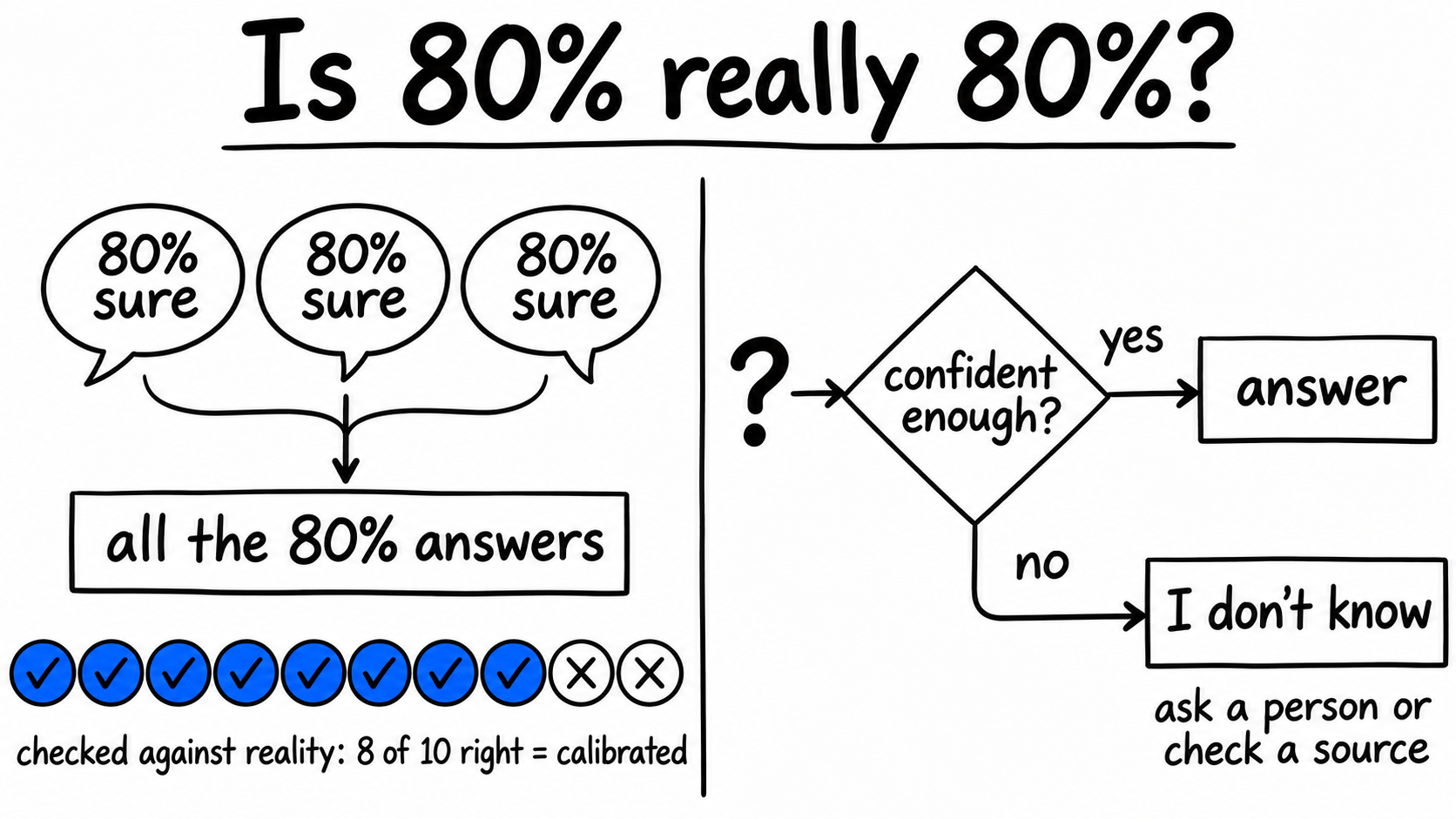
Hand-drawn diagram titled 'Is 80% really 80%?': three speech bubbles saying 80% sure feed a box labelled all the 80% answers, with ten circles below, eight ticked in cobalt and two crossed, captioned checked against reality: 8 of 10 right = calibrated; beside it a flowchart where a question enters a diamond asking confident enough?, yes leads to answer, no leads to I don't know with the note ask a person or check a source. (opens the full-size diagram)
Full explainer · 3 min

What it is

Calibration is the match between how confident a system claims to be and how often it is actually right. A calibrated 80% means that across many answers given with that score, roughly eight in ten turn out correct. Abstention is the partner skill: declining to answer, saying ‘I don’t know’, whenever the honest confidence is too low to be worth acting on.

How it works

Calibration is measured against outcomes: group answers by stated confidence, then check each group. Of everything marked 90%, how many were right? Classical classifiers get this checkup routinely, and scores that run hot get re-mapped. Chat assistants mostly do not, and their training pushes the other way: most leaderboards grade pure accuracy, so a blank answer scores zero while a lucky guess scores full marks. OpenAI's hallucination research proposes three buckets instead, counting right answers, wrong answers and abstentions, with a confident error scored as worse than an honest pass.

A concrete example

OpenAI published a telling comparison of two of its own models on the same factual quiz. One answered nearly everything: 24% right, 75% wrong. The other declined to answer half the questions: 22% right, only 26% wrong. Ranked on accuracy alone, the reckless model looks better. The same illusion exists at work: a colleague who guesses every figure from memory seems faster than one who says ‘let me check’, right up until the errors surface in a contract or a report.

Why it matters

An assistant’s confident tone is produced the same way whether it knows the answer or not, and almost no chat model has had its stated certainty tested against outcomes. So split your questions by stakes. Let the AI answer freely where a mistake is cheap, and for dates, figures, names, legal or medical wording, either verify independently or ask a person. You get most of the speed while keeping the errors out of the decisions that count.

Your turn

What should an AI assistant do when it is not sure?

No votes yet on yesterday's question: Would you trust a math proof only a computer has fully read?

One question: Has an AI ever given you a confident answer that was wrong? Reply to today's email to answer.