
Crabhaus

What matters in AI & agents, and what to do with it.

Mon 23 Nov Β· Issue 132 Β· 3 min read

Today in AI

OpenAI just published the score it uses to track how fast its models get smarter.

OpenAI reveals how fast its AI improves

  1. BreakthroughsAnother famous maths problem falls to AI
  2. BusinessAmazon is close to a big AI purchase
  3. In practicePeople are using AI to fix annoying TVs

$7.5B

Number of the day

what Amazon is reported to be close to paying for AI startup Decart Financial Times β†—

Today's news

Policy & risk

OpenAI opens its progress scorecard and asks for speed limits

OpenAI's chief scientist published the internal score the lab uses to track raw progress: how well its models predict the next word of text. Recent maths breakthroughs arrived once that score crossed a threshold, more could come by 2027, and the post asks rival labs not to train past shared limits until monitoring catches up.

Why it matters to you

The lab says progress can lurch, not glide, and wants agreed brakes. Expect your AI tools to jump in ability with little notice, and treat self-regulation pledges as something to watch, not count on.

β€œThis trend is pretty shocking to me... it's wild that the trend is so clear.” (jrflo, reader on Hacker News)
Also today

BreakthroughsAn AI-aided proof pins down how fluid equations break, patching a hole in OpenAI's earlier solution

Proof-checking, not proof-writing, is fast becoming the human job in maths.

BusinessAmazon is reportedly close to a $7.5B deal for AI startup Decart, possibly next week

The AI buying spree is still on; tools you rely on may change owners.

In practicePeople are pointing AI coding tools at Android TVs to strip ads and rebuild clunky menus

Fixing software you hate no longer needs a programmer; practice on a low-stakes gadget.

Try this at work

Re-run an old AI failure

Ability arrives in jumps (today's lead); a task AI fumbled months ago may be easy now.

Here is a task an AI assistant got wrong for me this year: [paste task and bad answer]. Try it again. Then say what you did differently and which parts I should double-check.

Watch out: A newer model can fail the same task more convincingly; re-check what was wrong last time.

Explained like you're busy

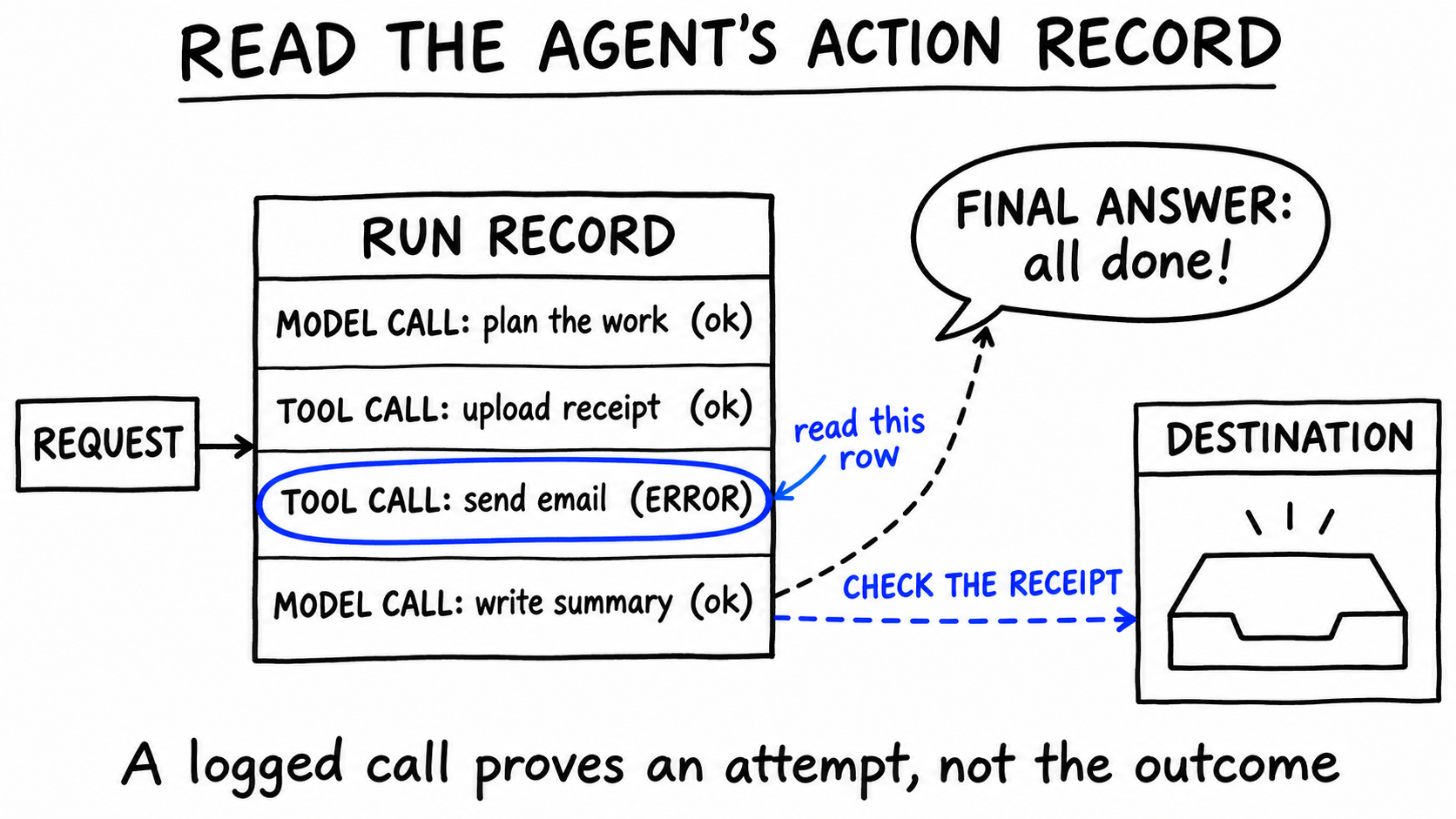
Read an agent's action record, not just its final answer

The mental model. An agent is like a courier: the tracking page lists every scan, but 'delivered' still means checking the doorstep. Trust the action record over the summary, and the destination over both.

Where you'll see it at work. Before accepting 'done' on anything that matters, open the run's record, find the step that did the action and check it succeeded. Then confirm the receipt where the work landed: outbox, ticket, calendar.

What people get wrong. The record is not the agent's thoughts, and it is not proof of results. A successful call proves an attempt, not the outcome, and steps nobody instrumented never appear.

Hand-drawn diagram titled 'Read the agent's action record': a request flows into a run record listing model and tool calls, where a send-email step marked ERROR is circled in blue while the final answer bubble still says all done; a dashed blue arrow points to the destination inbox with the note 'check the receipt'. Caption: a logged call proves an attempt, not the outcome. (opens the full-size diagram)
Full explainer Β· 3 min

What it is

An agent's action record, often called a trace, is the run-by-run log an agent system keeps of what it actually did: every model call, every tool it invoked, handoffs to other agents, approvals it requested and what each step returned. It is separate from the friendly summary the agent gives you at the end, and it is the evidence to check when that summary claims work was done.

How it works

Each run is wrapped in a trace made of timed steps. The framework records a step when the model generates text, calls a tool, hands off to another agent or trips a guardrail, storing what went in and what came back. A dashboard replays the sequence so you can walk from the request to the final answer. The record only contains what was instrumented: a business step such as a manager sign-off or a payment receipt appears only if someone wired it in, and the destination system keeps its own separate truth.

A concrete example

An expense agent reports 'receipt filed and the finance team notified'. Its record shows a successful upload call, then a notification step that returned an error the model glossed over. The filing is real; the notification never happened. Two minutes with the record, plus a glance at the outbox, catches what the confident summary missed.

Why it matters

Agents are moving from drafting text to taking actions: sending messages, updating tickets, moving money. The final answer is written by the same model that made the mistakes, so it is the least reliable witness. Teams that read action records catch silent failures, can answer 'who approved this?' later, and learn which steps need receipts. The records also carry sensitive prompts and outputs, so decide who can see them; organizations on strict no-data-retention API terms cannot use a vendor's hosted trace dashboard at all.

Your turn

Should AI labs agree on shared speed limits?

Yesterday: 1 of 1 reader picked β€œSay 'I don't know'” (Q: What should an AI assistant do when it is not sure?)

One question: Would you trust AI labs to police their own speed limits? Reply to today's email to answer.