
Crabhaus

What matters in AI & agents, and what to do with it.

Tue 24 Nov ยท Issue 133 ยท 3 min read

Today in AI

Jensen Huang has his old job back at Nvidia, with a White House push behind him.

Nvidia brings back CEO Jensen Huang

  1. AgentsClaude can now review and approve code changes
  2. ModelsGoogle's cheaper Gemini model does most jobs faster
  3. Policy & riskTwo states sue SpaceX over explicit AI images

$30B

Number of the day

Sierra's new valuation, double what the AI support startup was worth in May Bloomberg โ†—

Today's news

Business

Nvidia's board brings Jensen Huang back as CEO after a White House push

Less than two weeks after Huang resigned over an affair scandal, Nvidia's board unanimously brought him back, citing US government assurances. Trump said he made the deal; the stock closed up 31%, and Huang faces the Senate on December 3.

Why it matters to you

Nvidia's chips sit under nearly every AI product you use, so who runs it shapes prices and supply. The bigger signal: Washington now openly steers the companies your AI tools depend on.

Talking to Nvidia people, this commenter expects the board to escape personal liability, given the DOJ is not prosecuting and Delaware precedent sets a high bar. (icyfox, reader on Hacker News)
Also today

๐Ÿ›  AgentsClaude Ship lets Claude review, fix and approve pull requests (proposed code changes) under your team's rules

AI code review just became a product; start in observe mode and keep risky changes human.

ModelsGoogle's Gemini 4 Neon undercuts its flagship and, Google says, finishes most tasks about three times faster

Worth trying for routine tasks before paying flagship rates; testers put it just behind the top models.

Policy & riskOregon and Virginia sued SpaceX over Grok's 'spicy mode', citing over 1.8 million sexualized images

If your company ships or embeds image generation, safety guardrails are now a legal question.

Try this at work

Try the cheaper model first

A hands-on test this week found the priciest model and a cheaper rival nearly tied, with one bill five times higher.

  1. Pick one routine task you give AI, like a summary or first draft.
  2. Run it on your tool's cheaper model setting and on your usual one.
  3. If you can't tell the outputs apart, switch your default for that task.

Watch out: For contracts, customer-facing numbers or code that moves money, accuracy beats price; double-check anyway.

Explained like you're busy

Content Credentials: a history label, not a truth badge

The mental model. A Content Credential is a signed tracking slip that travels with a file. It can prove where the file started and that nobody altered the slip, not whether the photo shows something real.

Where you'll see it at work. Before acting on a consequential image, check it at contentcredentials.org/verify. A valid record shows origin and edit history; no record means unknown, not fake. Turn the labels on where your tools support them.

What people get wrong. These labels are not truth badges. A staged photo can carry a flawless credential, and stripping the label is trivial, so most real files have none. Verify the signer, then judge the content.

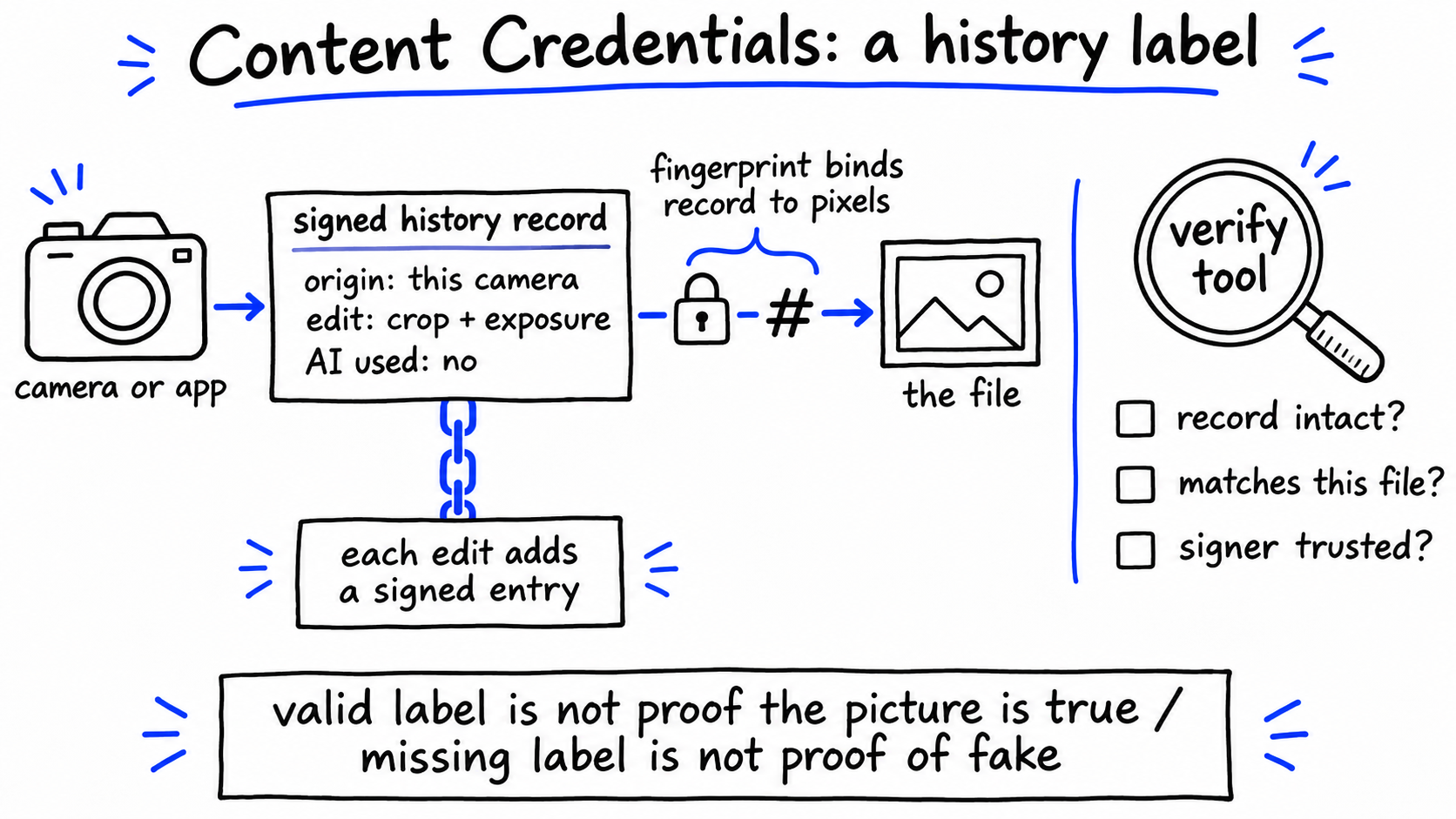
Hand-drawn diagram titled 'Content Credentials: a history label': a camera or app creates a signed history record (origin, edits, AI used), a padlock and hash fingerprint bind the record to the file, each edit adds a signed entry, and a verify tool checks record intact, matches this file, signer trusted; a note reads valid label is not proof the picture is true, missing label is not proof of fake. (opens the full-size diagram)
Full explainer ยท 3 min

What it is

Content Credentials are a signed record that can travel with a photo, video or document, listing where it came from and what was done to it: which camera or app made it, what edits followed, and whether AI was involved. The record comes from an open industry standard called C2PA, backed by camera makers, Adobe, Google and OpenAI. It certifies who signed the file's history and that nothing in the record was tampered with. It deliberately says nothing about whether the content itself is true.

How it works

A supporting camera or app creates a manifest: a small record with statements such as 'captured on this device' or 'colours adjusted in this editor'. The manifest is cryptographically signed and tied to the exact pixels with a fingerprint (a hash), so any later change to the file or the record shows up as a mismatch. Each further edit can add its own signed entry, building a chain. A checking tool verifies the record is intact, matches this exact file, and comes from a signer on a recognised trust list. Stripping the metadata simply removes the label.

A concrete example

A photo desk receives a dramatic storm picture. A credential check shows it was signed by a news agency camera, then cropped and exposure-adjusted, with no AI steps and no tampering, so the editor can trace its path before publishing. The same tool run on a viral 'leaked memo' screenshot finds no credentials at all. That proves nothing by itself: most genuine files carry none, so the editor falls back on ordinary verification.

Why it matters

AI images, voices and documents are now cheap and convincing, and these labels are already appearing: some cameras and editing tools attach them, and some platforms display them. Knowing what the label actually certifies (origin and edit history, from a named signer) protects you from two opposite mistakes: trusting a staged story because its file carries a valid credential, and dismissing a real photo because someone stripped its metadata.

Your turn

Would you let an AI approve your team's code changes?

No votes yet on yesterday's question: Should AI labs agree on shared speed limits?

One question: Have you ever spotted an AI-made image in the wild? Reply to today's email to answer.