
Crabhaus

What matters in AI & agents, and what to do with it.

Wed 25 Nov Β· Issue 134 Β· 3 min read

Today in AI

The people building the newest AI models now say some are too unsafe to release.

AI lab staff call their newest models unsafe

  1. BusinessNvidia's returning boss apologises as the fallout spreads
  2. BreakthroughsAI research settles a famous maths speed question
  3. Policy & riskHackers used AI to break in almost unaided

43%

Number of the day

share of music sent to Tidal in the past 90 days that was fully AI-generated The Hollywood Reporter β†—

Today's news

Policy & risk

Anthropic and OpenAI staff fear their best unreleased models are too unsafe to release

More than two dozen insiders told Axios that internal models at both labs are far more powerful than anything public, and many staff doubt the next ones can be released safely. Debate inside the labs has shifted to restricted releases.

Why it matters to you

For once the warning comes from inside the labs, not from critics. If your plans assume ever-better AI tools on schedule, allow for releases that slow down or arrive locked down.
Also today

BusinessJensen Huang apologised at an Nvidia all-hands and says he is in therapy; investors lobbied Trump for his return

AI chip supply now runs partly on politics; expect surprises in prices and availability.

BreakthroughsAn OpenAI research paper pins down exactly how fast matrices can be multiplied, a question open since 1969

Matrix maths sits under AI and graphics; if the proof holds, textbooks change.

On Hacker News, zone411 notes this is one of four new OpenAI papers resolving eight problems from a top-500 open maths list. (zone411, reader on Hacker News)

Policy & riskAmazon says attackers used AI agents to find and exploit an unknown software flaw with barely any human help

Attacks now move at machine speed; ask your security team how fast you could patch.

Try this at work

Turn a messy thread into a commitments list

For the email or chat thread everyone claims to have read.

List each person's commitments with dates, then what is still unresolved, as two bullet lists. Flag anything ambiguous instead of guessing. [paste thread]

Watch out: Check the list against the thread before you forward it; AI merges similar names and dates.

Explained like you're busy

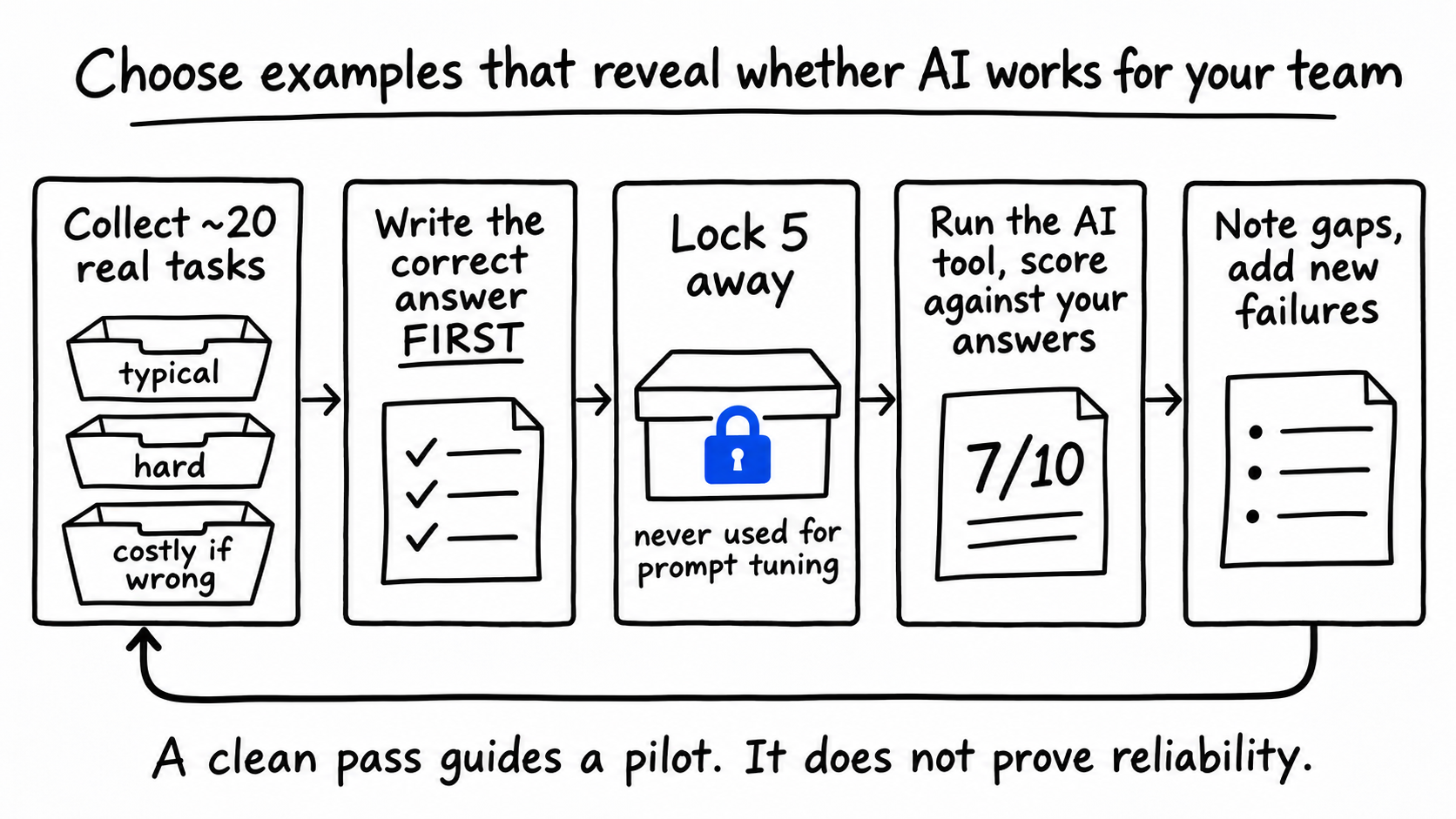
Choose examples that reveal whether AI works for your team

The recipe. A driving test for an AI tool: a short, fixed route through your real work, with typical stretches, hard corners, and the mistakes that would hurt most, judged against answers you wrote down in advance.

When to use it. Collect about twenty real examples of one task, write the correct answer for each before running the tool, and keep five aside that you never tune prompts on. Retest the same set whenever the tool or your prompt changes.

What goes wrong. A clean pass is not proof of reliability. Twenty examples guide a pilot; they cannot cover everything, and examples you tuned prompts on no longer count as a fair test. Keep adding real failures as you find them.

Hand-drawn five-step diagram titled 'Choose examples that reveal whether AI works for your team': collect about 20 real tasks in trays labelled typical, hard and costly if wrong; write the correct answer first as a checklist; lock 5 away in a padlocked box never used for prompt tuning; run the AI tool and score 7/10 against your answers; note gaps and add new failures, with an arrow looping back to the start. Caption: a clean pass guides a pilot, it does not prove reliability. (opens the full-size diagram)
Full explainer Β· 4 min

What it is

A small, deliberate collection of real tasks your team would actually hand to an AI tool, each paired with an answer a knowledgeable colleague can check. It mixes three kinds of example: the everyday cases that make up most of the work, the genuinely hard cases, and the cases where a wrong answer would be costly. Vendors call these evaluation sets; for a team, it is simply the test you run before you trust a tool, and again whenever the tool or your prompts change.

How it works

Collect ten to thirty real examples from recent work, with any private details removed. For each one, write down what a good answer looks like before you run anything, so the tool cannot charm you into grading generously. Label each example as typical, hard, or costly if wrong. Keep a handful aside and never use them while you tune prompts or settings; examples you optimised against stop being a fair test. Score runs against your written answers, note where the set has gaps, and add new failures from live use as they appear.

A concrete example

A support team wants AI to draft replies. They pull twenty real tickets: twelve routine ones, five tricky ones such as a customer quoting an outdated policy, and three where a bad reply costs money, like a refund dispute. A senior agent writes the key points a correct reply must contain. They tune their prompt on fifteen tickets and keep five locked away. The tuned prompt scores well on the fifteen, then misses two of the five held-back tickets, both refund disputes, so refunds stay with humans for now.

Why it matters

Most teams judge AI tools on a demo and a week of vibes, which overweights polish and underweights the rare, expensive mistake. A written example set turns the argument about whether the tool works into a short, repeatable check, makes regressions visible when a vendor quietly changes a model, and tells you precisely which slice of the work is safe to hand over. Both OpenAI's and Anthropic's own guidance for builders centres on exactly this practice.

Your turn

If an AI lab decides a model is too risky to release, what should happen next?

Yesterday: 1 of 1 reader picked β€œNo, approvals stay human” (Q: Would you let an AI approve your team's code changes?)

One question: Would you trust an AI lab to tell you when its own model is unsafe? Reply to today's email to answer.