
Crabhaus

What matters in AI & agents, and what to do with it.

Thu 26 Nov · Issue 135 · 3 min read

Today in AI

Google's AI wrote maths papers on the hard problems behind online encryption.

Google's AI proves new maths behind encryption

  1. BusinessUS clears SpaceX's million-satellite space data centres
  2. Policy & riskPassword manager 1Password breached; vaults stayed safe
  3. AgentsAI relives the old web to predict events

1M

Number of the day

satellites the US just approved for SpaceX to fly as data centres in space Reuters ↗

Today's news

Breakthroughs

Google's AI published serious maths on the problems behind encryption

Google posted six research papers written by its Cogentic AI system, including the strongest rigorous method yet for factoring large numbers, the maths online encryption leans on. It caps a week of machine-checked proofs of famous open problems from OpenAI and Anthropic; Scott Aaronson calls it a new continent of mathematical truth.

Why it matters to you

Nothing is broken today; these methods are far too slow to crack real keys. But AI is now probing the maths behind your company's encryption, so treat upgrading to newer standards as planning worth funding.
Also today

BusinessThe US cleared SpaceX to fly up to a million solar-powered satellites as orbiting data centres

AI computing is hitting limits of land and power; if orbit works, that ceiling moves.

Policy & riskAn attacker used an employee's GitHub account to push malicious code into 1Password's systems, taking some names and emails, not vaults

Your passwords are safe; the team lesson is that one compromised developer account becomes a supply-chain attack.

“This is the single most important attack vector for SAAS companies.” (tptacek, reader on Hacker News)

AgentsThree xAI founders launched Epochal: its Time Portal lets AI relive the web on any past date to train forecasters

AI forecasts will start appearing in work tools; ask what evidence sits behind them first.

Try this at work

Ask for the check, not just the answer

AI labs now ship proofs a computer can verify. Borrow the habit.

Give me a two-minute way to verify your answer without trusting you. What should I open, and what exactly should I see?

Watch out: A model can invent a check it conveniently passes; verify outside the chat, in the source itself.

Explained like you're busy

Automatic prompt tuning: testing better instructions

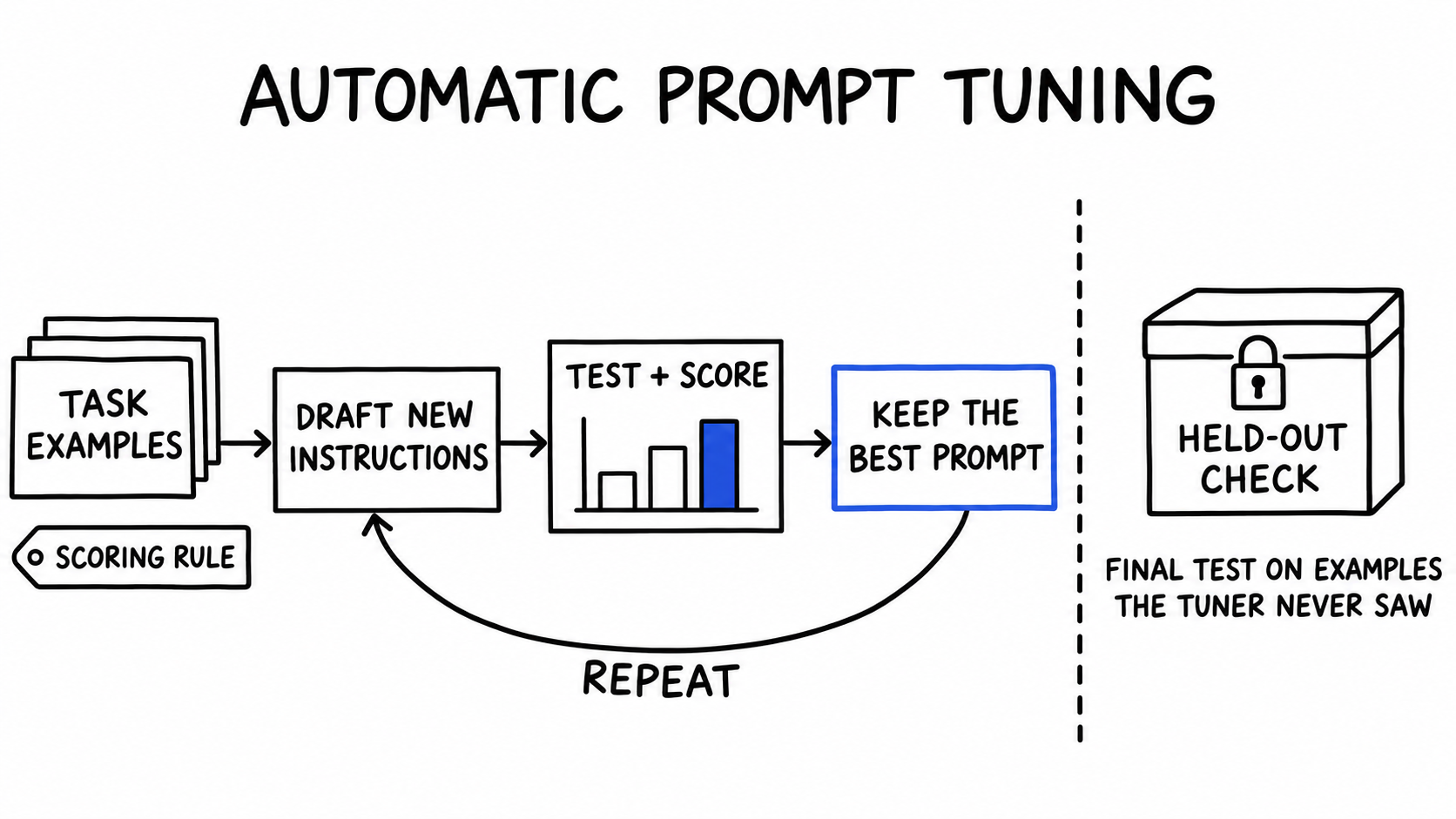
The mental model. A/B testing for the instructions you give an AI. You provide real examples of the task and a way to score answers; software rewrites and retests the instructions until the score stops improving, and shows you the evidence.

Where you'll see it at work. Before tuning, collect 20 to 30 real examples and lock a few away as a final check the tool never sees. Let it search, then judge the winning prompt only on the locked-away examples, and count the model calls the search burned before calling it a saving.

What people get wrong. A higher tuning score is not proof of better work. The search can overfit your examples, like a student memorising past exam papers, and a prompt tuned for one model often loses its edge when the model underneath changes.

Hand-drawn diagram titled 'Automatic prompt tuning': task examples with a scoring rule feed a loop of draft new instructions, test and score (bar chart with the winning bar in blue), and keep the best prompt, with a repeat arrow; a separate locked box labelled held-out check is the final test on examples the tuner never saw. (opens the full-size diagram)
Full explainer · 3 min

What it is

Software that improves the written instructions and examples you give an AI model by trying many variants and scoring the results, rather than a person editing the prompt on gut feel. You supply the task, a scoring rule and a small set of real examples; the tuner searches for wording that scores higher. The model itself stays untouched: no retraining, only the text sent to it changes.

How it works

You define a metric, a rule that scores an output, and collect sample inputs. The tuner runs your task many times, keeps traces of runs the metric liked, and uses a language model to draft alternative instructions grounded in those traces. It then tests combinations of instructions and worked examples on small batches, keeping score, so promising variants are refined and weak ones dropped. DSPy's MIPROv2 works this way: bootstrap good traces, propose instructions, then search with scores steering the proposals. The output is a new prompt plus the record of how candidates scored.

A concrete example

Say a team routes incoming support tickets with a model and the bare instruction 'classify this ticket'. They collect 30 real tickets with correct labels, define the metric as label accuracy, and let a tuner run for an afternoon. It finds that an instruction naming the five categories, plus two worked examples of ambiguous tickets, scores highest, and that prompt ships. The same search typically burns hundreds of model calls, which is part of the bill.

Why it matters

Prompts are the cheapest lever teams have: changing instructions costs nothing compared with retraining or switching models, and systematic search regularly finds wording a person would not try. It also replaces prompt folklore with evidence, because every candidate carries a score on your own data. But the search optimizes whatever rule you wrote, so a sloppy metric gets optimized sloppily, and the compute cost of hundreds of trial runs has to be counted against the gain.

Your turn

AI is proving famous maths theorems. What's your gut reaction?

Yesterday: 1 of 1 reader picked “Release it with strict limits” (Q: If an AI lab decides a model is too risky to release, what should happen next?)

One question: Would you trust a proof that no human has fully read? Reply to today's email to answer.