
Crabhaus

What matters in AI & agents, and what to do with it.

Fri 27 Nov ยท Issue 136 ยท 3 min read

Today in AI

A top scientist says AI labs are quietly sitting on maths that could break everyday encryption.

AI labs may hold encryption-breaking discoveries

  1. BusinessBig business software maker plans 10,000 job cuts
  2. Policy & riskNvidia halts AI server shipments to Southeast Asia
  3. Policy & riskState-backed hackers adopt AI break-in tool

10x

Number of the day

rise in some memory chip prices in one year, pushing up electronics costs worldwide Wall Street Journal โ†—

Today's news

Breakthroughs

AI labs may be sitting on encryption-breaking maths

After a week of AI systems settling decades-old maths problems, complexity theorist Scott Aaronson writes he is 'virtually certain, from multiple reliable sources' that AI labs hold unreleased results that could break deployed encryption. The specifics, he stresses, are unverified.

Why it matters to you

Encryption guards your banking, messages and logins, and nothing is confirmed broken today. Ignore sudden 'your accounts are at risk' pitches, they are scams, and expect security teams to watch this closely.
Also today

BusinessSAP, the business software giant, prepares to cut at least 10,000 jobs, about 9% of staff, for the AI era

Europe's biggest software maker is reorganising around AI. Expect AI features to arrive faster and human support to thin out.

Policy & riskNvidia told Dell, Supermicro and other partners to halt AI server shipments to Malaysia, Singapore, Thailand and Indonesia

US export controls are disrupting real deliveries. Teams with computing in Southeast Asia should expect delays and pricier capacity.

Policy & riskMicrosoft says state hackers in China and North Korea now use an AI break-in testing tool called Artex

Attackers are automating break-in testing with AI. The defence is unchanged: install updates, two-step login, phishing care.

Try this at work

The rumour sorter

Scary AI headlines travel faster than facts this week. Make your assistant separate them.

Here is an article. List each claim it makes and label every claim as: confirmed in this text, attributed rumour, or speculation. Quote the exact sentence that supports each label.

Watch out: 'Confirmed' only means confirmed by the pasted article; the model cannot check beyond the text you gave it.

Explained like you're busy

Steal this workflow: turn source documents into a checked brief

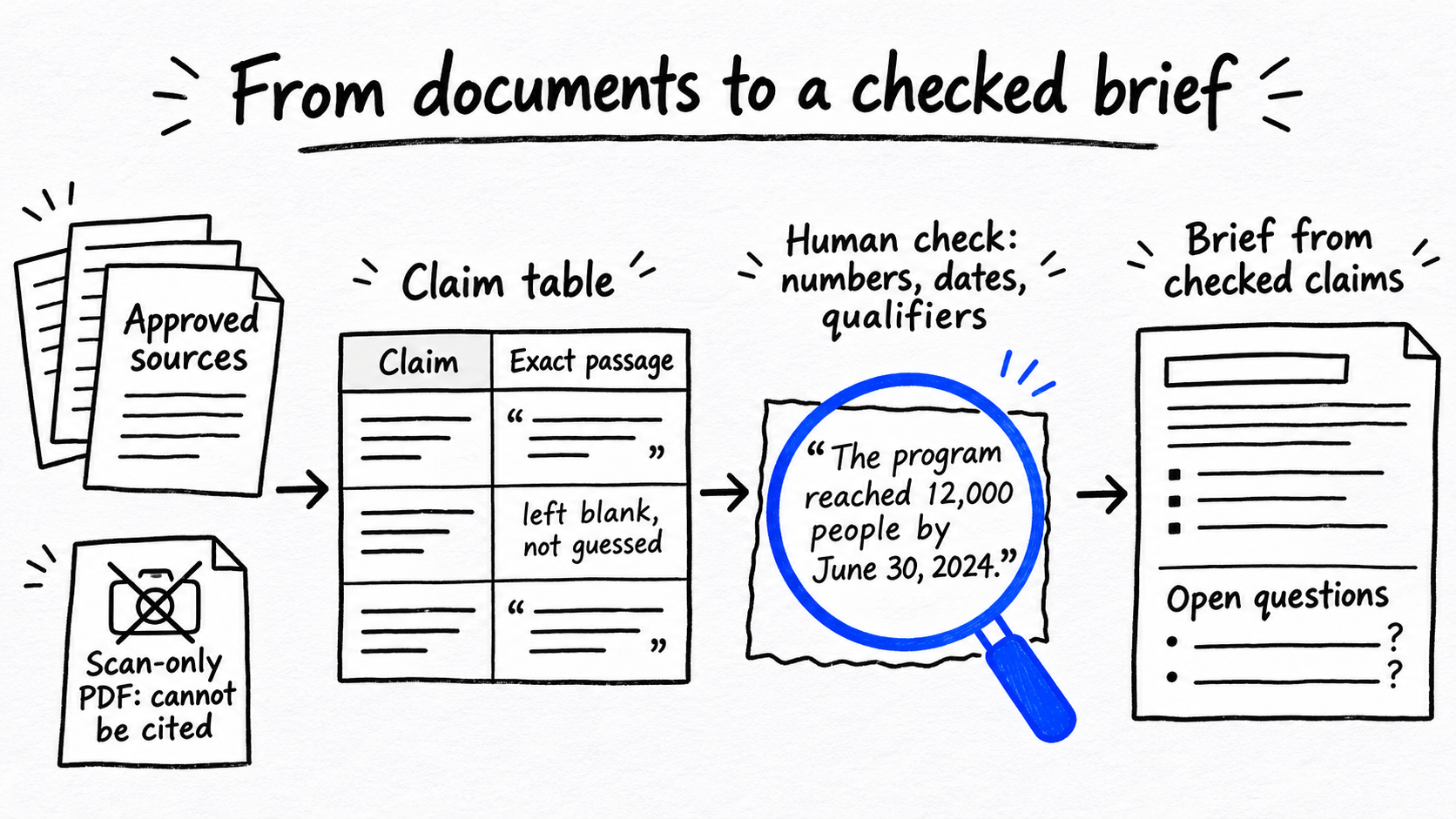
The recipe. Treat the assistant as a junior analyst who must show receipts: every claim arrives with the exact passage behind it, and a blank where sources say nothing. You check what matters, then write the brief from checked claims only.

When to use it. When a summary feeds a real decision, ask for a claim table instead of prose, open the five passages the decision rests on, and end with the questions the documents never answered. A scanned PDF without selectable text cannot be cited; check those pages by eye.

What goes wrong. A citation is not proof, only an address: the model can drop a qualifier or cite a passage that does not support the number. And 'the assistant found nothing' is not 'the documents say nothing'; a blank cell means look yourself.

Hand-drawn diagram titled 'From documents to a checked brief': approved source documents flow into a claim table with 'Claim' and 'Exact passage' columns, one passage cell left blank and marked 'left blank, not guessed'; a blue magnifying glass marks the human check of numbers, dates and qualifiers; the result is a brief from checked claims ending in open questions. A side page notes a scan-only PDF cannot be cited. (opens the full-size diagram)
Full explainer ยท 3 min

What it is

A repeatable routine for turning a folder of source documents into a short brief you can defend. Instead of asking an AI assistant to summarize the pile, you ask it to extract claims together with the exact passages behind them, verify the passages that carry weight yourself, and only then write the brief, listing the gaps instead of papering over them.

How it works

Step 1: choose a small, approved set of sources and tell the assistant to answer only from them. Step 2: ask for a claim table, one row per claim with its document and exact passage, and a blank wherever the sources are silent. Citation modes make this concrete: Anthropic's API splits documents into sentences and returns the quoted text with its location, page numbers for PDFs. Step 3: open each cited passage and check numbers, dates and qualifiers such as 'up to'. Step 4: write the brief only from rows that survived checking. Step 5: close with the questions the sources never answered.

A concrete example

Say you must brief your team on three vendor contracts and two security whitepapers. The assistant's claim table says vendor B guarantees 99.9% uptime; the cited clause turns out to promise that only for a premium tier your quote does not include. The check catches it in one click, and the finished brief carries twelve verified claims plus two open questions for the vendor, rather than a confident summary hiding a wrong one.

Why it matters

A brief is only useful if someone can act on it without re-reading the pile, and acting on an unchecked AI summary is how wrong numbers reach real decisions. This routine spends human attention in the one place it pays: the few claims the decision actually rests on. It also fails honestly, because a blank cell or an open question is visible, while a smoothed-over summary is not.

Your turn

If an AI lab discovers a way to break common encryption, what should it do?

No votes yet on yesterday's question: AI is proving famous maths theorems. What's your gut reaction?

One question: Would you change any password today based on a credible rumour? Reply to today's email to answer.