
Crabhaus

What matters in AI & agents, and what to do with it.

Sat 28 Nov ยท Issue 137 ยท 3 min read

Today in AI

A physicist wrote a quantum gravity theory with GPT-6 Astra, and other physicists are split.

AI helps draft a disputed quantum gravity theory

  1. ModelsAnthropic previews a personal AI assistant app
  2. In practiceAlmost half of EU workers use AI weekly
  3. Policy & riskBanned Nvidia chips found in Chinese data center

44%

Number of the day

of employed EU consumers used AI at work weekly, the European Central Bank finds Bloomberg โ†—

Today's news

Breakthroughs

A physicist and GPT-6 Astra take on quantum gravity

A Stanford physicist posted an 83-page proposal describing gravity with quantum mechanics, crediting GPT-6 Astra with help on its calculations and proofs. Sam Altman praised it; other physicists flagged issues or called it a stunt. It is not yet peer reviewed.

Why it matters to you

AI as a research collaborator now reaches physics: real contributions, real pushback, no verdict yet. Treat 'AI cracked physics' headlines as unfinished work until peer review.
Also today

ModelsAnthropic previews Claude Duet, a personal agent app that briefs you each morning and works while you are away

Personal AI agents are going mainstream. Worth a look if you already pay for Claude in a launch country.

In practiceA European Central Bank survey: 44% of employed EU consumers use AI at work weekly, and 18% use it daily

Weekly AI use at work is now mainstream. If your team has no habits around it, colleagues are forming their own.

Policy & riskChinese filings place export-restricted Nvidia Blackwell chips in a Shanghai data center tied to Megaspeed

Chip export controls are leaking in practice. Expect more checks on who buys and hosts AI computing.

Try this at work

The upgrade spot check

AI tools change under the hood without warning. Keep a tiny safety net for the ones you rely on.

  1. Save three real work prompts, each with an answer you trusted, in a note.
  2. After an upgrade, or when a tool feels different, run all three again.
  3. Compare with the saved answers before trusting new output.

Watch out: One odd answer can be random chance; rerun a prompt twice before blaming the upgrade.

Explained like you're busy

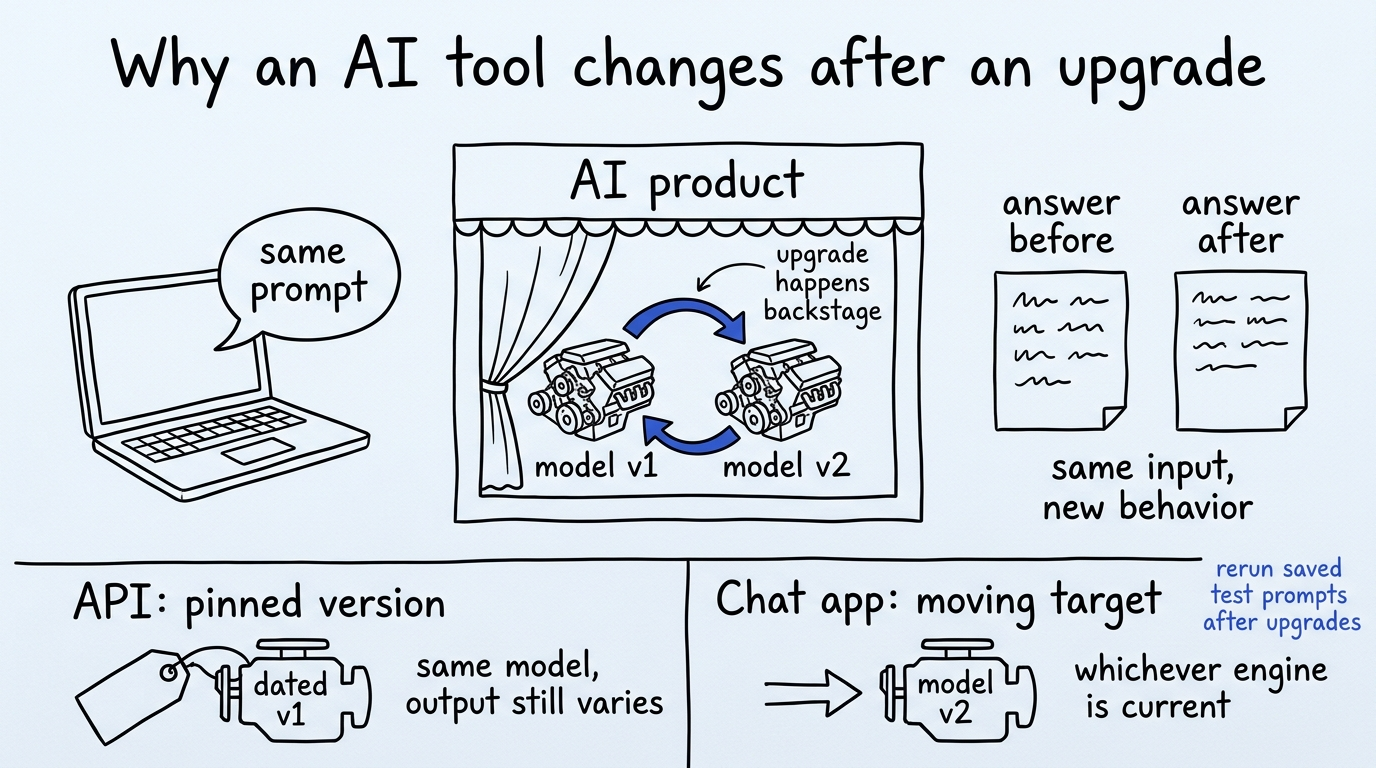
Why an AI tool changes after an upgrade

The mental model. An AI product is a restaurant, not a recipe. The menu name stays the same while the kitchen changes cooks. Developers can order a numbered recipe (a dated model version); chat app users eat whatever the kitchen serves today.

Where you'll see it at work. Keep a few saved prompts from your real work, each with an answer you trusted. When a tool announces an upgrade, or just feels different, rerun them and compare before relying on it.

What people get wrong. A version number does not mean identical answers: models sample with randomness, and the hidden instructions and filters around them change too. Judge an upgrade by consistent quality on your own checks, not identical text.

Hand-drawn diagram titled 'Why an AI tool changes after an upgrade': a laptop sends the same prompt to an AI product drawn as a storefront, where engine blocks model v1 and model v2 swap behind a curtain, noted 'upgrade happens backstage'; two cards show 'answer before' and 'answer after', captioned 'same input, new behavior'. Below, 'API: pinned version' tags a dated v1 engine ('same model, output still varies') while 'Chat app: moving target' points at whichever engine is current, with a blue note to rerun saved test prompts after upgrades. (opens the full-size diagram)
Full explainer ยท 3 min

What it is

The reason an AI assistant can answer differently this week than last, even though you typed the same thing. Every AI product sits on top of a model version. When the provider upgrades or swaps that model, or changes the hidden instructions around it, the tool's behavior shifts without anything changing on your side.

How it works

Providers ship models as named versions, and their guidance is blunt: generative AI is variable, so one input can produce different outputs even on a single version. Chat apps point at whichever backend the provider currently serves, and that target moves with upgrades and experiments. Developers calling the API can pin a dated model version, which freezes the model itself, but sampling randomness and changes to the product around it still vary results. That is why the labs' own docs push evals: a fixed set of your own test cases, rerun whenever something changes.

A concrete example

A support team drafts replies with an AI assistant. After an upgrade, the tone turns stiffer and it starts refusing a boilerplate refund paragraph it wrote happily for months. Nothing in their prompt changed. They rerun ten saved example requests against the new version, find two regressions, adjust their instructions for those cases, and note which version they checked.

Why it matters

If your work leans on an AI tool behaving a certain way, an upgrade is a silent policy change. Knowing the difference between a pinned API version and a moving chat product tells you what you can rely on, and rerunning a few known examples after an upgrade catches regressions before your customers or your boss do.

Your turn

Would you let an AI agent keep working for you while you're away?

No votes yet on yesterday's question: If an AI lab discovers a way to break common encryption, what should it do?

One question: Have you noticed an AI tool getting better or worse after an upgrade? Reply to today's email to answer.