Crabhaus

What matters in AI, and why.

Fri 17 Jul · Issue 003 · 5 min

In Today’s Edition:

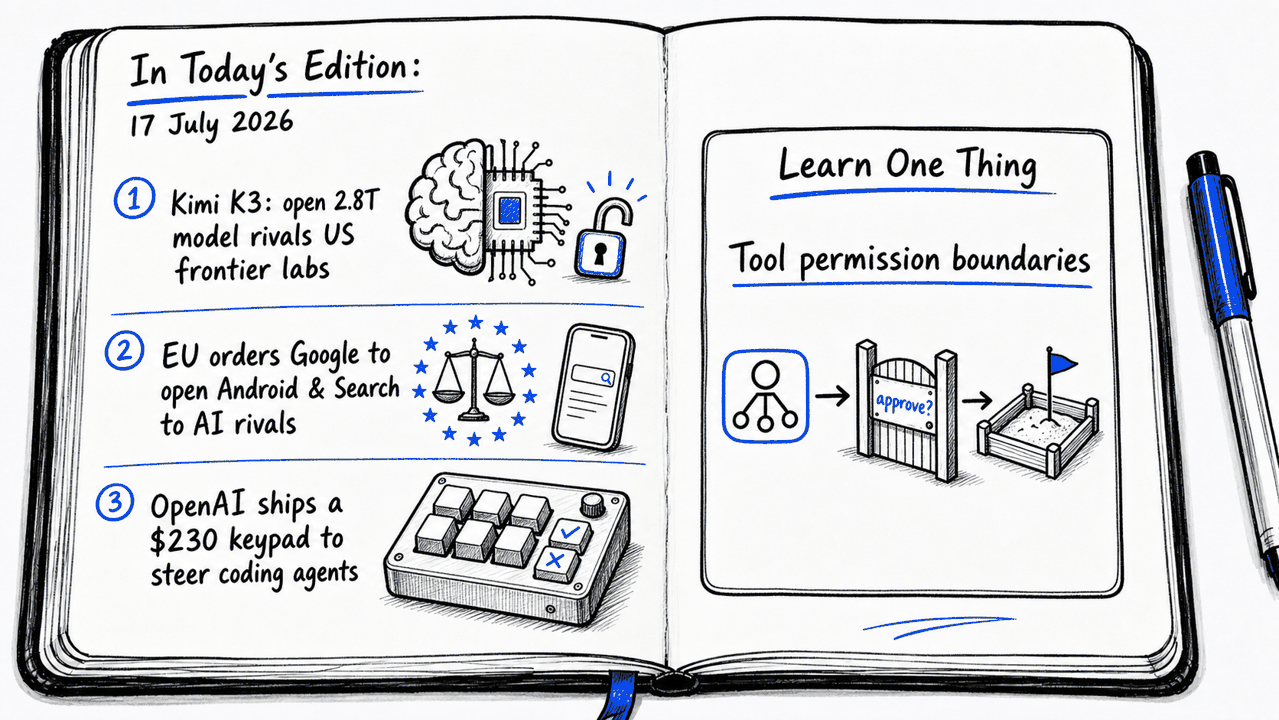
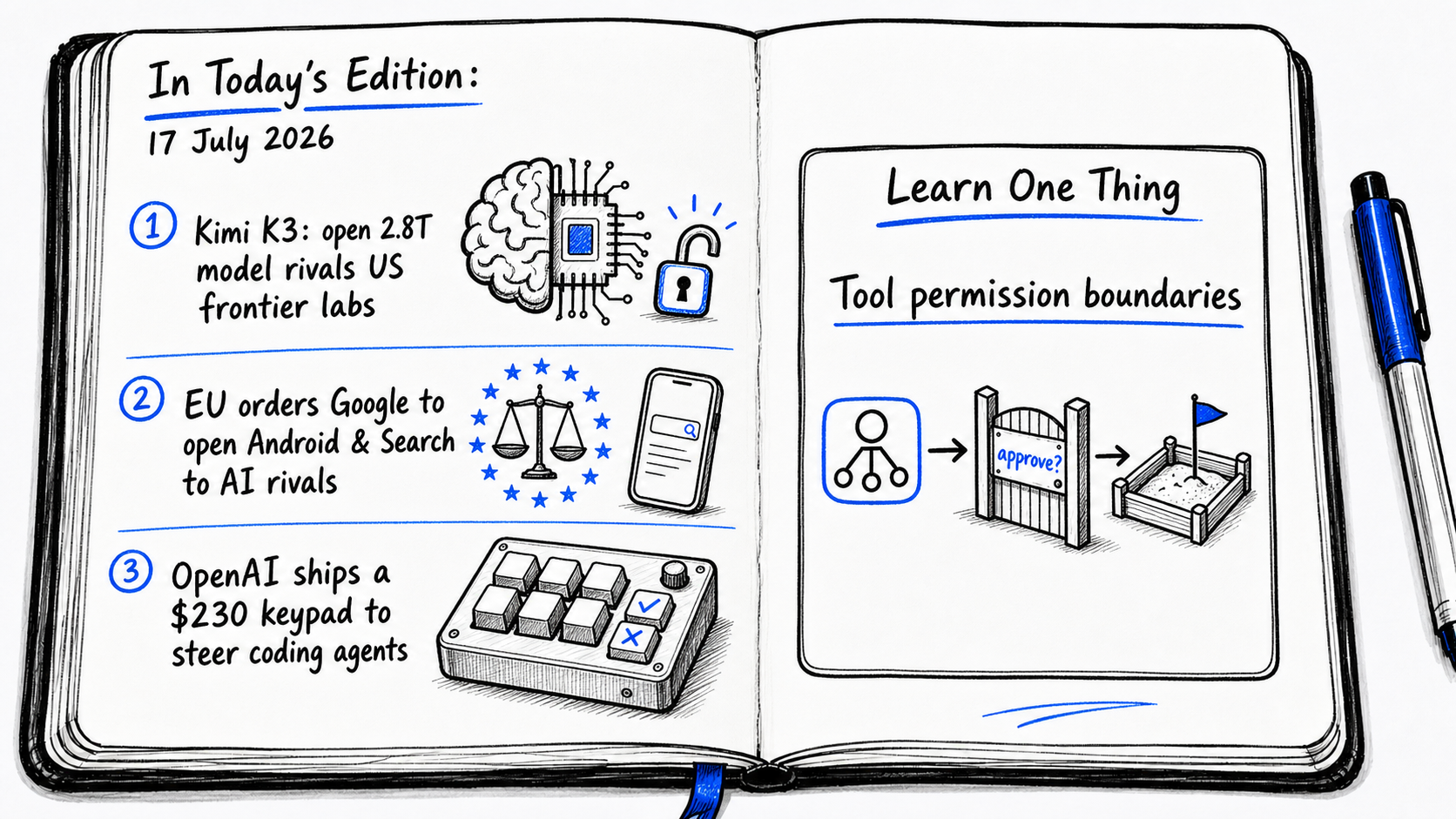
Hand-drawn field-notes page dated 17 July 2026 sketching an open frontier model, an EU antitrust order against Google, a $230 agent control keypad, and tool permission boundaries.
An open frontier challenger from China, Europe forcing Google open, agent controls going physical, and where an agent's power really stops.
View full-size field notes ↗

The one that matters

Moonshot's Kimi K3 lands as an open frontier model rivaling US labs

The 2.8T-parameter model tops the Frontend Code Arena, ranks just behind GPT-5.6 Sol on Terminal Bench 2.1, and is set to release open weights by July 27.

Why it matters

An open-weights model at the public frontier narrows the gap between what teams can self-host and what they rent from closed APIs.

Learn one thing

Tool permission boundaries
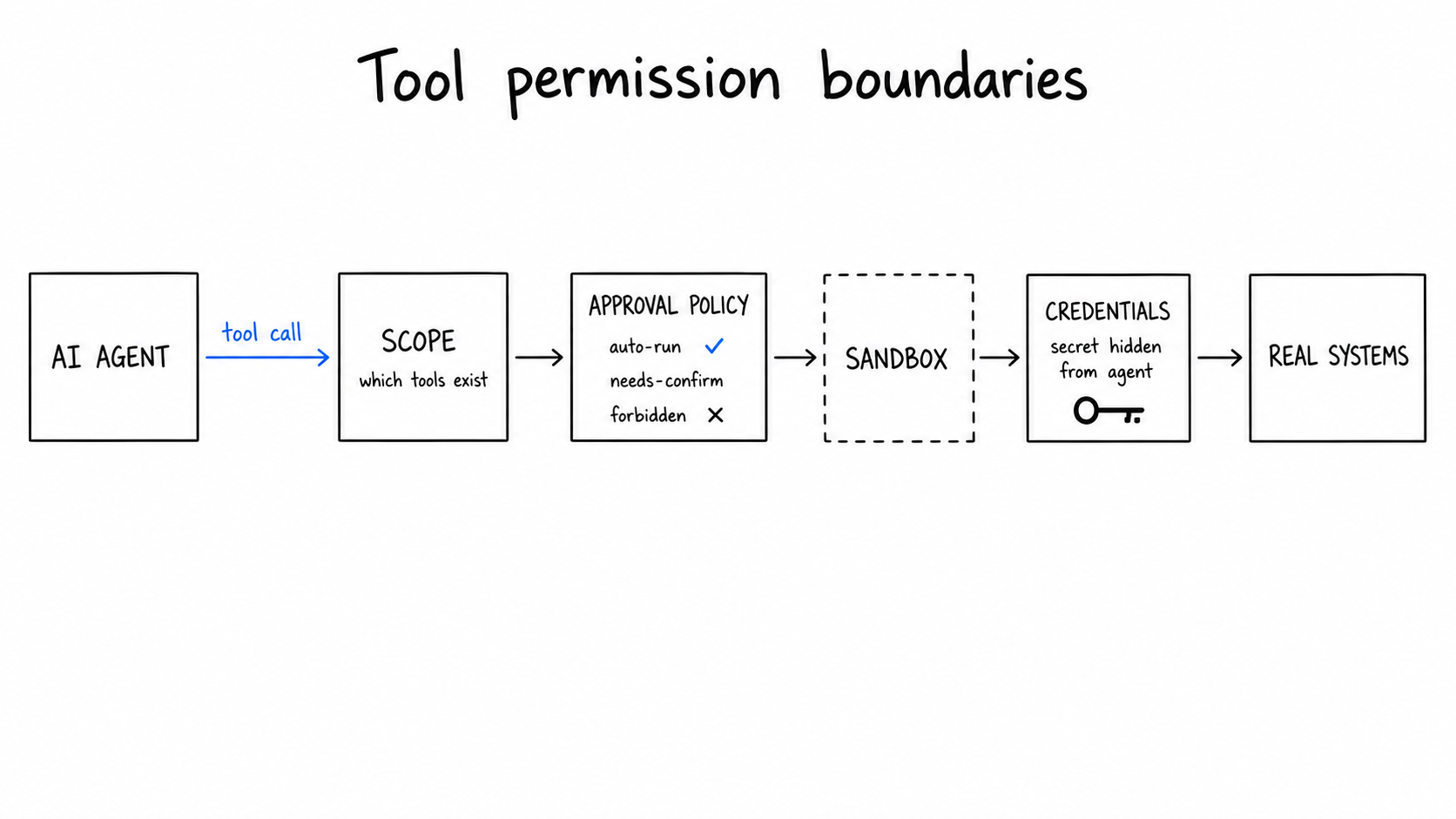
Hand-drawn diagram of an AI agent whose tool calls pass through scope, an approval policy, a sandbox, and a credential layer before reaching real systems, with one call auto-running and another paused for confirmation.View full-size diagram ↗

What it is

The rules that decide which tools an AI agent may call, with what arguments, and how far each call can reach before a human or the host system has to approve it.

How it works

The runtime around the model, not the model itself, enforces the boundary: scope limits which tools exist, an approval policy marks each call as auto-run, needs-confirmation, or forbidden, a sandbox caps blast radius, and a credential layer lets the agent act without seeing the secret.

A concrete example

A coding agent edits files in one project directory freely, but deleting files or running a shell command elsewhere needs confirmation, and it can never reach the production database because that credential was never in its sandbox.

Why it matters

As agents gain write access to real systems, the permission boundary is the main thing between a useful action and an expensive, irreversible mistake.

What people get wrong: Listing a tool in the prompt or telling the model to 'ask first' is not a boundary; model instructions are advisory, while a real boundary is enforced outside the model by the runtime, sandbox, and credential layers.
Today's top 5

BizThe EU issues two DMA orders requiring Google to open Android and Search to rival AI assistants and share some search data.

Forced interoperability could reshape how AI assistants reach users on the world's biggest mobile platform.

AgentsOpenAI ships Codex Micro, a $230 keypad whose keys accept, reject, and switch coding-agent tasks and tune reasoning levels.

OpenAI's first branded hardware bets that steering agents deserves dedicated physical controls.

Agents1Password lets Claude sign in to websites on your behalf without ever seeing the password or 2FA code.

A concrete pattern for giving agents access without handing over the underlying secrets.

LabsA German AI consortium releases Soofi S, an open 30B model that tops several English and German benchmarks.

European open-weights efforts keep the frontier from being a two-country race.

BizFireworks raises $1.5B at a $17.5B valuation on over $1B annualized revenue serving AI chips and open models.

Inference infrastructure for open models is now a multi-billion-dollar business of its own.

See the full wire feed →

Get Crabhaus

A concise daily briefing on the AI developments worth understanding. Subscribe on the homepage.