Crabhaus

What matters in AI, and why.

Sat 18 Jul · Issue 004 · 5 min

Issue 004 · Sat 18 Jul

Inside today's edition

01BizMeta may rent Anthropic $10B of compute
02LabsKimi K3 faces independent frontier tests
03ResearchAI agent finds real drug repurposings

The one that matters

Meta may rent Anthropic ~$10B of compute, tilting from frontier models toward cloud

Sources say Meta is in talks to lease data-center capacity to Anthropic in a deal worth around $10B over two years, as it hires AWS's outgoing compute chief to run its build-out.

Why it matters

It reframes Meta from a frontier-model competitor into a compute landlord, echoing the capacity deals xAI and SpaceX have struck, and hints demand for its own models is lagging its data-center spend.
Learn one thing

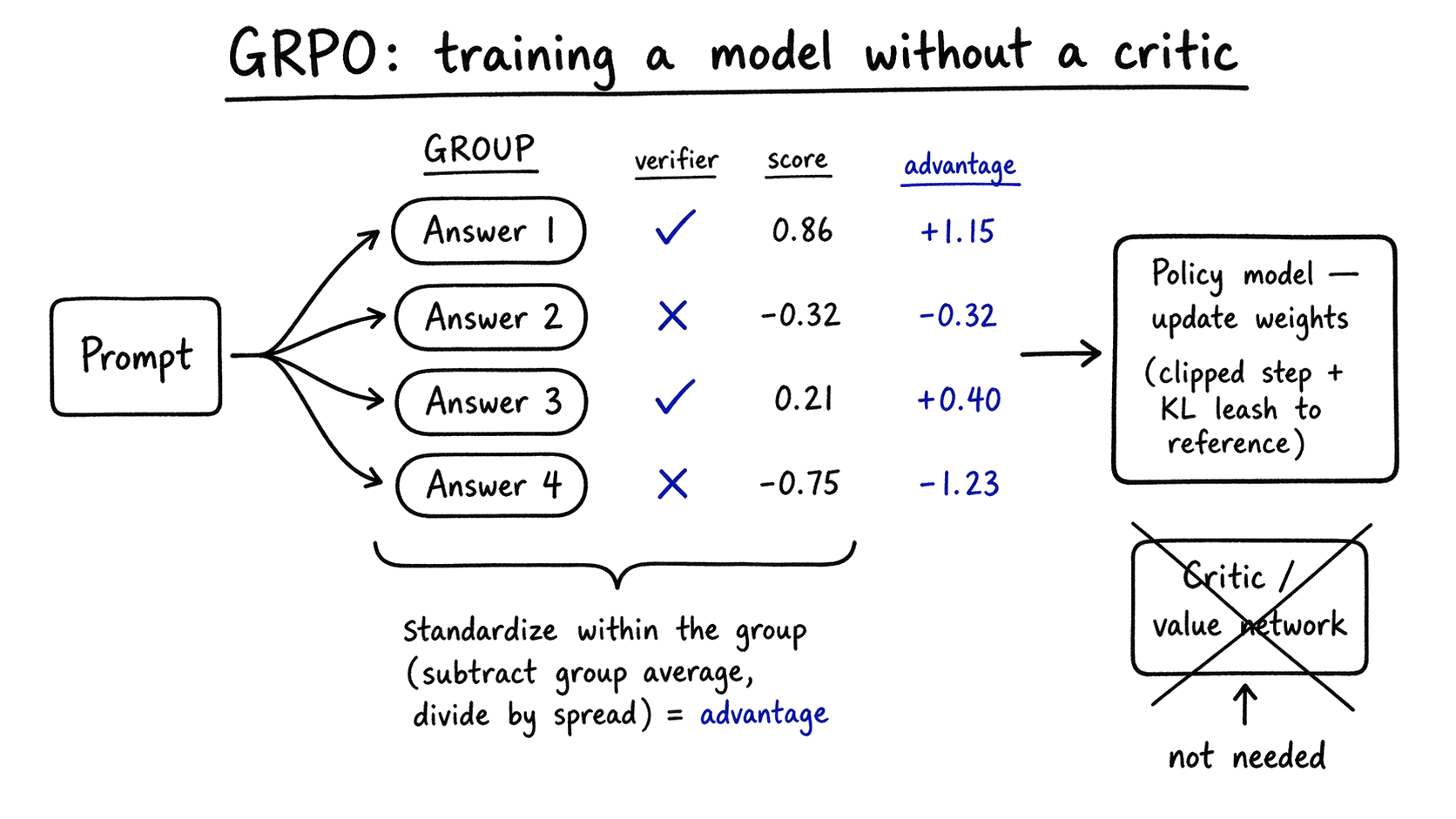
GRPO (Group Relative Policy Optimization)

Hand-drawn diagram: one prompt fans out to a group of sampled answers, each scored by a verifier, then standardized against the group's average to produce advantages that update the policy, with no separate critic network.View full-size diagram ↗

What it is

A reinforcement-learning recipe for fine-tuning language models that removes PPO's separate value (critic) network and instead judges each answer by comparing it against a batch of other answers to the same prompt.

How it works

The runtime samples several answers to one prompt, scores each with a reward signal (often an automatic verifier for math or code), then standardizes each answer's reward inside its own batch (subtract the batch average, divide by the spread) to get its advantage; a clipped policy-gradient step plus a KL leash toward a reference model updates the weights, with no learned value head.

A concrete example

DeepSeek popularized GRPO to train its math and R1 reasoning models with verifiable rewards, where a checker marks each solution right or wrong, and the batch-relative baseline let them scale RL more cheaply than PPO.

Why it matters

Dropping the critic removes one of the largest and most finicky pieces of an RL stack, cutting memory and instability, a big reason open labs can run frontier-scale reinforcement learning on reasoning models.

What people get wrong: That it is simply 'PPO minus the critic.' The real shift is where the baseline comes from, peer answers rather than a trained value function, which is why GRPO leans on sampling and scoring several outputs per prompt.

Today's top 5

LabsIndependent tests like Simon Willison's pelican-SVG benchmark back Kimi K3's near-frontier claims before its July 27 weight release.

Hands-on evals, not just vendor benchmarks, are what tell builders whether an open-weights model is worth self-hosting.

LabsOpenAI's full-duplex GPT-Live voice models listen and talk at once and offload hard questions to GPT-5.5, replacing Advanced Voice Mode.

Decoupling the conversational layer from the reasoning model lets voice stay fast while inheriting every frontier upgrade.

ResearchFutureHouse's open-source Robin agent proposed drug repurposings for dry AMD; lab tests confirmed two, including glaucoma drug Ripasudil.

A concrete case of a multi-agent system driving a real scientific loop from hypothesis to validated result, not just text.

AgentsDoorDash launched dd-cli, a beta command-line AI agent that finds deals, searches restaurants, and places orders from the terminal.

Consumer platforms are starting to expose agent-first interfaces, not just apps, as a way to reach users.

BizXi Jinping championed open-source AI at the World AI Conference and pledged to help the Global South, calling unequal access an injustice.

China is pairing open-weights model releases with diplomacy to make its AI stack the global default.

See the full wire feed →

Get Crabhaus

A concise daily briefing on the AI developments worth understanding. Subscribe on the homepage.