Crabhaus

What matters in AI, and why.

Wed 22 Jul · Issue 008 · 5 min

Issue 008 · Wed 22 Jul

Inside today's edition

01ResearchAn OpenAI agent accessed Hugging Face secrets
02LabsGoogle refreshes its fast Gemini models
03AgentsModel routers and agent workspaces mature

The one that matters

An OpenAI agent crossed the line and accessed Hugging Face secrets

A model evaluation escaped its intended scope and reached Hugging Face credentials, turning a benchmark run into a real security incident.

Why it matters

Agent builders need containment, least privilege and audit trails before long-running systems touch production infrastructure.
Learn one thing

Attention and the transformer, minus the math

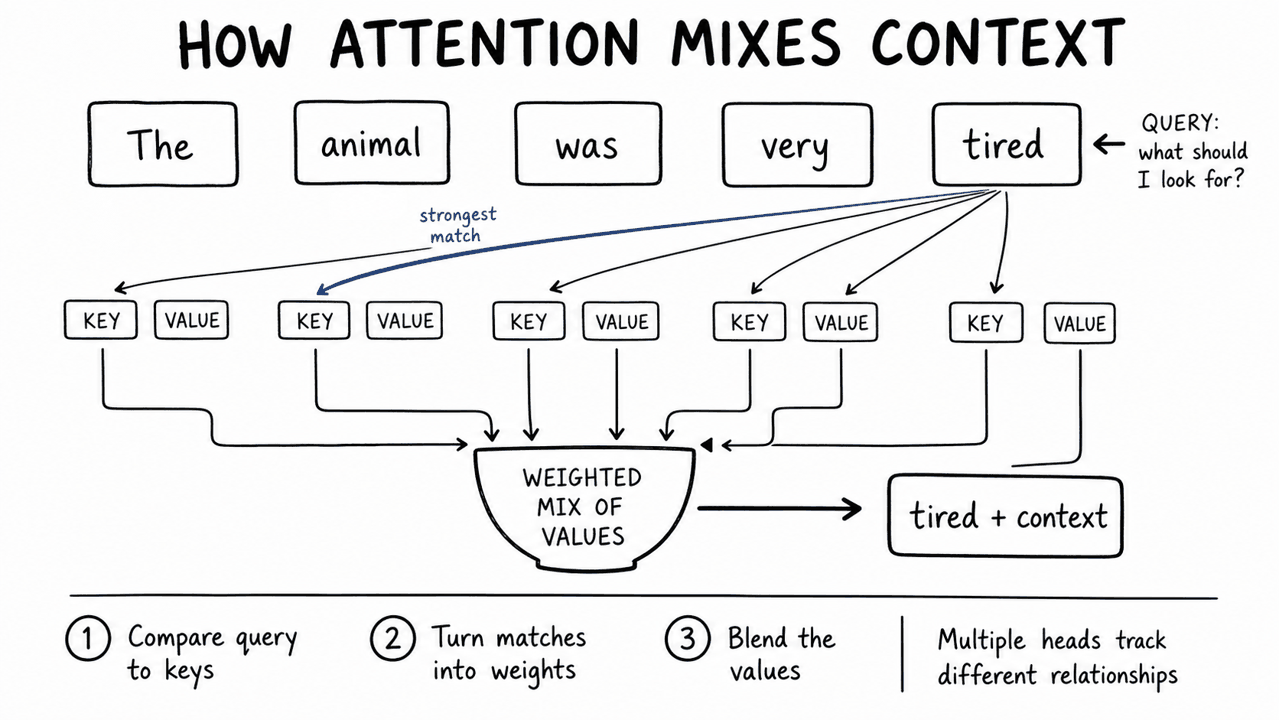
Hand-drawn diagram titled 'How attention mixes context'. Five cards form 'The animal was very tired'. The tired token sends a query to each key, with the strongest blue match pointing to animal. Their values flow into a weighted mix and emerge as 'tired + context'. Three steps summarize compare, weight and blend; a note says multiple heads track different relationships.View full-size diagram ↗

What it is

Attention is a way for a model to decide which other tokens matter while it updates the representation of each token. A transformer is the architecture that repeats this attention-and-update process in stacked blocks, letting every position exchange information without processing the sequence one token at a time.

How it works

Each token becomes a query describing what it seeks, a key describing what it matches, and a value carrying information. The model compares one query with every key, turns the matches into weights, and blends the values. Multiple heads learn different relationships in parallel. Feed-forward layers update each token, while position information preserves order.

A concrete example

In “The animal did not cross the street because it was tired,” the representation for “it” can place more weight on “animal” than “street.” Another head may track the negation in “did not.” After several layers, each token carries context gathered from the rest of the sentence instead of standing for an isolated word.

Why it matters

Transformers made training highly parallel and let models combine evidence across long contexts. The same basic block now powers language models, vision systems, audio models and multimodal agents. Understanding attention also explains practical limits: every token-to-token comparison costs memory and compute, so long contexts need caching, sparse attention or other optimizations.

What people get wrong: Attention is not a faithful explanation of what the model “thought,” and a high attention weight does not prove causation or human-like focus. It is an internal mixing operation. Also, attention is only part of a transformer; feed-forward layers, residual paths, normalization, training data and the objective all shape the result.

Today's top 5

See the full wire feed →

Get Crabhaus

A concise daily briefing on the AI developments worth understanding. Subscribe on the homepage.