Crabhaus

What matters in AI, and why.

Sat 25 Jul · Issue 011 · 5 min

Issue 011 · Sat 25 Jul

Inside today's edition

01LabsClaude Opus 5: near-Fable 5 at half the price
02BizBig tech signs letter defending open weights
03LabsMeta opens first paid API with Muse Spark 1.1

The one that matters

Anthropic ships Claude Opus 5

Anthropic's new default on Claude Max claims performance close to Fable 5 at half the price - $5 in / $25 out per million tokens - its fourth model release in under two months.

Why it matters

The frontier is commoditizing itself: near-flagship capability at mid-tier prices resets what every team should expect to pay for top-model tokens.
Learn one thing

Base models vs instruction-tuned models

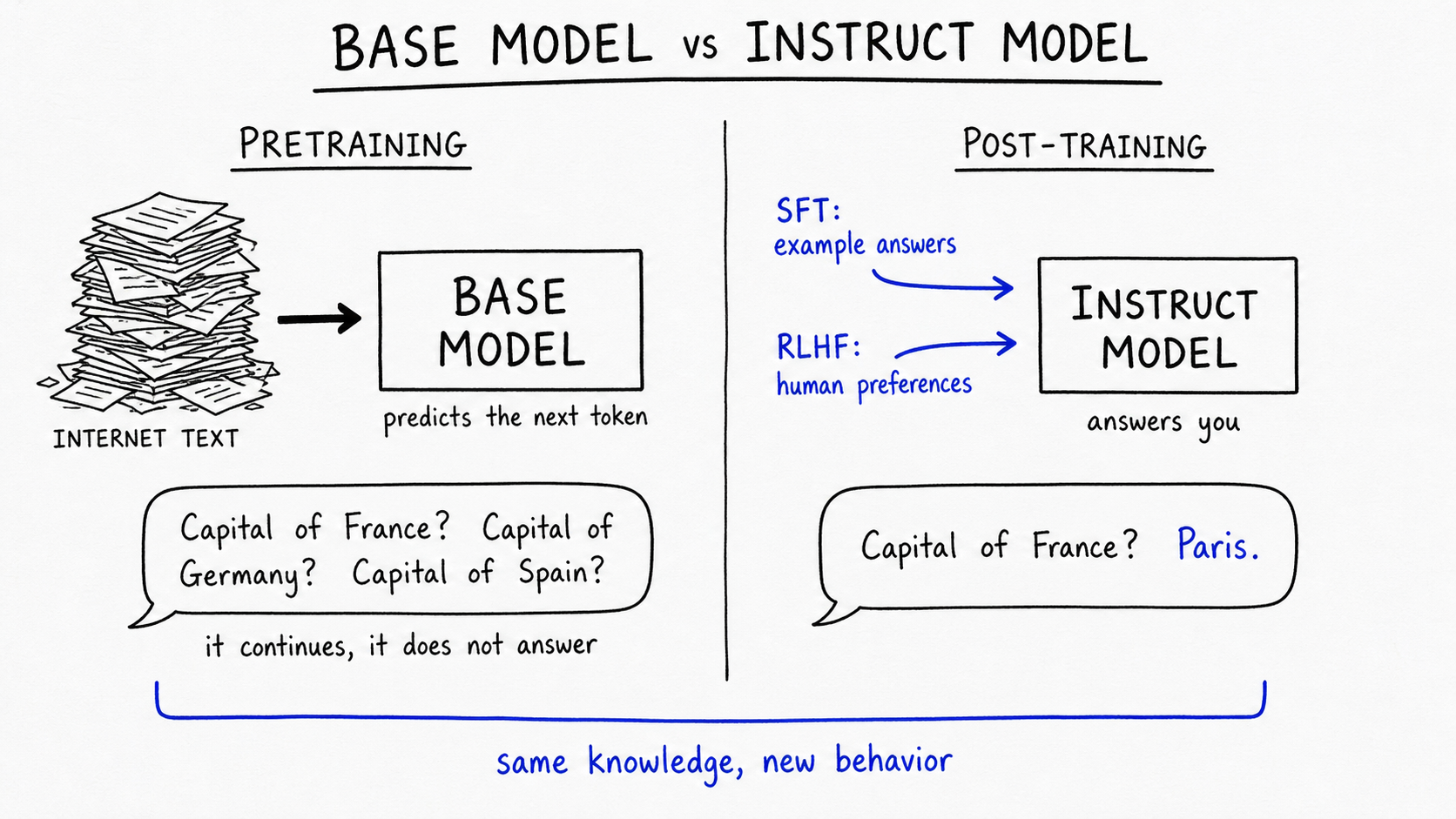
Hand-drawn diagram, black ink with cobalt accents. Left, Pretraining: Internet Text stack arrows into a Base Model box, 'predicts the next token'; bubble: 'Capital of France?' continued with more questions - it continues, not answers. Right, Post-training: cobalt arrows SFT and RLHF feed an Instruct Model that 'answers you': 'Paris.' Cobalt bracket: 'same knowledge, new behavior'.View full-size diagram ↗

What it is

A base model is what pretraining produces: a network trained only to predict the next token across trillions of words. An instruction-tuned model is the same network after post-training teaches it to answer requests and behave like an assistant.

How it works

Pretraining yields a completion engine: ask a raw model a question and it may reply with more questions, because a quiz sheet is a plausible continuation. Post-training reshapes that: supervised fine-tuning on instruction-response pairs, then preference optimization (RLHF or DPO), plus a chat template marking user and assistant turns. Capability comes from the base run; post-training shapes it.

A concrete example

Prompt a base model with 'What is the capital of France?' and a typical continuation is 'What is the capital of Germany?' - it imitates a quiz sheet. The instruct version replies 'Paris.' Compare any open '-base' checkpoint with its '-instruct' sibling on Hugging Face to see it live.

Why it matters

Open releases ship both variants, and the choice changes results: fine-tune the base for a clean slate on narrow formats, fine-tune the instruct to keep chat ability. It also explains daily failure modes - an instruct model run without its chat template quietly degrades.

What people get wrong: That instruction tuning adds knowledge or intelligence. Nearly all capability comes from pretraining; post-training mostly changes behavior. Nor are base models useless - they are often the better start for custom fine-tunes and tasks that want diverse continuations.

Today's top 5

LabsMeta ships agent-trained Muse Spark 1.1 and opens Meta Model API, its first paid model access, priced well under rival flagships.

An ad-subsidized lab attacking API margins pulls agent running costs down for everyone.

LabsMoonshot details Kimi K3's 2.8T-parameter MoE built on linear Kimi Delta Attention; open weights are promised by July 27.

The largest open-weights release to date is days away, with the architecture already published.

See the full wire feed →

Get Crabhaus

A concise daily briefing on the AI developments worth understanding. Subscribe on the homepage.