Crabhaus

What matters in AI, and why.

Sun 26 Jul · Issue 012 · 4 min

Issue 012 · Sun 26 Jul

Inside today's edition

01AgentsAnthropic deletes 80% of Claude Code's prompt
02BizOpen-weight AI's 'Kubernetes moment'
03BizDeepSeek freezes its fundraise after viral leak

The one that matters

Anthropic cuts over 80% of Claude Code's system prompt

Anthropic published the context-engineering rules it now follows for Claude 5-generation models, after removing more than 80% of Claude Code's system prompt - and says the same lessons apply to any agent you build.

Why it matters

Smarter models need less scaffolding: if the lab that writes the best-known agent prompt is deleting most of it, your carefully layered instructions may now be dead weight that degrades behavior instead of steering it.
Learn one thing

Quantization: running big models in small memory

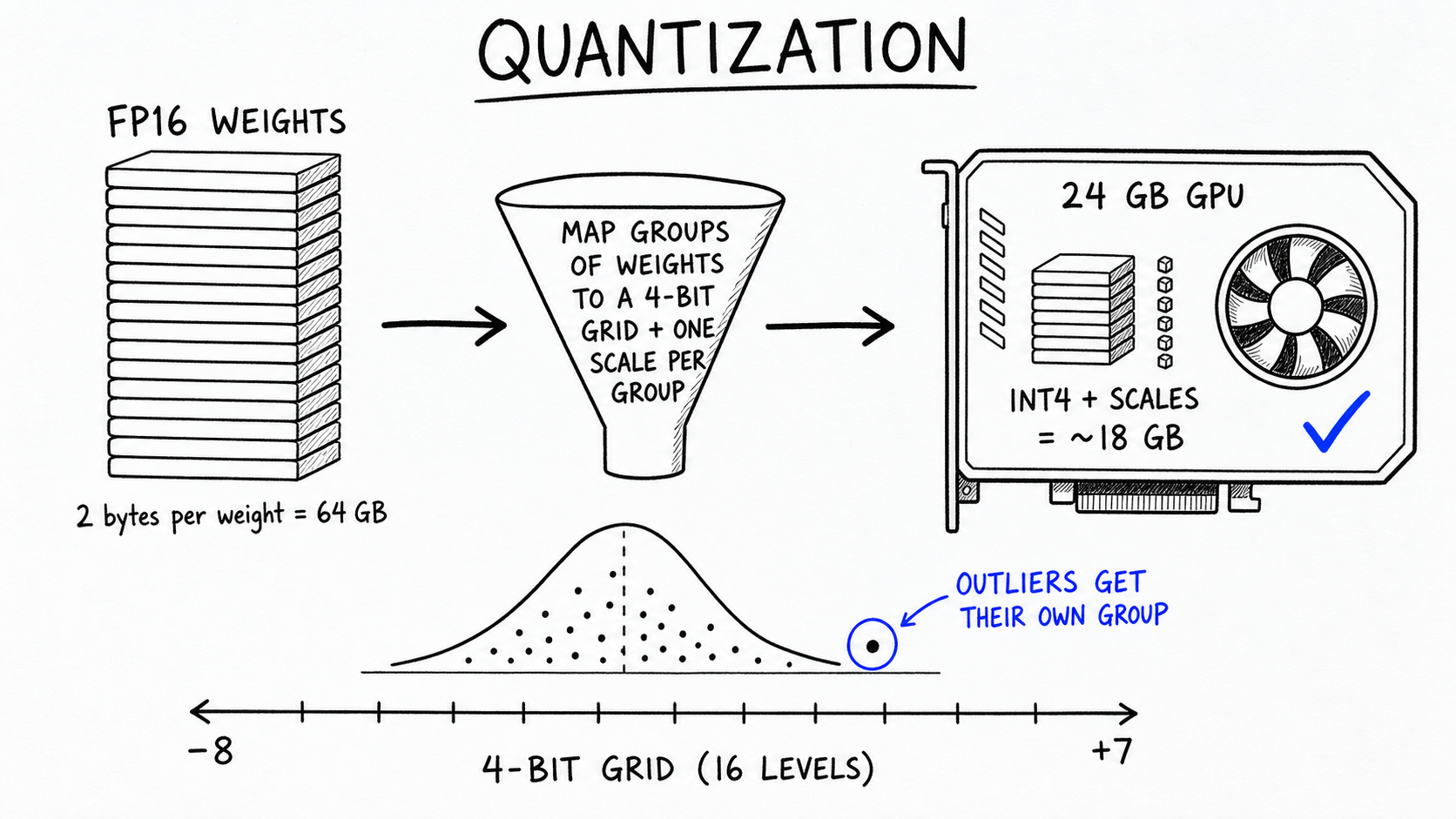
Hand-drawn diagram, black ink with cobalt accents. A tall FP16 weights stack (2 bytes per weight = 64 GB) funnels through 'map groups of weights to a 4-bit grid + one scale per group' into a small INT4+scales ~18 GB stack inside a 24 GB GPU card, cobalt check. Below, a bell curve of weights over a 16-level 4-bit grid, -8 to +7; one circled outlier: 'outliers get their own group'.View full-size diagram ↗

What it is

Storing a model's weights in fewer bits - say 4-bit integers instead of 16-bit floats - so the same network needs a fraction of the memory and bandwidth. The file shrinks roughly in proportion to the bit width, at the cost of a tiny approximation error in every weight.

How it works

Weights cluster in a narrow bell-shaped range, so small groups of them are mapped onto a coarse integer grid with one scale factor per group; grouping stops rare outliers from wrecking precision for everyone else. Methods like GPTQ and AWQ calibrate on sample data to minimize each layer's output error, and formats like GGUF's K-quants use non-uniform grids matched to the weight distribution.

A concrete example

A 32B model at 16 bits needs ~64 GB for weights alone - no consumer GPU holds that. Its 4-bit GGUF build lands around 18-20 GB and fits a 24 GB RTX 4090 or a 32 GB MacBook with room for the KV cache. That is why the default file Ollama pulls for most models is a 4-bit variant.

Why it matters

Quantization is what makes local and on-device AI possible, and it cuts cloud serving costs too. Generating tokens is memory-bandwidth-bound - each token streams all the weights past the compute units - so halving the bytes also speeds up decoding, not just storage.

What people get wrong: That quality drops in proportion to bits, as if 4-bit were half as smart as 8-bit. A well-made 4-bit quant of a large model gives up only a small benchmark delta; damage is nonlinear, biting below roughly 3-4 bits and on small models. Quantizing weights is also separate from quantizing activations or the KV cache.

Today's top 5

BizMesosphere co-founder Tobi Knaup: open-weight AI is at its 'Kubernetes moment'; the US should compete in the ecosystem, not wall it off.

A sharp historical lens on the open-weights fight from someone Kubernetes actually disrupted.

BizDebian opens a project-wide General Resolution on LLM usage with three proposals, incl. one barring LLM-assisted contributions.

Whatever Debian decides will become a reference point for every open-source project's AI policy.

ResearchA 28.9M-param LLM runs fully on an $8 ESP32-S3 at ~9.5 tok/s: 4-bit weights, 25M embedding params served from flash (Gemma-style PLE).

A neat demonstration that quantization plus clever memory placement keeps shrinking the floor for local AI.

See the full wire feed →

Get Crabhaus

A concise daily briefing on the AI developments worth understanding. Subscribe on the homepage.