Crabhaus

What matters in AI, and why.

Tue 28 Jul · Issue 014 · 5 min

Issue 014 · Tue 28 Jul

Inside today's edition

01BizAnthropic shows its open-weights hand
02LabsKimi K3 weights and tech report are out
03ResearchAgents rebuild multi-week software for $251

The one that matters

Anthropic finally shows its open-weights hand

After a week as the industry's lone holdout, Anthropic publishes its position: it says it has never backed an open-weights ban, defends chip export limits to China, and calls for global model testing.

Why it matters

Open weights are the substrate of local AI and self-hosting; where the most safety-cautious frontier lab draws this line will shape what regulation targets next.
Learn one thing

In-context learning and few-shot prompting

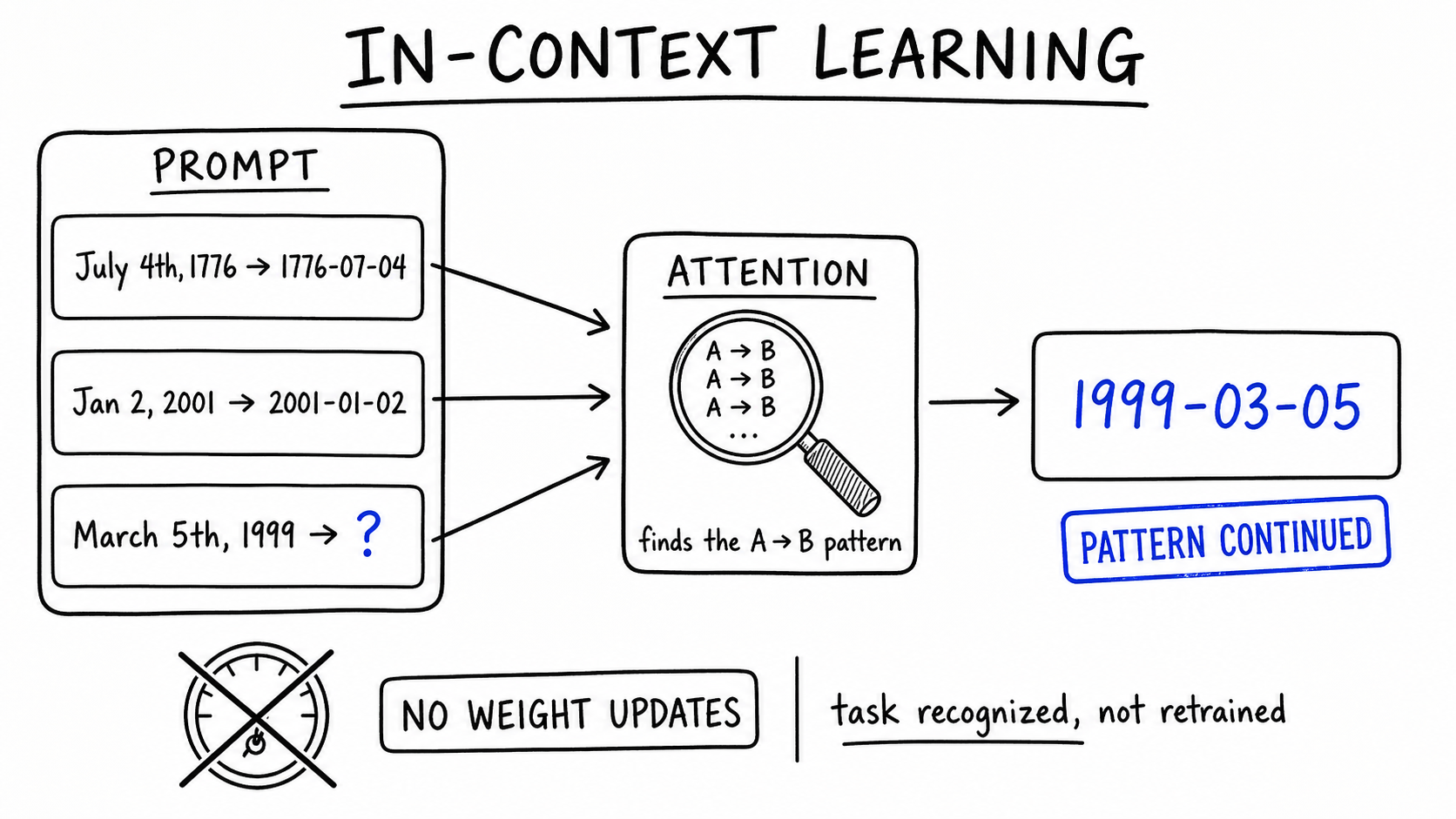
Hand-drawn diagram, black ink with cobalt accents. A PROMPT panel stacks three example cards ending in 'March 5th, 1999 -> ?'. Arrows converge into an ATTENTION box where a magnifying glass shows repeated 'A -> B' pairs. An arrow leads to '1999-03-05' in cobalt stamped PATTERN CONTINUED. A crossed-out dial reads 'NO WEIGHT UPDATES': task recognized, not retrained.View full-size diagram ↗

What it is

In-context learning is a model's ability to pick up a task from examples placed in the prompt itself — no training run, no weight updates. 'Few-shot prompting' is the everyday form: show two or three worked input-to-output pairs, then a new input, and the model continues the pattern.

How it works

Attention lets the model read earlier prompt tokens while predicting the next one. Circuits that researchers call induction heads find repeated structure — 'last time A was followed by B' — and copy it forward. Demonstrations mostly help the model locate a task it already knows rather than teach it new knowledge.

A concrete example

Ask a model to turn 'March 5th, 1999' into a date code and you may get any format back. Show it two examples — 'July 4th, 1776 -> 1776-07-04' and 'Jan 2, 2001 -> 2001-01-02' — and it emits '1999-03-05'. The examples pinned down format, delimiter, and zero-padding in one shot.

Why it matters

Few-shot examples are the cheapest adaptation lever you have: they beat instructions when a task is easier to show than tell — format conversions, house style, fuzzy labeling rules. They cost context tokens every call, so long example blocks pair naturally with prompt caching and long context.

What people get wrong: That the model 'learns' from your examples the way training does. Weights never change — and Min et al. (2022) showed models do nearly as well with randomly wrong demonstration labels: the win comes from showing format and label space. Task recognition, not task learning.

Today's top 5

BizAnthropic says it has never backed an open-weights ban, defends chip export limits to China, and calls for global model testing.

The last holdout lab put its policy in writing — this document is what open-model regulation fights will cite.

LabsMoonshot releases Kimi K3's weights under a custom 'Kimi K3 License', with a technical report detailing the training recipe.

A frontier-class open release with a real technical report — the strongest local-model option shifts again.

BizNvidia forms the Open Secure AI Alliance with CrowdStrike, Hugging Face, and Dell to share tools for AI safety and cybersecurity.

Post-Hugging-Face-breach, AI security is becoming an ecosystem play — and notably without OpenAI, Google, or Anthropic.

ResearchEpoch and METR release MirrorCode: agents reimplement whole programs from CLI access; Opus 4.7 did a 2-17-week human task for $251.

Concrete evidence of week-scale autonomous coding — and a price tag that reframes what agent labor costs.

AgentsIndependent audit questions Bun's $165K AI rewrite in Rust: six weeks after the merge, still no release tag and constant CI churn.

A rare hands-on check of a headline AI-coding claim — worth reading before repeating anyone's rewrite numbers.

See the full wire feed →

Get Crabhaus

A concise daily briefing on the AI developments worth understanding. Subscribe on the homepage.